
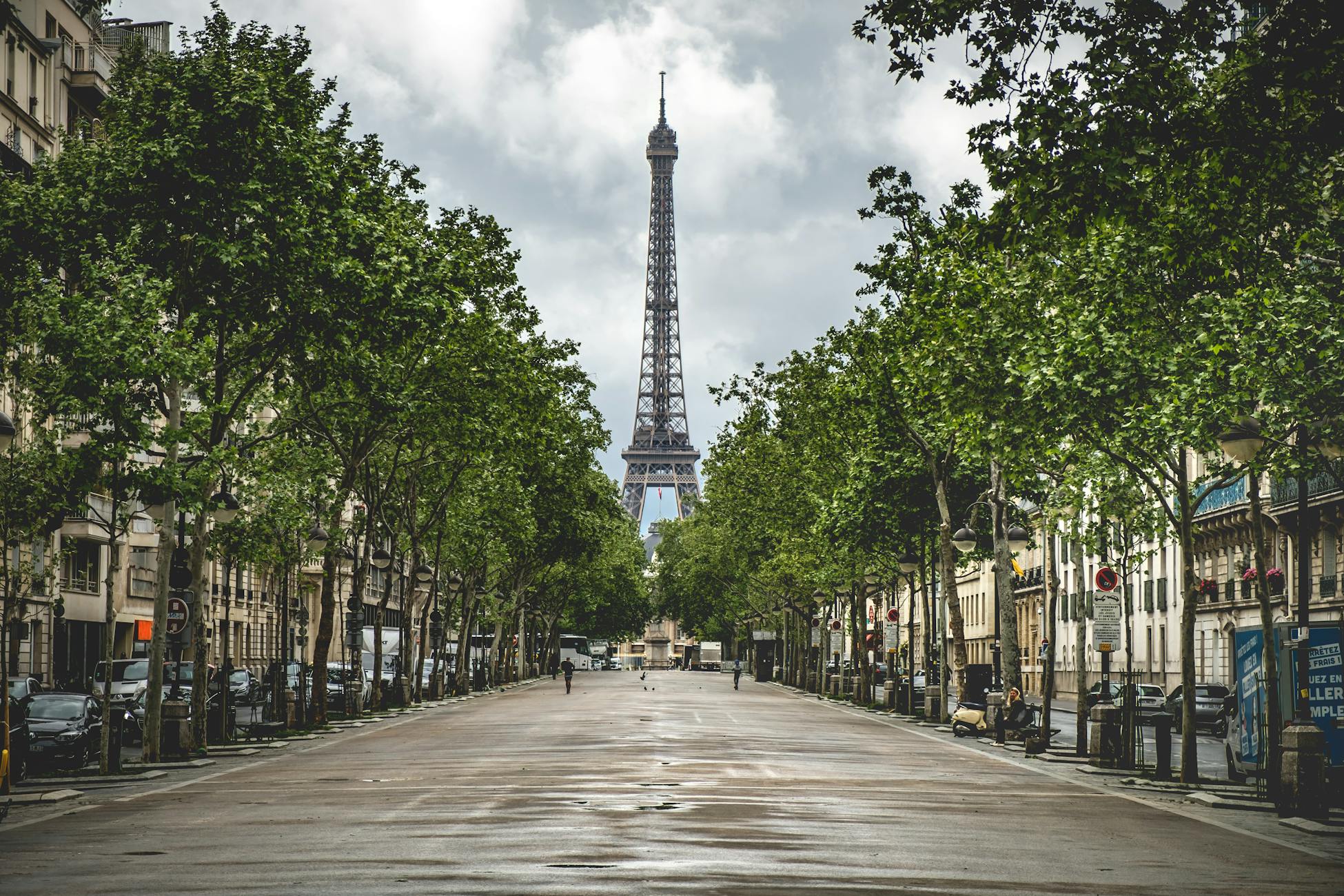
The Eiffel Tower gets taller in July. The iron that Gustave Eiffel’s engineers riveted together for the 1889 World’s Fair responds to a Paris heatwave the way any large metal object does — by stretching. On the hottest summer afternoons, when direct sun pushes the metal well above the ambient air temperature, the tower can stand around 15 centimetres taller than it does in midwinter, and the heated flank pushes the summit several centimetres off vertical, leaning away from the sun like a slow sundial.
The lean is small. The physics is not.
What is happening at the Champ de Mars on a hot afternoon is the same effect that bends railway tracks, opens expansion joints in motorway bridges, and forces semiconductor designers to worry about chiplets warping inside a laptop. Iron, like nearly every solid, swells when its atoms vibrate harder. The tower simply does it on a scale you can measure with a tape.
Why iron grows when it warms
The number that governs the tower’s summer growth spurt is the coefficient of linear thermal expansion. For wrought iron, that coefficient is around 12 millionths of a metre per metre per degree Celsius, a value documented in standard reference tables of linear thermal expansion coefficients for common metals. Multiply by the tower’s height of roughly 300 metres. Multiply again by a temperature swing of about 40 degrees between a January morning and a July afternoon, allowing for direct sun heating the metal above the air temperature. The arithmetic lands at roughly 14 to 15 centimetres of vertical stretch.
The Eiffel Tower’s operating company is more conservative on the official record, describing the height change as a few millimetres and the daily sun-driven lean as a roughly 15-centimetre circular curve traced by the summit. Both descriptions are pointing at the same underlying physics; engineers calculating from first principles and direct-sun temperatures land at the higher figure, while the monument’s day-to-day variation against ambient air sits at the lower end. Either way, the structure is moving.
That is the basic principle behind every thermomechanical analysis instrument used in materials labs: heat a sample, watch it lengthen, calculate the coefficient. The tower is just a very large, very public version of the same experiment, running continuously in the open air since 1889.
The lean away from the sun
The height change is symmetrical. The lean is not.
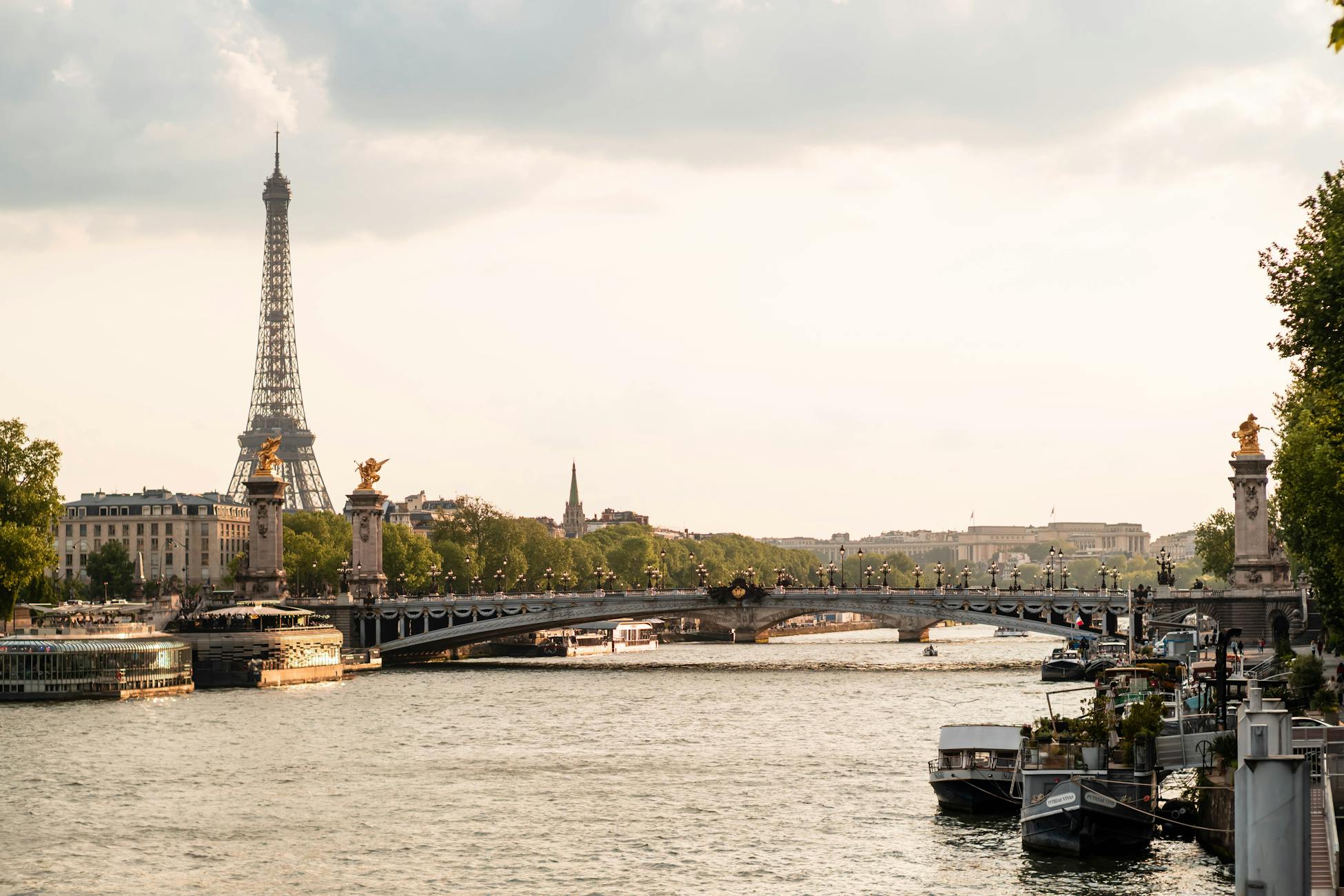
On a clear summer day, sunlight hits the south face of the tower for hours while the north face sits in shadow. Wrought iron is a decent conductor, but the four legs are open lattice, not solid bar, and temperature differences across the structure develop. The hotter side stretches more. The cooler side stretches less. The result is a gentle bow, with the summit drifting away from the sun.
According to the monument’s operators, the sun’s movement across the sky causes the top of the tower to trace a circular curve roughly 15 centimetres in diameter over the course of a clear day. As the sun arcs from east to south to west, the lean swings with it. A pendulum hung from the summit would draw out that ellipse over the course of a sunny afternoon.
Wind moves the tower too — gusts can push the top several centimetres in a storm — but the thermal lean is a significant everyday effect, and one that Eiffel himself anticipated. His calculations allowed for both wind loading and thermal deformation, and the curved profile of the legs was chosen partly to resist exactly these forces.
How a 19th-century engineer planned for it
Eiffel did not invent thermal expansion, but he respected it. The iron pieces and rivets that make up the tower were designed with deliberate tolerance for movement. As the official monument history records, the curvature of the four edges was mathematically determined for wind resistance, and the geometry of the lattice was sized against the deformations expected from temperature change as well. The four legs sit on masonry piers fitted with hydraulic jacks — originally installed to level the structure during construction, but also useful for absorbing small shifts over time. The lattice itself, with its thousands of cross-braces and open panels, allows the metal to breathe without buckling.
Large steel structures exhibit thermal expansion effects similar to what the Eiffel Tower experiences. Bridge decks can shift laterally on hot days, and railway rails require gaps every few metres to keep them from kinking in summer. Every large steel structure on Earth is doing some version of what the Eiffel Tower does. Most of them are just less photogenic about it.
The science behind the stretch
At the atomic level, the explanation is straightforward. Iron atoms in a crystal lattice sit in potential wells that are slightly asymmetric — easier to push apart than to squeeze together. As temperature rises, the atoms vibrate with more energy, and the average distance between them grows. Multiply that microscopic shift by the countless atoms stacked along the tower’s vertical axis, and you get centimetres of growth at the top.
Modern researchers use sophisticated simulations to model how heat plays out in complex geometries. Lattice Boltzmann methods, used for modelling heat transfer in porous media, can resolve thermal transport across the kind of intricate, multi-scale geometries that show up everywhere from geothermal reservoirs to engineered insulation. The Eiffel Tower, in that sense, is a 135-year-old physics demonstration of the same fundamental problem — how heat moves through an irregular structure — that contemporary computational physicists still find rewarding to model.
The same problem at microscopic scale
The headache that thermal expansion causes for the Eiffel Tower is the same one that haunts modern electronics engineers, only flipped in scale. When silicon dies, copper interconnects, and ceramic substrates inside a chiplet package heat up unevenly, they expand at different rates. The stresses can crack solder joints or warp the substrate.
A 2025 paper from Pennsylvania State University, Intel, Arizona State and the University of Notre Dame proposed a floorplanning method called STAMP-2.5D for reducing thermally-induced structural stress in chiplet packages — essentially, arranging the hot and cool components so the package does not bow like a tiny Eiffel Tower under the heatsink. The materials differ. The principle is the same one Eiffel’s team worked around in Paris in the 1880s.
Winter shrinkage and the daily breath
What expands also contracts. In January, with Paris temperatures dropping to a few degrees above zero and the iron sometimes sitting below freezing, the tower shrinks back. The annual cycle is something like a 15-centimetre breath, taken once a year, with the official tower operators describing the day-to-day variation more conservatively as a few millimetres against ambient air.
There is a faster rhythm laid over the top. Each day the tower stretches a little after sunrise, peaks in late afternoon, and contracts overnight. The structure has been doing this tens of thousands of times since it opened in 1889 — a slow, silent inhalation and exhalation that nobody standing on the Trocadéro can see, but that any laser rangefinder pointed at the summit can detect.
How they measure it
Modern measurements come from a mix of GPS receivers, strain gauges, inclinometers, and laser surveys. Distributed sensors track the summit through daily thermal cycles and seasonal drift. Strain-gauge instrumentation campaigns reported in the monument operator’s news and technical communications have been used during major repaint and reinforcement works to confirm how the lattice members carry load through each temperature cycle. The data confirms what Eiffel’s calculations predicted: the tower behaves like a textbook thermal expansion problem, scaled up to monumental proportions.
The same instruments pick up the wind sway, vibrations from passing trains, and even the tiny pulse of the elevators climbing the legs. The tower is in constant, low-amplitude motion. The thermal expansion is just the largest and slowest movement in the repertoire.
Heat as a structural force everywhere
Once you start looking, thermal expansion is everywhere. Pipelines are built with flexible sections so they can expand in summer without rupturing. Large suspension bridges experience vertical changes at midspan between hot and cold days. Heat pumps and solar-thermal systems, like the 54 solar-assisted heat pump configurations recently modelled for German homes, depend on engineered expansion and contraction of working fluids inside their coils.
Even direct expansion solar heat pumps for residential hot water rely on a refrigerant that swells and shrinks across the same temperature ranges Paris itself experiences. The Eiffel Tower’s summer growth is a more visible cousin of the process happening inside millions of household appliances every minute.
A monument that keeps moving
The tower has outlived its 20-year planning permit by more than a century. It has been repainted many times, refitted with broadcast antennas, and survived two World Wars, a near-demolition after the original concession expired, and the addition of glass floors on the first level in 2014.
Through all of it, the iron has done what iron does. It stretches in the sun. It shrinks in the cold. It leans, almost imperceptibly, away from whichever face is warmest.
On any clear July afternoon, somewhere above the Seine, the summit of the Eiffel Tower is several centimetres higher than it was at dawn, and several centimetres further from the sun than the morning’s geometry would predict. Visitors taking the lift to the top are riding a structure that is, very slowly and very quietly, still alive to the weather — the same weather Gustave Eiffel’s engineers were calculating against when they pencilled the curves of the legs onto drafting paper in 1884.
The tower will be a little shorter tomorrow morning. Then a little taller by lunchtime. The breath continues.
