
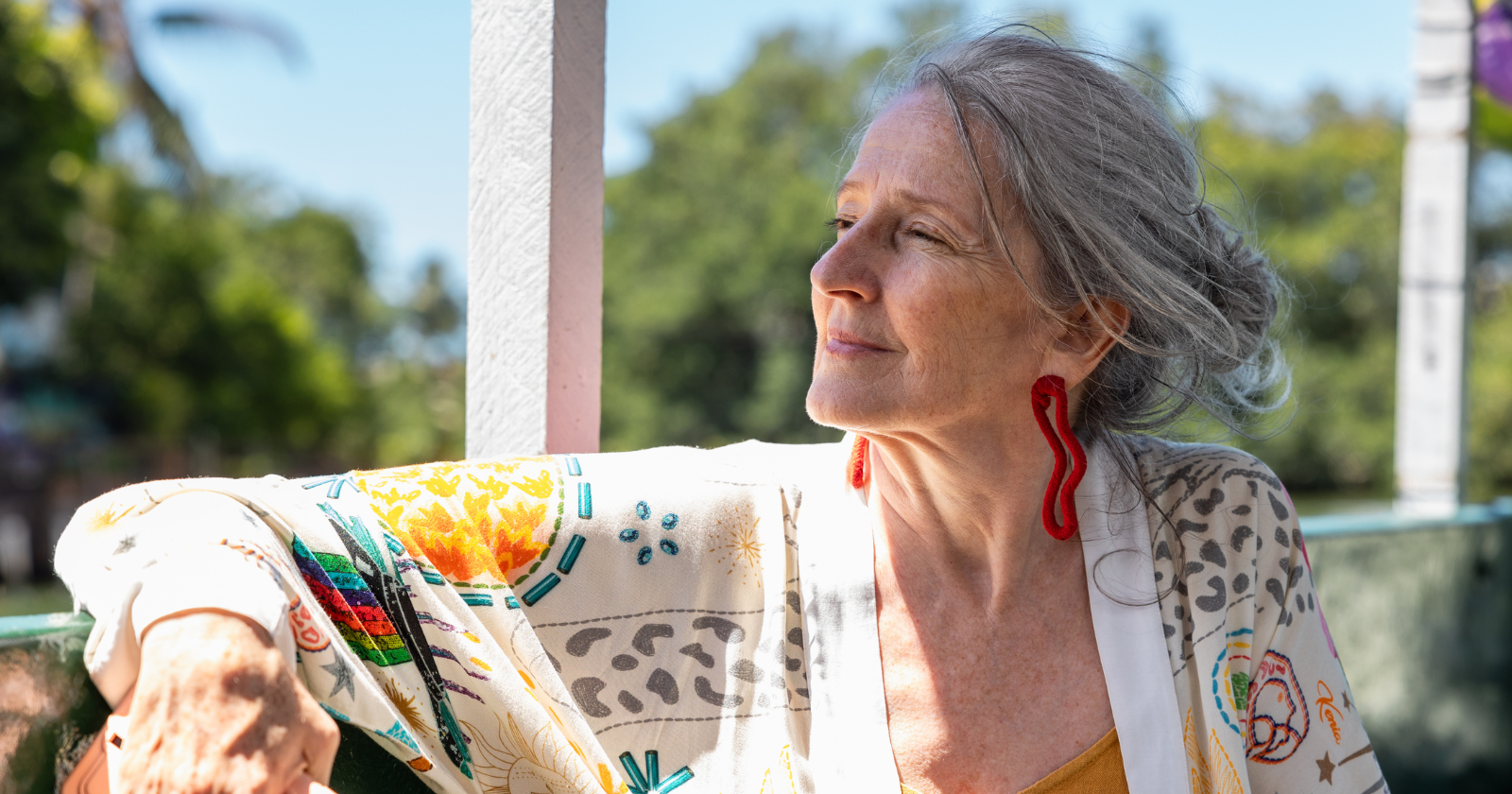

The picture is common enough to have become a stereotype. An older parent, an older neighbor, an older relative, moving through the week with the same three or four names on rotation — the same friend for tea on Wednesday, the same walk with the same person on the weekend, a birthday-card list that hasn’t changed in years. It looks, from the outside, like the social world has shrunk without anyone quite meaning it to.
It is easy to read that shrinking as a quiet defeat. The story often goes: as we age we lose the energy for new people, the invitations dry up, the circle contracts because we can no longer keep it wide. There is a version of aging in the culture that treats a small social world in late life as evidence of failure, or at least of drift.
But it may be totally backward.
This is an interpretive essay drawing on published psychological research. We are writers, not clinicians; nothing here is a substitute for professional advice on aging, isolation, or mental health.
There is nothing surprising about how that reading takes hold. Modern social life measures breadth almost by reflex. Contact lists, follower counts, the vague sense of who you would invite to a milestone party. A person whose circle has narrowed to five or six can seem to be doing badly on a scoreboard everyone was quietly keeping.
The scoreboard is the problem — it measures the wrong thing for the wrong stretch of a life.
What research suggests
Perhaps, the clearest account of what might be going on comes from socioemotional selectivity theory, developed by Stanford psychologist Laura Carstensen, founding director of the Stanford Center on Longevity. The theory begins from a plain observation. As people age, their sense of time left in life shortens. And when time feels shorter, what people want out of a given hour, or a given relationship, shifts.
Carstensen has told the story of arriving at this idea through two elderly sisters she was interviewing years ago. She was trying to convince them there were plenty of new people they could get to know in their apartment complex. One of them looked at her and said, in effect, no thank you, they didn’t have the time. Carstensen assumed for a moment they meant time in the day. Then, as she recalled on NPR’s TED Radio Hour, “I realized that she wasn’t talking about time in the day. She was talking about time left in life. And I realized that at some point in life, we’re never going to make a new old friend because there isn’t time.”
That is the shift underneath the smaller circle. Younger people tend to keep the network wide because the future is long and any of those connections might matter later. A shorter horizon does the opposite. Under it, spending an evening on a casual acquaintance who might, in principle, become a friend in five years is a poor use of what is left. Sitting with the friend who already knows the whole story is a good one.
What the data behind the theory look like
The pattern is not just theoretical. When researchers track the same people over time, the ones who reach later adulthood tend to keep their close relationships intact while quietly letting go of peripheral ones. Tammy English and Carstensen followed a group of adults over ten years and reported that “reductions were observed primarily in the number of peripheral partners; the number of close partners was relatively stable over time”.
The core stayed intact; what shrank was the edges, and the shrinking was linked to feeling better in ordinary life, not worse.
The same shift shows up in everyday behavior. USC Dornsife’s coverage of Susan Charles’s work summarizes the pattern this way: older adults tend to leave a conversation once it becomes heated, and are more likely to change the subject than to dig in. The energy that would have gone into managing a difficult peripheral relationship goes somewhere else instead.
What the small circle is actually doing
Seen from inside, the small unchanging circle looks less like a failure of social effort and more like a decision. A decision to spend the finite Wednesday afternoons on the person who already knows you at forty and at fifty and now at seventy, and can therefore hold the whole shape of a life at once, rather than on someone who would have to be caught up from scratch.
This is not the same thing as loneliness, though the two can look similar from outside. Loneliness has to do with whether the relationships you have meet the needs you have. A person can have a very small circle and be well met by it, and a person can have a very wide one and be lonely inside it. Assuming that a narrow circle in late life is bad because it is narrow makes the same mistake as assuming that a full inbox is good because it is full.
The trade, breadth for depth, is also not a rejection of new people. Plenty of older adults do meet new friends. What has changed is the threshold. A new person now has to be worth the time in a way that a new person at twenty-five didn’t have to be, because at twenty-five the time budget felt effectively infinite.
What this changes in how we read the pattern
For anyone watching an older parent or neighbor from the outside, the useful move is probably to stop assuming the shape of their week as evidence of decline. The small circle may be exactly what they want it to be. If they are seeing three friends regularly and each of those friends has decades of shared history, the arithmetic on their side of the table is much better than it looks from the outside.
The reverse is worth naming too. A person who is isolated, who has lost the core rather than pruned the edges, is in a different situation. The research doesn’t claim every small circle is healthy — only that a small circle in late life is not, by itself, a symptom of anything, and that it is often the outcome of a considered choice.
If you are worried that an older relative has slipped past pruning into isolation — a lost core rather than trimmed edges — that is worth raising with their GP, a counsellor or therapist, or an organisation like Age UK (or the equivalent where they live).