
The day after Christmas 2013, a team from Harvard Business School and the University of Minnesota asked 140 adults a plain question: did your family have a ritual for the holiday? They defined a ritual as “a series of actions performed in a prescribed order before, during, or after an event to achieve a desired outcome.” Then they asked how the day had gone.
Two more surveys, one on New Year’s Eve and one on Easter, joined it in a 2016 paper in the Journal of the Association for Consumer Research, which covered 1,098 adults. They were online survey-takers averaging about 37 years old, and the paper does not say how many were parents, let alone parents of grown children. Thanksgiving was not studied. Every finding below comes from this one paper, and none of its surveys was designed around families with grown children.
Who spent the day with family
People with a family ritual were far more likely to have spent the holiday with family. At Christmas, only 3.5% of them had been elsewhere, against 30.9% of people without one. Among those who were with family, the ones with a ritual rated the day more enjoyable and felt closer to their family: 5.99 and 6.15 on a 7-point scale, against 4.92 and 5.05. The New Year’s Eve and Easter surveys pointed the same way. The Christmas and New Year’s Eve surveys asked about rituals before asking how the day went, which may have widened the gaps; when Easter respondents rated the day first, the difference shrank but held (see the fine print below).
The Artful Parent
Family-life ideas and sharp reads, in your inbox.
The paper’s account of why runs through two feelings. Its models compared people who kept a ritual and spent the day with family against everyone else surveyed. Those people felt closer to their families, feeling close went with finding the day more fun and interesting, and both went with enjoying it more. Once those two feelings were taken into account, little direct link remained between keeping a ritual with family and enjoying the day. It is a pattern in the answers, not proof of cause.
Which ritual a family kept showed no clear link to enjoyment: in the paper’s tests, dinners, church services and egg hunts did not differ significantly. So the eight below are not ranked, and none was tested experimentally. Each is a kind of ritual that people in these surveys wrote about.
1. The meal that doesn’t change
Dinner was the ritual people wrote about most for New Year’s Eve and Easter (49% and 36% of the rituals described), and second only to presents at Christmas. The answers were specific. One Easter meal involved desserts baked ahead and a ham prepared the night before with pineapple, cloves and a ginger brown sugar glaze, all “served on dinnerware that is only used for Easter.” At Christmas, one respondent’s grandmother cooked ham, chicken wings and “tons of desserts,” and made sure they went home with a ton of leftovers.
For a grown child who has moved twice in five years, a menu that has not moved at all can be its own kind of welcome.
2. The order the presents are opened
One participant’s in-laws open gifts by age, oldest to youngest one year and youngest to oldest the next. Opening presents was the Christmas ritual described most often, at 39%, and for this family the sequence is the ritual. An order like that works just as well when everyone opening presents is an adult.
3. Hanging the same ornaments again
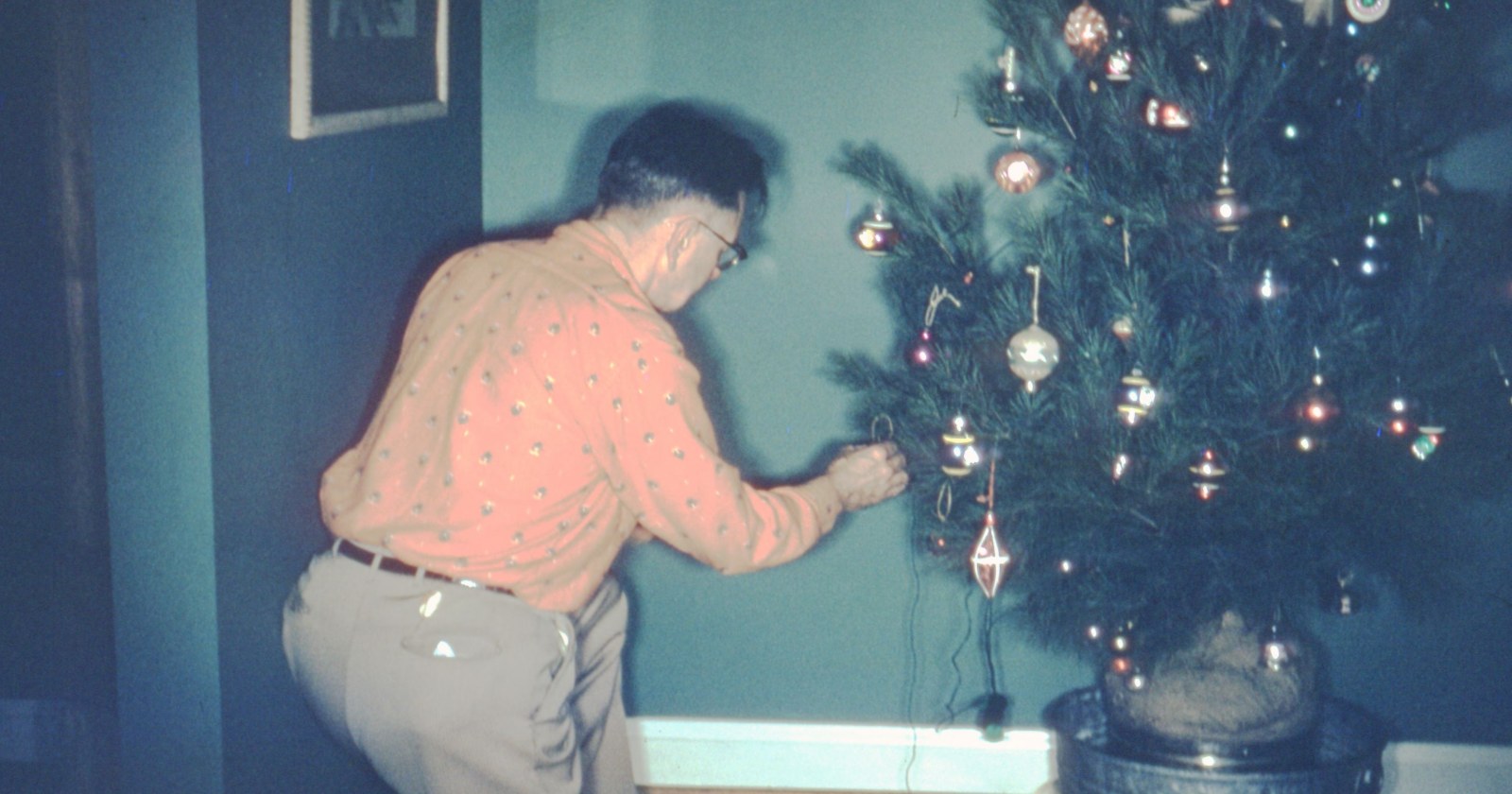
Down from the attic comes the tree, its fake leaves fanned out and its lights strung, and then the ornaments, “the same exact ones every year.” That was one respondent’s Christmas. Decorating the tree made up about one in ten of the Christmas rituals.
If your children are grown, the box may still hold ornaments they made or chose. Letting them hang their own is a small way to hand the ritual on.
4. Going to a service together
For one Easter family, the ritual was getting dressed up and going to the morning service together, as they did every year. Religious services made up about a quarter of the Easter rituals (24%) and about one in ten at Christmas. For families of faith, it can be the one hour of the day when nobody is cooking or driving. When grown children have come to their own beliefs, it may sit more easily as an invitation than an expectation.
5. The game that comes out after dinner
Games were the least described ritual at Christmas and on New Year’s Eve, but they show how a ritual can stretch. One New Year’s family hugs, sings “Auld Lang Syne” and plays games, with a circle that now includes partners and children. A board game needs no history to join, which makes it an easy first ritual for a new son- or daughter-in-law.
6. Watching the ball drop
“We sit together in the living room and just watch the ball drop on TV,” one person wrote. Watching the ball drop accounted for 16% of the New Year’s Eve rituals. It asks only that people be in the same room, which suits a house full of adults on different schedules.
7. Counting down to midnight
Another 12% were the countdown itself. It is over in seconds, which may be part of its appeal for adult children with somewhere else to be later that night.
8. The egg hunt everyone joins
Egg hunts made up 22% of the Easter rituals. In one household, everyone searched for eggs the respondent’s wife had hidden around the house, filled with candy and money; the answer does not say how old the hunters were. A hunt does not need small children. In a house of adults it can be for the grown ones, and in time for grandchildren. Decorating eggs (9%) and filling Easter baskets (8%) came up too.
The fine print
Asking about rituals first could have pushed the two groups’ ratings apart. At Easter, the researchers tested that. About half the participants, assigned at random, rated the day before being asked about rituals. Among those who spent Easter with family, people with a ritual enjoyed the day about a point more than people without one (6.06 against 5.00) when rituals came up first. When the rating came first, the gap was about a third of a point (5.44 against 5.10), only just reaching statistical significance.
The authors also write that it is “possible and even likely” that families with rituals were already close, so a ritual may reflect a close family as much as build one. Each answer came from one family member, describing the family’s ritual and rating their own day. The one possible exception on ritual type, New Year’s resolutions, rested on four people, and the paper’s own summary says type made no difference in any of the three surveys. Rituals kept alone, without family, were rare and showed no link to enjoying the day in the two surveys that asked about them. And the percentages in the list are shares of the rituals people described: respondents said how many their family kept but described only one in detail.
One of the paper’s four authors is Francesca Gino. Harvard concluded that she had manipulated data in at least four of her studies and revoked her tenure in 2025; she has denied the allegations. A separate 2016 paper on rituals, which she co-wrote with several other researchers, was retracted at its co-authors’ request after an internal audit. This holiday paper is not listed in the Many Co-Authors database, where her co-authors have posted unvetted accounts of where the data for their shared papers came from, and we found no retraction, correction or misconduct finding concerning it in news coverage. The paper says its data are available online; we did not re-analyse them.
Holidays are also when old strains surface. If this season brings a rift, a recent loss or plain dread, talking it through with a family therapist or counselor can help.
The surveys also do not say why grown children come home in the first place. An earlier piece on this site argued that it often isn’t for the food or the traditions, and no one in these surveys was asked.
A ritual, in this paper’s definition, is a set of actions done in a set order, around an event, for a purpose. The surveys did not test which part of that matters most. Our own guess is that part of the appeal is the order itself, something everyone, newcomers included, can learn and find a place in.