
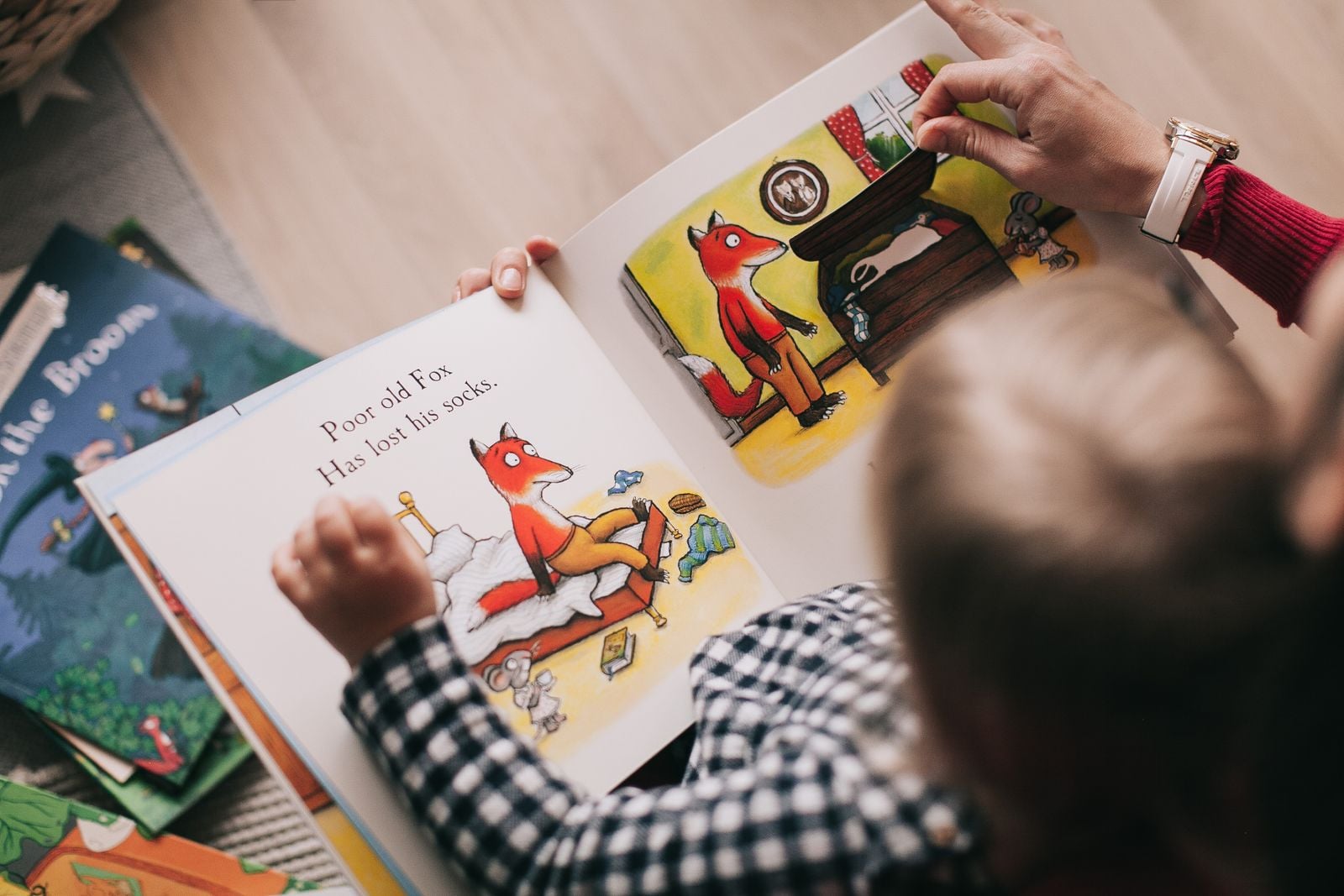
A child read to daily from a stack of picture books arrives at kindergarten having heard about 1.4 million more words than a child who was never read to at all. That figure comes from a 2019 study led by Jessica Logan at Ohio State University, which combed through 60 of the most commonly shared children’s books — board books and picture books alike — and counted every word inside them.
The number is not a metaphor. It is an actual tally, arrived at by opening the books and adding up what is on the pages.
How the count was built
Logan’s team started with a practical question: if a parent reads their child five books a day, how many words does that child actually hear before formal school begins? To answer it, the researchers worked with the Columbus Metropolitan Library to pull the 100 most-circulated board books and the 100 most-circulated picture books, then randomly drew 30 titles from each list — 60 books in all, the Goodnight Moon and The Very Hungry Caterpillar stratum of the shelf — and counted the words on every page.
The Artful Parent
Family-life ideas and sharp reads, in your inbox.
The team calculated that a child read five books a day would hear roughly 1.4 million more words by kindergarten than a child who was read to zero times a week.
The full gradient looked like this: a child read one book a day heard about 290,000 more words than a never-read-to peer. Five books a day pushed that number past a million. The gap compounds quietly, one bedtime at a time.
Why picture books do more heavy lifting than conversation
Everyday talk in a household tends to draw from a small, familiar pool. Dinner, socks, park, snack, bath. Picture books widen the pool immediately. A single page of The Snowy Day will hand a three-year-old the word crunch, the word slowly, the word heaping. The vocabulary in printed children’s books is measurably richer and rarer than the vocabulary of casual adult-to-child speech, which is a big part of why the read-aloud effect shows up so strongly in later reading tests.
Logan’s team argued that this exposure gap is one plausible engine behind the vocabulary and comprehension differences teachers see on the first day of kindergarten. As the Ohio State announcement of the study put it, children who hear more vocabulary are better prepared to meet those same words in print once they reach school.
What the brain is doing while a book is being read
The stakes of that exposure are biological. In early childhood, a child’s brain is forming new neural connections at an extraordinary rate, and the pathways that get used repeatedly are the ones the brain keeps. A nightly book is, in that sense, a repeated signal to the wiring: this pattern matters, keep it.
Reading aloud lights up more than the language centers. When a caregiver holds a child on their lap and turns pages, the child is also processing facial expression, tone of voice, the rhythm of a hand smoothing the corner of a page. That braided input — sound, image, touch, warmth — is what the research on shared reading keeps circling back to.
Brain imaging research has found that reading fiction with a strong narrative can produce increased connectivity in language-processing regions, with effects that persist for days afterward. The effect looked something like muscle memory, but for words.
The five-books-a-day version
Five books a day sounds like a project. In practice it is more like ten to fifteen minutes, because most board books are shorter than a pop song. A Sandra Boynton is 90 seconds. Brown Bear, Brown Bear is under two minutes. Stack a few on the coffee table and the count builds itself.
As a write-up of the Ohio State findings pointed out, the five-a-day number is not a prescription so much as a ceiling — a way of showing what is possible if reading is treated like brushing teeth rather than an occasional treat.

The one-book-a-day tier is worth pausing on too. Even a single nightly story adds a quarter-million words to a child’s ear by age five. That is not a rounding error. That is a small paperback novel’s worth of language, delivered in bite-sized snowy days and hungry caterpillars.
Why this is not a solved problem
Knowing the number does not make the gap close. Michigan spent roughly $80 million over three years on early literacy programs, and the state’s third-grade reading proficiency rates dropped anyway, from 50 percent in 2014-15 to 44 percent by 2016-17. The share of fourth-graders reading proficiently on the National Assessment of Educational Progress fell far enough over the previous decade to drag Michigan from 28th to 41st among states.
The Education Trust-Midwest, the nonpartisan research group led by founding executive director Amber Arellano, found that Michigan’s decline diverged sharply from the pattern in other states that gave comparable tests — its drop was roughly triple that of any other state that slipped over the same window. The money is real. The reading gains, so far, are not. Part of the reason educators keep circling back to the read-aloud research is that it happens outside the school funding fight entirely — on couches, in laps, at bedtime, before a child ever sees a classroom.
A separate commentary in the Sidney Daily News made the same point more bluntly: schools can layer on reading specialists and phonics curricula, but they cannot replace the thousands of hours of pre-literate language exposure a child either does or does not arrive with.
What actually counts as “reading to”
The Ohio State count assumes a caregiver reading the words on the page. It does not assume perfect performance. It does not require voices, or finger-tracing, or asking questions about the illustrations, though all of those things add layers. The mechanism is simpler than that: the child hears the words, sees them anchored to pictures, and hears them again the next night, and the night after, because young children famously demand the same book seventeen times in a row.
That repetition, which can feel like a small domestic torture, is exactly the pattern the developing brain is designed to consolidate. Each re-read of Where the Wild Things Are is another pass at the same 336 words, another chance for gnashed and terrible and rumpus to settle into long-term storage.
Physical books, not screens
The research keeps distinguishing between paper books and tablet versions. Print picture books tend to promote deeper caregiver-child interaction than the same story on a screen — more pointing, more back-and-forth, more shared attention focused on the same object, the kind of interaction that anchors early language.
A TMJ4 News summary of the reading research noted the same pattern showing up in classroom outcomes years later: children who were read to regularly tended to do better in school and, downstream of that, in adult life measures the researchers could track.
The compounding math of a bedtime habit
The 1.4 million figure is what makes the finding travel. But the more interesting number might be the daily one. A parent who reads a single 200-word picture book to a two-year-old, every night, for three years, will have spoken roughly 219,000 book-words into that child’s ear before kindergarten. Add a second book on weekends and the total climbs past 300,000.
None of that requires a curriculum, a subscription, or a specialist. It requires a library card and the willingness to read Goodnight Moon again when the child hands it over for the fourth time in one evening.
Logan’s team was careful not to frame the gap as a verdict on any individual family. Not every parent has the language, the literacy, the time, or the quiet ten minutes before sleep. The point of counting was to make visible something that is otherwise invisible: that the difference between one book a night and none is not sentimental. It is measurable, and it stacks up in the hundreds of thousands of words, page by soft cardboard page, in the years before a child ever sits down with a pencil.
The picture books on the shelf are, on this count, doing arithmetic in the dark.