
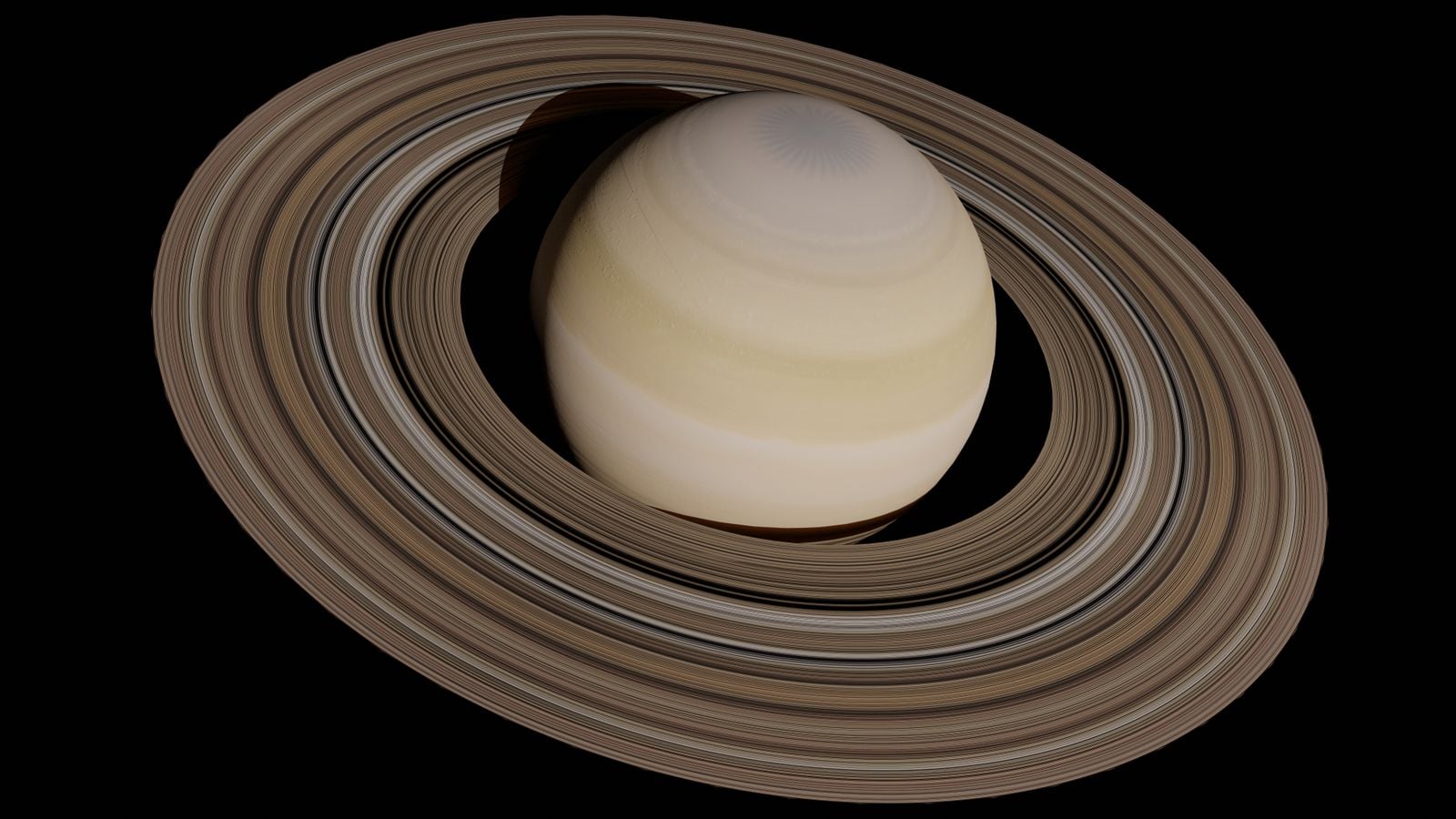
On Titan, a child with a set of cardboard wings strapped to both arms could actually get off the ground. Not in a game. In physics. NASA’s own case for going there starts with two numbers: Saturn’s largest moon has an atmosphere four times denser than Earth’s, and a gravitational pull only about one-seventh as strong. Run fast enough, flap hard enough, and the numbers work out. Human-powered flight, the daydream every kid has had staring out a car window, is a real thing a person could do standing on the shore of a methane lake far from home.
The math is not a metaphor. It is the reason NASA is sending a nuclear-powered rotorcraft there.

The two numbers that make flight possible
Start with the air. Titan’s surface pressure sits at roughly 1.5 bar, about 50 percent higher than sea level on Earth by pressure alone. What matters more for a wing is density. Titan’s air is mostly nitrogen, much like Earth’s, but it is far colder (around -179°C) and packed much tighter. The result is an atmosphere with roughly four times the density of the air outside a kitchen window.
The Artful Parent
Family-life ideas and sharp reads, in your inbox.
Then the gravity. Titan pulls down at about 1.35 m/s², against Earth’s 9.81. A child who weighs 60 pounds on a bathroom scale here would register a little over 8 pounds there.
Lift on a wing scales with air density and with the square of your speed. Weight scales with gravity. Put the two together and Titan offers an environment where the lift-to-weight ratio for a flapping human is roughly 28 times more generous than on Earth. That is not a novelty calculation, it is the premise of a working spacecraft: the engineers building NASA’s Dragonfly say it is physically easier to fly on Titan than on Earth or Mars, a point made by mission principal investigator Elizabeth “Zibi” Turtle of the Johns Hopkins Applied Physics Laboratory.
What it would actually feel like
Picture a lakeshore of dark hydrocarbon sand. The sky is a bruised orange, hundreds of times dimmer than an Earth afternoon, because sunlight arrives faint at Saturn’s distance and the haze absorbs most of what is left. The air is thick enough that swinging an arm feels like swinging it through cool water. Sound travels differently in denser air, so voices carry farther and lower.
Strap on wings roughly the span of a hang glider, call it three meters tip to tip, and take a running start along the packed sand. On Earth, wings that size would demand a takeoff speed no human legs can produce, which is why nobody has ever flapped their way off a runway. On Titan, the speed required drops to something closer to a jog. Flap once, hard, and you rise. Flap again and you climb.
Kate Howells, public education specialist at The Planetary Society, walks through exactly this scenario in her guide to standing on Titan’s surface, noting that a person there could strap wings onto a spacesuit, flap them, get a running start and take off. She calls Titan the easiest place in the solar system for flying.
Why the atmosphere is so thick in the first place
Titan is the only moon in the solar system with a substantial atmosphere, and researchers have been trying to work out where all that gas comes from. A study published in October 2024 in The Planetary Science Journal, led by Lauren Schurmeier of the University of Hawai’i at Mānoa, proposed a mechanism that had been missing from earlier models: a methane-rich clathrate crust up to six miles thick sitting on top of the water-ice shell.
The team noticed something odd in the crater data. Only about 90 impact craters have been identified on Titan, and they sit hundreds of meters shallower than expected. When the researchers modeled plausible starting depths using fresh craters on Ganymede, a similar-sized icy moon, something on Titan was clearly making its craters relax and fade, at roughly the rate fast-moving warm glaciers flow on Earth.
The modeling pointed at a crust of methane clathrate, water ice with methane gas locked inside the crystal structure. Methane clathrate is stronger and more insulating than ordinary water ice. It keeps the deeper shell warm and ductile, and it slowly leaks methane upward, feeding the atmosphere.
Which is to say: the reason a child could theoretically fly there is that a six-mile blanket of methane-laced ice has been quietly outgassing for a very long time.
NASA is sending a rotorcraft to prove it
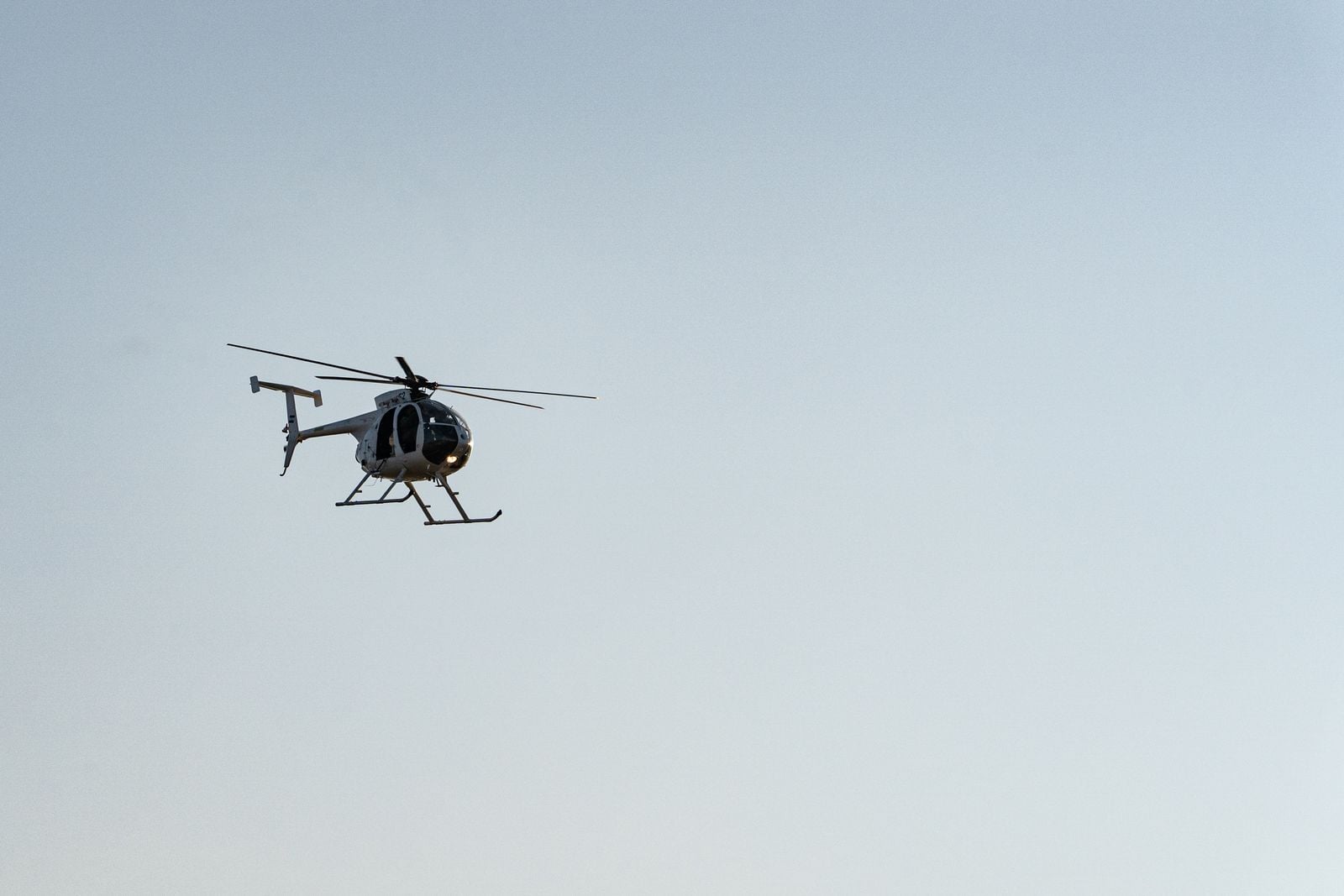
The Dragonfly mission is scheduled to launch no earlier than July 2028 and to reach Titan in 2034. It is a nuclear-powered octocopter, eight rotors in four stacked pairs, roughly the size of a small car, designed to hop from site to site across the surface. Its plutonium-238 generator produces about 100 watts, which trickles into a battery. No rotorcraft that large could fly on Earth on that budget. On Titan, the thick air and low gravity make it not just feasible but efficient.
The mission profile depends on the same math a schoolchild’s wing-flapping fantasy depends on. The idea dates to 2000, when APL aerospace engineer Ralph Lorenz, now Dragonfly’s mission architect, was working out how much power it would take to push an airship around Titan and realized a helicopter would be the better platform. The flight environment shaped every design choice that followed, from rotor size to hop distance. Dragonfly will visit dune fields, sample organic-rich sand, and finish at Selk crater, chosen because impact heat there once mixed liquid water with Titan’s carbon chemistry.
A full battery charge buys a hop of a few kilometers. Across a mission of nearly three years, NASA expects the rotorcraft to cover more than 100 miles, almost double the distance driven by all the Mars rovers combined.
The child’s-eye version
Kids ask about flying constantly. It comes up in the same breath as invisibility and talking to animals, the standard shortlist of powers a five-year-old considers plausible until told otherwise. Titan is the answer that does not require telling them otherwise.
Titan is one of those problems worth chewing on. A moon where the air is thick enough to swim through and gravity is weak enough to fly through is not an abstraction. It is a place with a mailing address and a spacecraft on the way.
Show a child the numbers. Four times the air. One-seventh the pull. Ask them to work out what would happen if they jumped off a picnic table there. The answer involves drifting.
What is under the wings
The ground below a Titanian flier would be strange. The surface is water ice, hard as rock at those temperatures, dusted with dark organic sand made of tholins, the sooty molecules produced when sunlight breaks apart methane high in the atmosphere. Rivers of liquid methane carve channels through it. Lakes as large as North America’s Great Lakes sit at the poles.
Titan’s channels behave in ways that echo terrestrial hydrology, only with hydrocarbons instead of water. There is a full weather cycle. Methane rain falls. Methane clouds drift. Rain is rare, and it may be centuries between showers at any given spot, but when it does fall the drops come down slowly through the thick air, fat and unhurried.
A person flying on Titan would need a pressure suit and, more urgently, a heated one. The atmosphere is nitrogen with a few percent methane and no oxygen whatsoever, so it could not be breathed at all, and nothing about -179°C is survivable without engineering.
Why this is not the same as flying on Mars
Mars is the other planet children ask about, and Mars is the opposite problem. Its atmosphere is less than 1 percent as dense as Earth’s, mostly carbon dioxide, and gravity is about 38 percent of Earth’s. NASA’s Ingenuity helicopter proved a small drone could fly there, but only barely, with counter-rotating blades spinning at extremely high speeds to bite into air closer to a laboratory vacuum than a sky. A human with strap-on wings on Mars would simply fall.
Titan is the mirror image: less gravity than Mars, and more than a hundred times the atmospheric density. It is also the world in this class that researchers keep circling back to. At the first Humans to Titan Summit, held in Boulder in June 2026, Amanda Hendrix of the Planetary Science Institute argued for normalizing the idea that Titan is a reasonable destination for humans, not because it is hospitable, but because it is interesting in a way that rewards imagination.
The atmosphere that will not stay put
Atmospheres leak. Earth’s outer hydrogen cloud, the geocorona, reaches some 390,000 miles into space, well past the orbit of the moon. When the Apollo 16 astronauts stood on the lunar surface in 1972 and photographed that cloud, they did not know they were standing inside its outskirts, at densities so low it counts as vacuum.
Titan leaks too. Sunlight breaks methane apart high in its atmosphere, the hydrogen escapes to space, and the heavier products settle back down. The reason there is still an atmosphere left at all is the crust: a slow, patient methane resupply from below.
Whether other worlds could sustain that kind of setup matters for the search for life. Modeling by University of California Riverside planetary scientist Michelle Hill and colleagues, published in The Planetary Science Journal in June, found that a rocky world needs to be at least roughly Mars-sized to hold an atmosphere long enough for life to get started. Titan is smaller than Mars, but the extreme cold slows the leak. It is a moon that gets to keep its air because it is freezing.
What kids do with a fact like this
Facts about faraway places land differently than facts about local ones. Telling a child that cornstarch and water behave like a solid when squeezed gives them a thing to poke at the sink. Telling them there is a moon where they could fly gives them something to draw. Both are science. Neither requires a worksheet.
Cardboard wings, a bedsheet cape, the running-jump-from-the-porch-step phase most kids cycle through around age four: none of it is irrational. It is the correct behavior for a species that lives on the wrong moon.
Dragonfly arrives in 2034. A child born this year will be eight when the first human-built rotorcraft lifts off from Titan’s surface and hops across a dune field, its rotors turning easily in air so thick it might as well be soup. Somewhere on Earth, that child will probably be flapping cardboard wings at the time.