
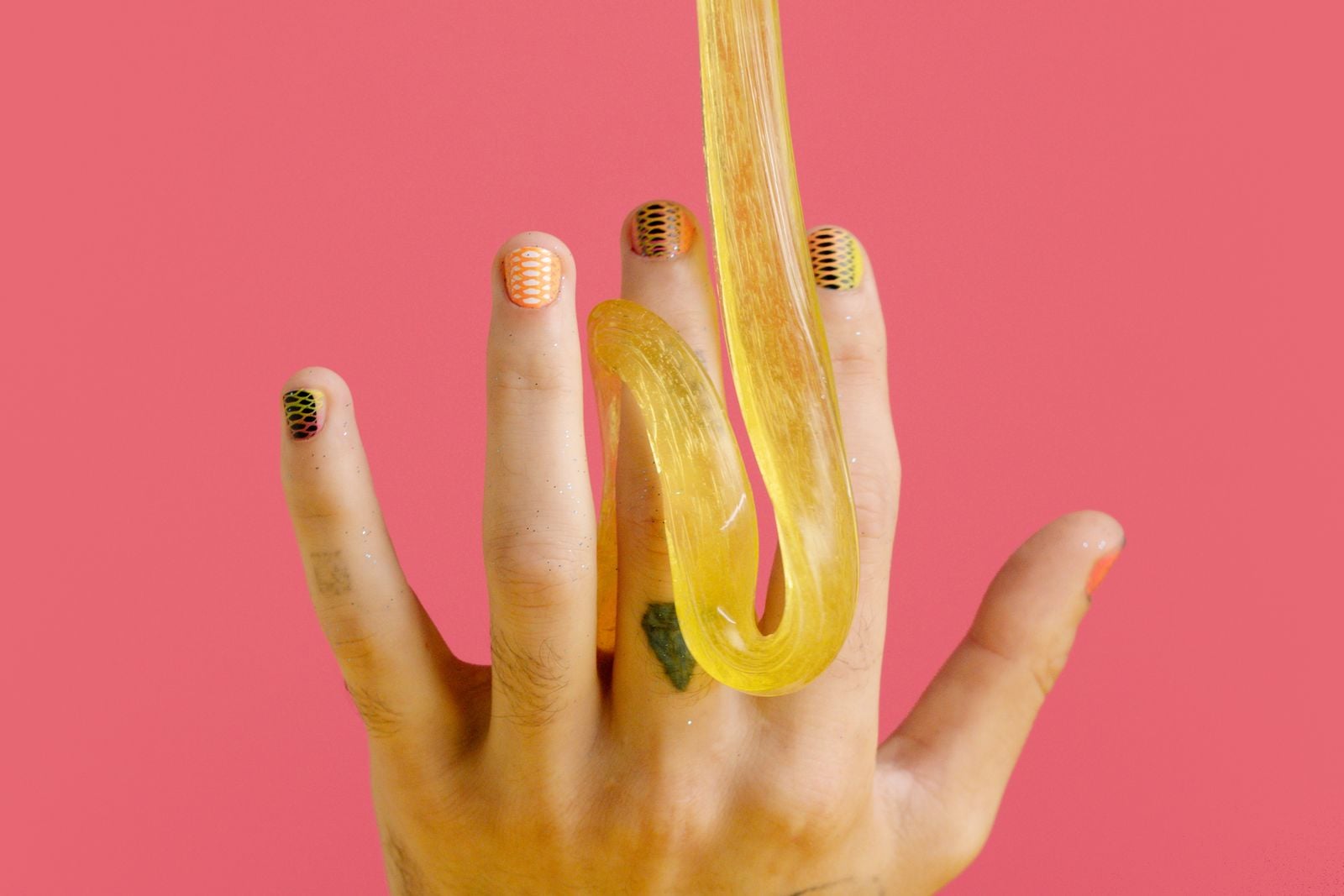

Pull a fresh batch of homemade slime off the kitchen table and it comes up in one rubbery sheet, leaving the wood almost dry. A minute earlier those same ingredients — white school glue, a splash of liquid starch, a drop of food colouring — were a milky puddle that would have taken a sponge and a bad mood to clean up. The transformation happens in under 30 seconds, and it is one of the most accessible pieces of polymer chemistry a child will ever hold in their hands.
The active ingredient in ordinary white school glue is polyvinyl acetate, a long-chain synthetic polymer suspended in water. The active ingredient in liquid starch is sodium tetraborate — borax, listed on the bottle by its chemical name. When the two meet, borate ions reach across the polymer chains and stitch them together at thousands of points at once. The puddle becomes a net. The net is slime.
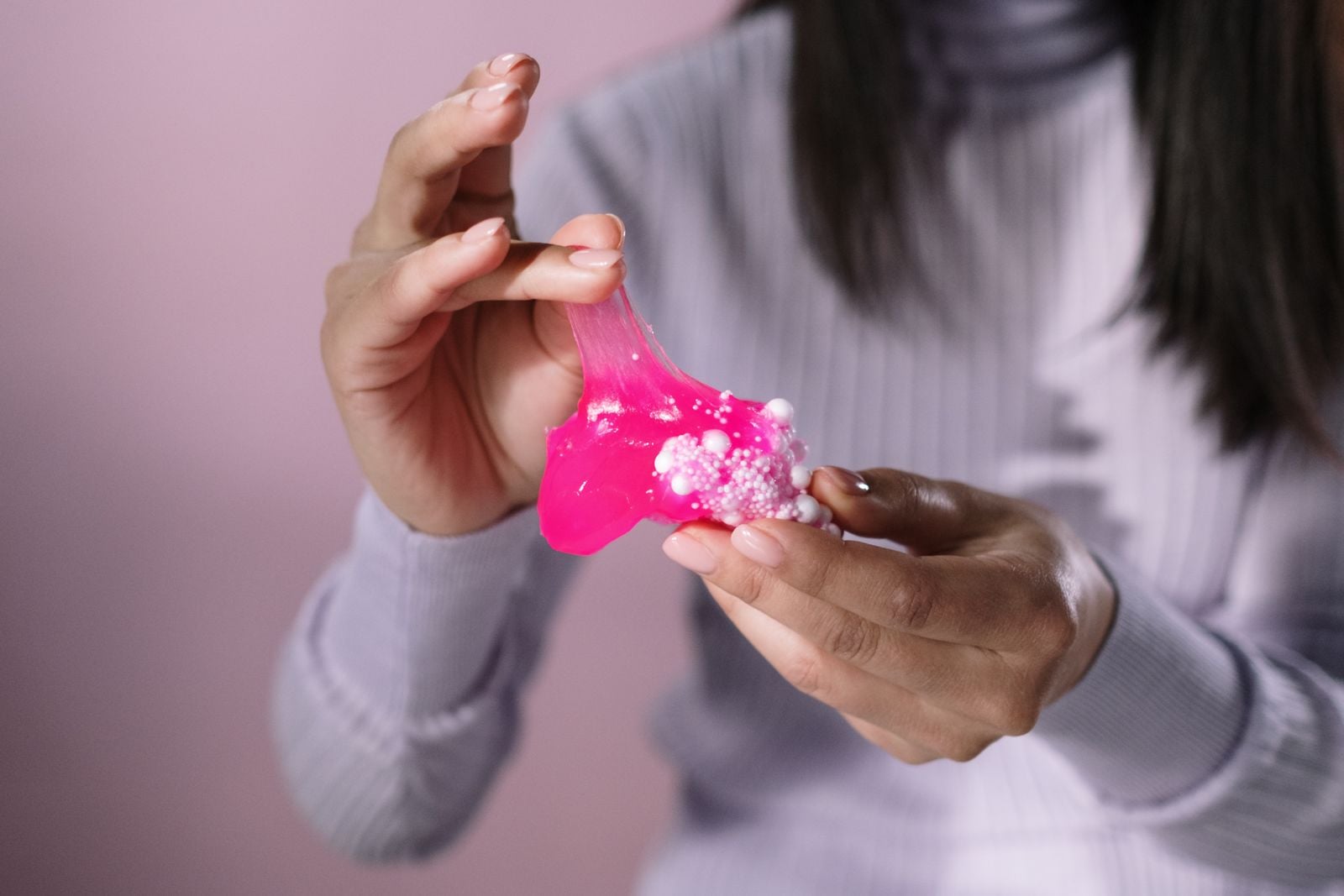
What is actually in the bottle
White school glue is polyvinyl acetate dispersed in water with a small amount of polyvinyl alcohol added as a stabiliser. The polyvinyl acetate molecules are long — thousands of repeating units strung together — but in the bottle they slide past each other freely, which is why glue pours.
Liquid starch looks innocent on the laundry shelf, but a scan of the ingredient list on most bottles turns up sodium tetraborate decahydrate, the same compound sold as borax powder. Many “borax-free” recipes circulating online actually still contain borax, just under its scientific name, tucked into starches and detergents.
That is why liquid starch works. It is not the starch doing the chemistry. It is the borate.
The cross-linking reaction, in slow motion
When borate ions dissolve in water, they exist in equilibrium with boric acid and hydroxide. Each borate ion carries four oxygen atoms arranged like the points of a tetrahedron, and those oxygens are hungry to hydrogen-bond with anything nearby that carries a hydroxyl group.
Polyvinyl alcohol has hydroxyl groups all along its backbone. Polyvinyl acetate has ester groups, which are less reactive but still participate — and because glue contains some polyvinyl alcohol as a stabiliser, there are plenty of hydroxyls available. A single borate ion can grab a hydroxyl on one polymer chain and another hydroxyl on a completely different chain, physically tethering the two together.
Repeat that across thousands of ions and millions of chain segments, and the free-flowing polymer soup becomes a three-dimensional web. As Chemical & Engineering News explained in its 2018 feature on the slime boom, the result is a non-Newtonian fluid: it flows like a liquid under gentle pressure and behaves like a solid when yanked. Pour it slowly and it drips. Yank it fast and it snaps.
Why it peels instead of smears
Wet glue smears because the polymer chains, unbound to each other, happily coat whatever surface they touch. Slime peels because the cross-links have turned the whole batch into a single connected object. When you lift one corner, you are not lifting a fluid — you are lifting a net whose far edge has to come with it.
The cross-links are not permanent covalent bonds. They are reversible hydrogen bonds that continuously break and reform as the slime is handled. That is why slime slowly flattens into a puddle if left alone: with no shear force to hold the network taut, the bonds reshuffle and gravity wins. Come back in an hour and the batch has spread across the container like a dropped pancake.

An old chemistry demo, rediscovered
The reaction is not new. Polymer chemists have been demonstrating polyvinyl alcohol and borax cross-linking in classrooms for decades — the American Chemical Society has run a version of the slime experiment as a public chemistry demo for years, framed as an introduction to polymers for elementary-age children.
What changed around 2017 was the audience. The online interest in slime exploded, and YouTube hosts millions of slime videos, some with tens of millions of views each. Glue manufacturers saw significant increases in sales at the peak of the craze.
John Fellenstein, a content specialist at the Akron Global Polymer Academy at the University of Akron, told C&EN he goes through five-gallon jugs of glue every two or three weeks doing school demonstrations across Ohio. At one STEM Day event with the Akron RubberDucks minor league baseball team, he burned through four jugs in 40 minutes. Some schools banned slime outright, so Fellenstein rebranded. He now uses scientific terminology to rebrand the substance, calling it a cross-linked polymer putty.
The safety asterisk on borate
Borax powder in its concentrated form can irritate skin, and in 2017 reports of chemical burns from home slime-making prompted public health warnings in several countries. The concern is dose. A tablespoon of borax dissolved in a cup of water and used briefly to make a batch of slime is a very different exposure than a child kneading straight borax powder into glue.
Liquid starch dilutes the borate further, which is part of why it became the default. Contact lens solution — which contains a small amount of borate as a buffering agent — works the same way, as does Tide liquid laundry detergent. All three deliver the same active ion at a much lower concentration than raw powder.
Parents who want to skip borate entirely can, though the chemistry changes. Recipes built around cornstarch and shampoo, or cornstarch and glue, produce a dough-like putty rather than a stretchy net — the thickening there comes from starch granules physically jamming against each other, not from polymer cross-linking. It feels different in the hand because it is a different phenomenon.
What a child’s hands are actually learning
The pull-and-snap of slime is a physics lesson delivered through the palms. Push slowly and the polymer chains have time to slide past each other, so the material flows. Push fast and the cross-links cannot reshuffle quickly enough, so the material tears. Children discover the two behaviours by accident within about 90 seconds of first contact and spend the next hour testing the boundary.
That kind of open-ended sensory investigation matters more than it looks. Messy sensory play engages touch, proprioception, and fine-motor planning in ways a worksheet cannot. A child squeezing slime through their fingers is running dozens of small experiments per minute — pressure, temperature, viscosity, elasticity — without ever being told they are doing science.
Audrey Bridgstock of Pure Organic Ingredients, a Utah company that sells bulk chemicals to the DIY market, told C&EN that slime aligns with a broader wave of hands-on home activities: kinetic sand, rubber-band weaving, homemade play dough. Industry observers note that slime-making aligns with a broader wave of hands-on home activities popular with families, including kinetic sand, rubber-band weaving, and homemade play dough.
The wonder moment
Fellenstein described the moment of transformation as genuinely surprising, explaining that children who witness the change for the first time show visible wonder when they see the liquid suddenly become a stretchy putty.
The transformation is genuinely surprising even when you know the chemistry. One second the bowl holds a milky liquid. The next, the stirring stick lifts out something coherent — something that resists being put back down, something that peels away from the sides of the bowl in a single piece. The polymer soup has become a fabric.
The reason it feels magical is that most everyday state changes are slow (ice melting) or invisible (bread rising). Slime happens in real time, in the child’s own bowl, at the speed of stirring. The cause and effect are compressed into the same 30-second window, which is roughly the attention span the chemistry needs to lock in.
What is happening if the slime fails
Sometimes the batch stays sticky. Sometimes it comes out rubbery and stiff on the first stir. Both failures trace to the same variable: the ratio of borate ions to polymer chains.
Too little borate and there are not enough cross-links to hold the network together, so the mixture behaves like thick glue. Too much borate and the network becomes over-stitched, with so many tie points that the chains cannot slide past each other at all — the result is a stiff, bouncy blob that tears instead of stretching.
The sweet spot is roughly one part liquid starch to one part glue, though the exact ratio depends on the concentration of borate in the specific starch brand. This is why slime recipes vary so wildly across the internet. The chemistry is fixed. The bottles are not.
A polymer that remembers being liquid
Leave a jar of finished slime on a shelf for a week and open it again. The blob has flowed into the shape of its container, filling every corner, the surface as flat as poured water. Pick it up and it still stretches. Squeeze it and it still snaps.
That is the strange dual identity of a cross-linked polymer network. Given enough time, the reversible borate bonds break and reform in whatever configuration lowers the system’s energy — which usually means a puddle. Given a sudden pull, those same bonds hold long enough to behave like a solid. The slime is neither liquid nor solid. It is a material whose identity depends entirely on the timescale of the question being asked.
Which is a strange thing to be holding in a plastic mixing bowl on a Tuesday afternoon, watching a four-year-old discover that if they pull slowly, the world stretches, and if they pull fast, it breaks.