
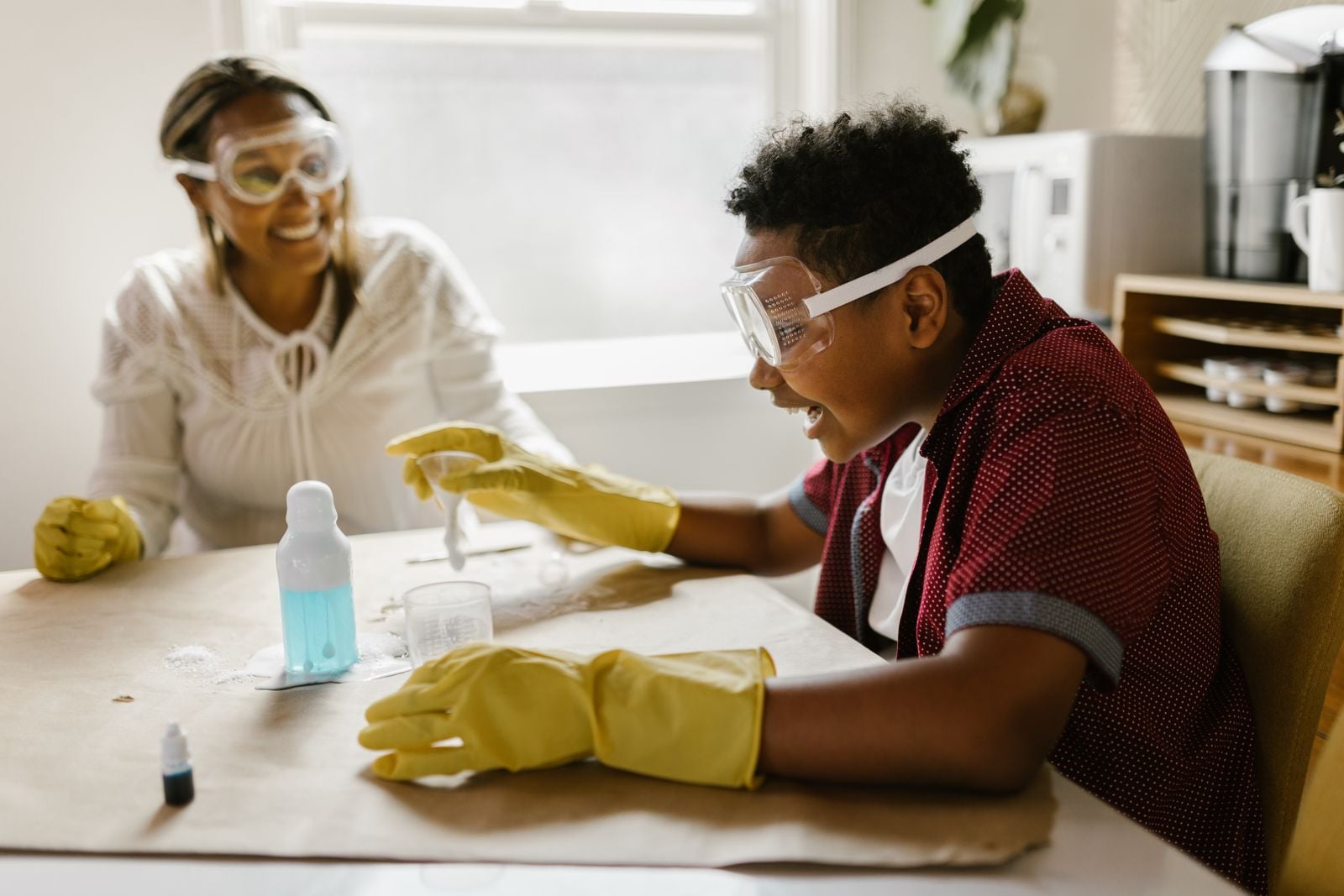
Tip a spoonful of baking soda into the bottom of a paper-mache cone, add a splash of white vinegar, and within a second or two the mound erupts into foam that climbs the sides, spills over the rim, and pools on the tray below. The fizz is carbon dioxide gas, produced by an acid-base reaction that finishes in seconds. It is the same gas that lifts soda bread in the oven and the same gas dissolved in a can of seltzer, only here, on the kitchen table, the bubbles have nowhere to hide.
The kitchen volcano is one of the oldest tricks in the children’s science canon, and it works because the chemistry is fast, visible, and easy to repeat. The American Chemical Society’s middle school curriculum uses this pairing to teach children how changing the amount of a reactant changes the amount of product. Add more baking soda and the reaction can make more gas, but only until the vinegar runs out.
What is actually happening in the foam
Vinegar is a dilute solution of acetic acid in water, usually around 5 percent. Baking soda is sodium bicarbonate, a mild base. Pour one onto the other and the acid transfers a proton to the bicarbonate. The carbonic acid formed during that process is unstable at room temperature and quickly breaks down into water and carbon dioxide.
The Artful Parent
Family-life ideas and sharp reads, in your inbox.
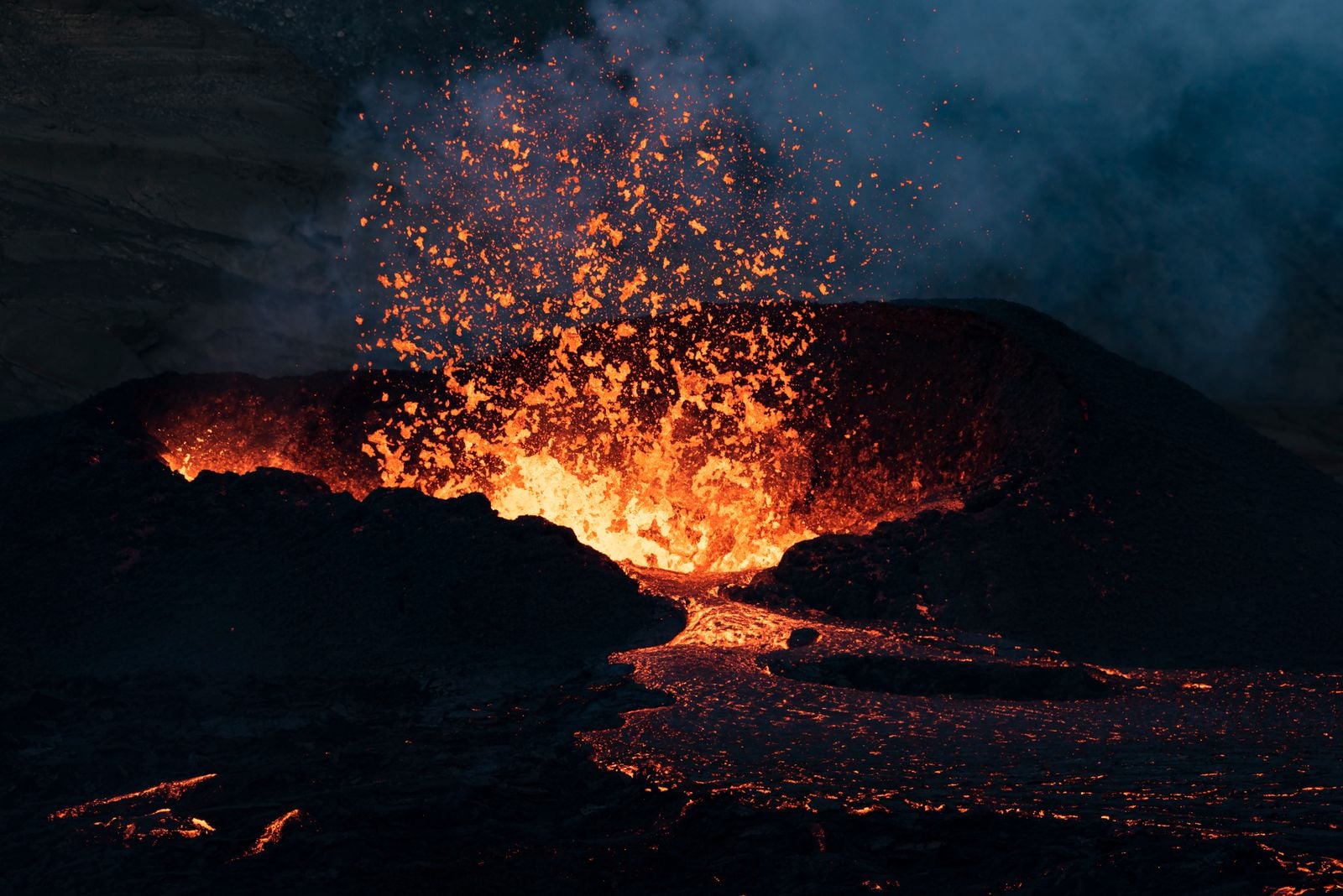
The gas is what you see. Each bubble is a pocket of CO2 pushing its way out of the liquid, surrounded by a thin film containing water and dissolved sodium acetate, the salt produced by the reaction. On a flat plate the bubbles would pop and disperse. Inside a narrow volcano throat they pile up, pull liquid with them, and overflow the crater in a slow-motion boil.
The reaction is endothermic, meaning the mixture absorbs more energy than it releases as the chemical changes take place. Depending on the amounts used, the container can become noticeably cooler. An ACS lesson on energy changes reports a temperature decrease of about 7°C in its classroom setup, although the exact change varies.
The same gas that leavens a quick bread
A biscuit rises for much the same reason a paper-mache volcano foams. Baking powder contains baking soda together with one or more dry acids and a moisture-absorbing ingredient, often cornstarch, that helps keep the components apart until liquid arrives. Once the batter is wet, the acid and base begin producing carbon dioxide.
Baking soda by itself needs an acidic ingredient added by the cook, such as buttermilk, yogurt, molasses, lemon juice, or natural cocoa. Baking powder brings its own acid. Discover Magazine explains that this difference is why the two products are not interchangeable scoop for scoop. A careless one-for-one substitution can leave excess base in the batter and produce an unpleasant alkaline taste.
The bubbles in a scone and the bubbles in a volcano are chemically identical. In the oven they become trapped inside a stiffening network of starch and proteins, allowing the bread to hold its expanded shape. On an open tray, they escape into the air.
Why more baking soda does not always mean more fizz
Children often discover the limit within a few tries. Empty a large mound of baking soda into the container and pour on only a splash of vinegar, and much of the powder remains damp and unreacted. The reaction is limited by whichever ingredient runs out first, something chemists describe using the idea of a limiting reactant.
With ordinary 5 percent household vinegar, one part baking soda by weight requires roughly fourteen to fifteen parts vinegar for near-complete neutralization. If there is too much baking soda, unused powder remains. If there is too much vinegar, the leftover liquid remains acidic.
An ABC News chemistry explainer describes the products as water, sodium acetate, and carbon dioxide. It also notes that many popular cleaning recipes use a large excess of one ingredient, so the mixture left after the fizz stops is not necessarily a perfectly neutral solution.
This matters before scaling up a volcano for a birthday party. Doubling only the baking soda does not double the gas if the vinegar is already exhausted. Increasing both ingredients in approximately the same reacting ratio can produce roughly twice as much carbon dioxide, provided the container has enough room for the resulting foam.
Tricks that make the eruption more dramatic
The underlying reaction is fixed by chemistry, but the presentation is largely an engineering problem. A few adjustments can make the same amount of gas look far more impressive.
Dish soap. A small squirt of dish detergent traps the escaping CO2 inside longer-lasting bubbles. Instead of a quick fizz that flattens almost immediately, the foam holds together and climbs. Surfactants in the soap help stabilize the thin films of liquid surrounding each gas pocket.
Warm vinegar. A modest increase in temperature can make this reaction proceed faster. Vinegar warmed gently to around body temperature usually produces gas more quickly than very cool vinegar. Use warm rather than hot liquid, and let an adult control any warming step.
Food coloring. The dye does not alter the reaction, but red or orange coloring turns white foam into something that reads as lava in photographs and videos. Add only a few drops, since concentrated food coloring can stain clothing and porous surfaces.
A narrow neck. Volcano cones and bottles make the eruption look larger by directing foam upward. The same reaction spread across a wide bowl may look unimpressive. Inside a narrow opening, the bubbles accumulate and push the liquid above them toward the top.
Why this reaction is safer than flame-based demonstrations
A household vinegar-and-baking-soda volcano is low-risk compared with demonstrations involving flames, concentrated chemicals, or flammable fuels. Low-risk does not mean precaution-free. The American Chemical Society’s family experiment guidance says vinegar and baking soda may sting skin and eyes and recommends adult supervision, properly fitting safety goggles, and gloves when pouring vinegar.
The reaction should also remain open to the air. Carbon dioxide can build pressure inside a sealed container, so a rigid bottle or jar should never be capped during the experiment. The ordinary volcano setup needs no flame and contains no flammable fuel, but spills should still be wiped up and hands washed afterward.
Those precautions sit in a very different risk category from demonstrations involving alcohol. On May 13, 2026, a 15-year-old at Greeneview High School in Ohio was flown to a hospital after an ethanol-related classroom experiment caught fire. The student suffered burns over roughly half her body, according to local reporting from WHIO.
The baking-soda volcano offers visible, chemically real change without introducing a flame. With eye protection, adult supervision, small quantities, and an open container, it is a much more suitable way for young children to observe gas formation.
What the volcano teaches that a video cannot
A child watching a video of a fizzing volcano sees the eruption. A child pouring the vinegar hears the hiss begin before the foam appears, smells the sharp vinegar, feels the container cool, and notices what happens when more baking soda is added to a puddle whose acid has already been used up. Very little happens, and that failed attempt becomes part of the lesson.
This is the argument for process-led kitchen chemistry over a demonstration that an adult performs once. The child can change one variable at a time. Add a little more soap and observe the foam. Compare cool and warm vinegar. Change the amount of baking soda while keeping the vinegar constant. Each round offers feedback within seconds.
A related kind of hands-on discovery appears in homemade slime, where changes at the molecular level turn separate liquid ingredients into a stretchy material. In both activities, the visible result is not a screen effect or a trick. It comes directly from what the materials are doing.
The cleaning-hack myth, briefly
Somewhere along the way, the baking-soda volcano was repurposed as a green cleaning tip. Pour vinegar over baking soda in a clogged drain, the internet says, and the fizz will remove grease. The bubbling can sometimes help loosen material mechanically, but the acid and base also neutralize much of each other’s useful cleaning chemistry.
Once the reaction is finished, the liquid contains water, sodium acetate, and whichever reactant was added in excess. For mineral deposits such as limescale, vinegar is generally more useful before it has been neutralized. For scrubbing, dry or damp baking soda can provide mild abrasion. The spectacular foam should not be mistaken for proof that the resulting mixture is a powerful all-purpose cleaner.
That does not diminish the volcano. It was never supposed to clean the sink. It was supposed to make a child stop, watch, and ask why.
A note on doing this with a two-year-old
Experiments with very young children move quickly. There may be fifteen seconds of foam, then a puddle, then an immediate request to do it again. Many toddlers engage most comfortably in short bursts, which makes a reaction that can be repeated in under a minute easier to explore than a long demonstration with several waiting stages.
Place the volcano inside a deep tray on the floor or a stable low table. Give the child a tablespoon and a small cup containing only the vinegar needed for one round, while an adult keeps control of the main bottle. Use safety goggles, prevent tasting, and help with every pour.
The residue will usually contain water, sodium acetate, dish soap, food coloring, and some leftover vinegar or baking soda if the proportions were not exact. Wipe it up promptly, especially on wood, fabric, grout, or other surfaces that may stain.
What lingers after the foam is gone
Wait a few minutes and the tray goes quiet. The foam collapses into a shallow puddle of tinted liquid. The volcano cone, if it was made from paper-mache, may be soggy at the base. Dissolved among the leftovers is sodium acetate, the same salt used in some reusable hand warmers.
Those hand warmers release heat when a supersaturated sodium acetate solution crystallizes after the metal disc is clicked. It is a different process rather than a repeat of the vinegar reaction, but it involves the same compound in another form.
Pour the diluted mixture down the drain with plenty of water, rinse the tray, and the whole event leaves little behind beyond a vinegary smell and, if the timing was right, a child who now knows that a spoonful of white powder and a splash of clear liquid can look, for a few seconds, like the inside of a mountain.