
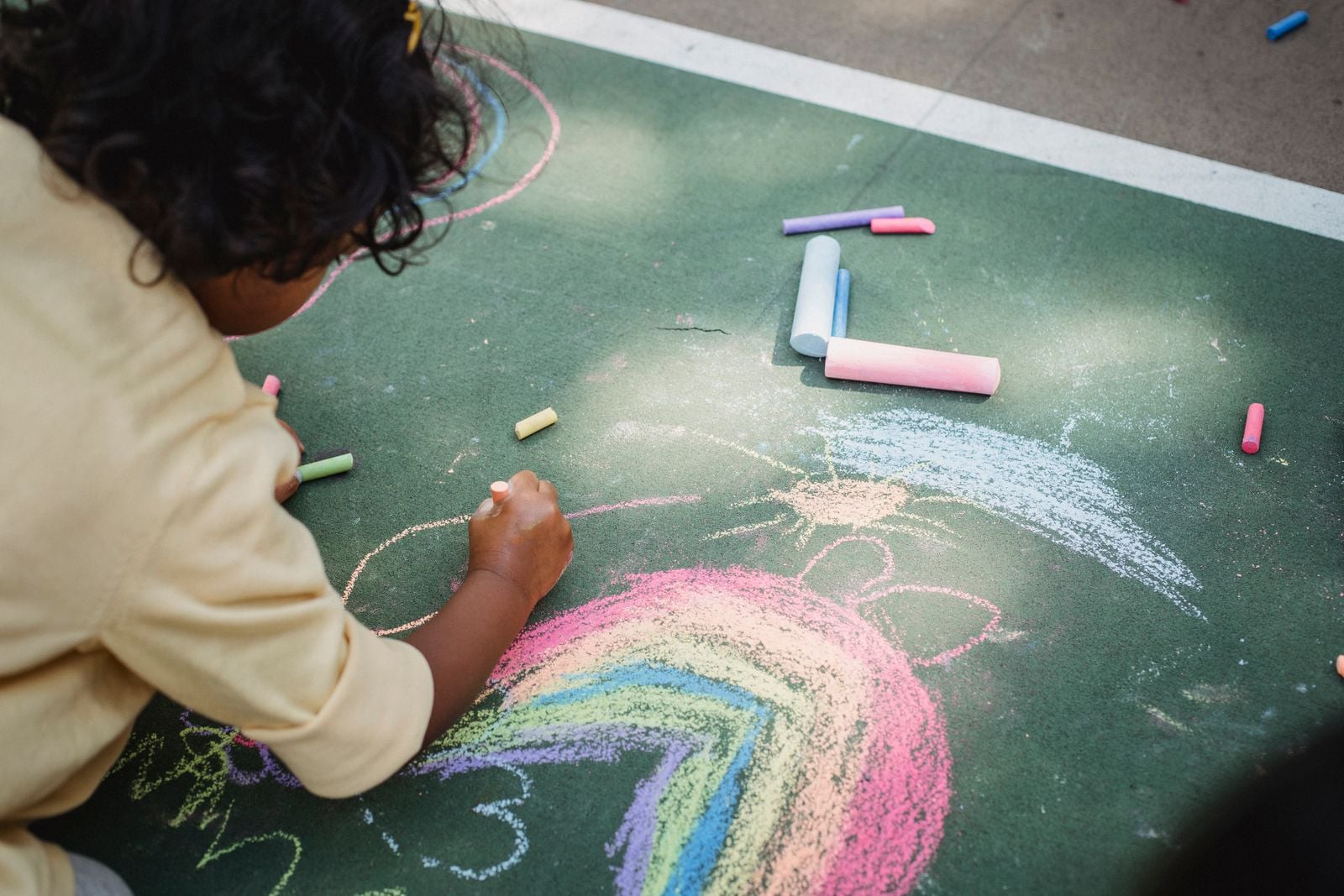
Chalk pastels are close to what artists call a raw pigment stick. A little dry pigment, a small amount of chalk or clay filler, and the barest whisper of a binder pressed together into a soft cylinder — that is the whole recipe. When a child drags a stick of soft pastel across black paper and then smudges it with a fingertip, the mark spreads and blooms because there is almost nothing holding the pigment particles to each other. The finger crushes the loose calcium carbonate and pigment grains, and they fan out across the tooth of the paper in a way no brush can copy.
That is the whole magic of the medium, and it is why a four-year-old with a set of $8 chalk pastels can produce a smoky sunset on their first try.
What is actually in the stick
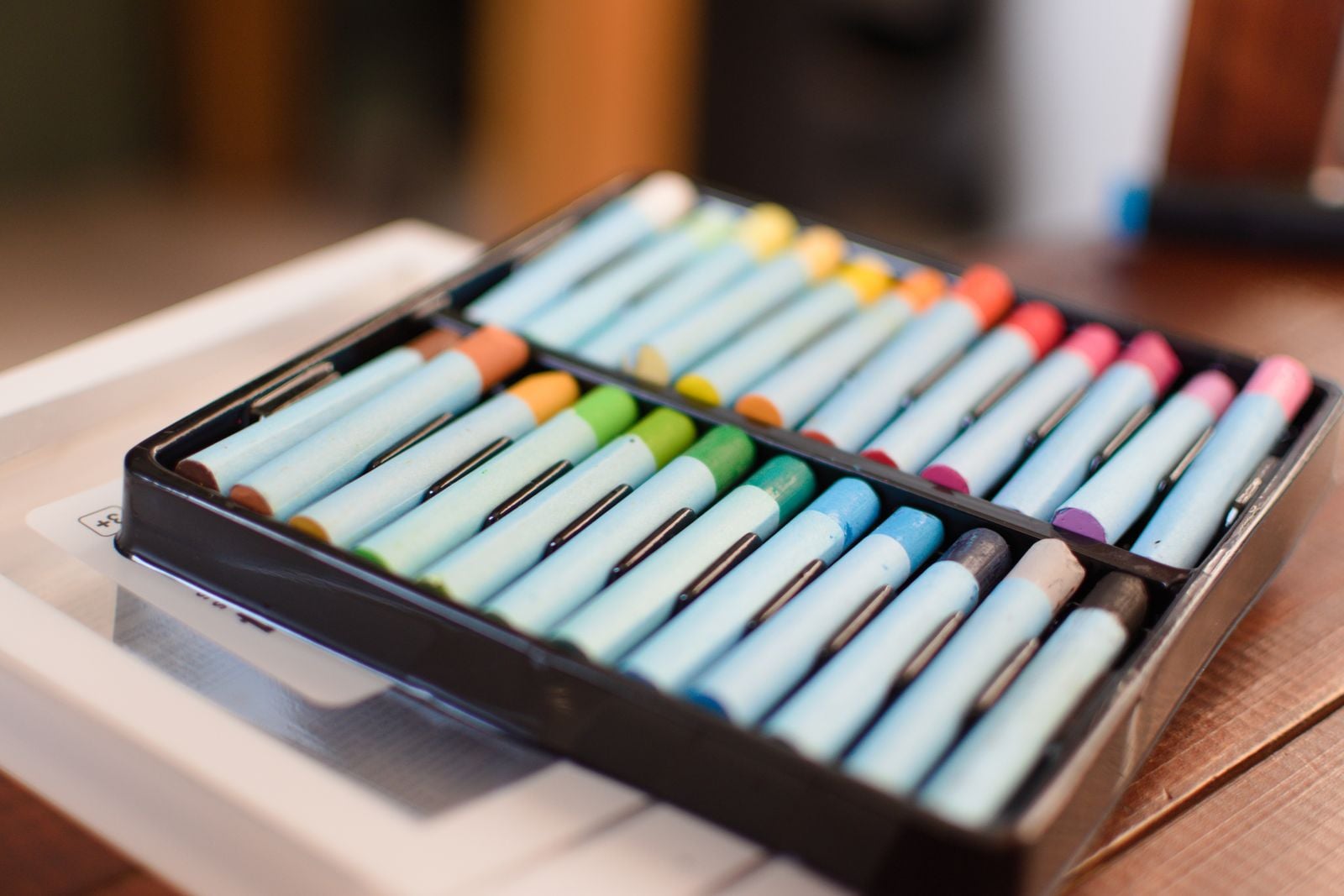
Pastels are made by mixing dry pigment, some chalk, and a binder together. The proportions are what set soft pastels apart from every other stick-shaped drawing material a kid might pick up.
The Artful Parent
Family-life ideas and sharp reads, in your inbox.
Sidewalk chalk is mostly calcium carbonate — the same stuff as limestone and eggshells — mixed with silt and clay. Chalk is white or light in color and considerably harder than pastel. Some chalk gets folded into pastel sticks to lighten a tint, but the pigment load is what does the work.
A soft pastel is closer to compressed powder than to a crayon. Crayons are pigment suspended in wax. Coloured pencils are pigment bound in a stiff wax-and-clay core. Oil pastels are pigment bound in non-drying oil. Soft pastels have gum tragacanth or methylcellulose in vanishingly small amounts — just enough to keep the stick from crumbling in the box. That is why a pastel leaves a mark on paper that behaves almost like dust, because that is almost exactly what it is.
Why the finger works better than the brush
The blending trick is a story about particle size. In pigment science, the width and shape of the particle-size distribution — how many big grains, how many fine ones, how uniform — controls how a colour reads on a surface. Narrower, finer particle distributions produce stronger, more even color, while broader distributions reduce color strength.
A pastel stick contains a range of particle sizes by design. When a fingertip presses on freshly laid pastel, the pressure crushes the larger aggregates into finer fragments, and those finer fragments settle into the microscopic pits of the paper’s tooth. A brush cannot do this. A brush glides over the top layer, moves some grains sideways, and often lifts pigment right off the sheet. A finger has warmth, moisture, and pressure — three things that push chalk pigment down into the paper instead of across it.
This is also why pastel drawings smudge if you breathe on them wrong. There is no film of dried binder locking the pigment in place. The mark is mechanical: grains wedged into fibres.
Binders — the invisible variable in almost every art material
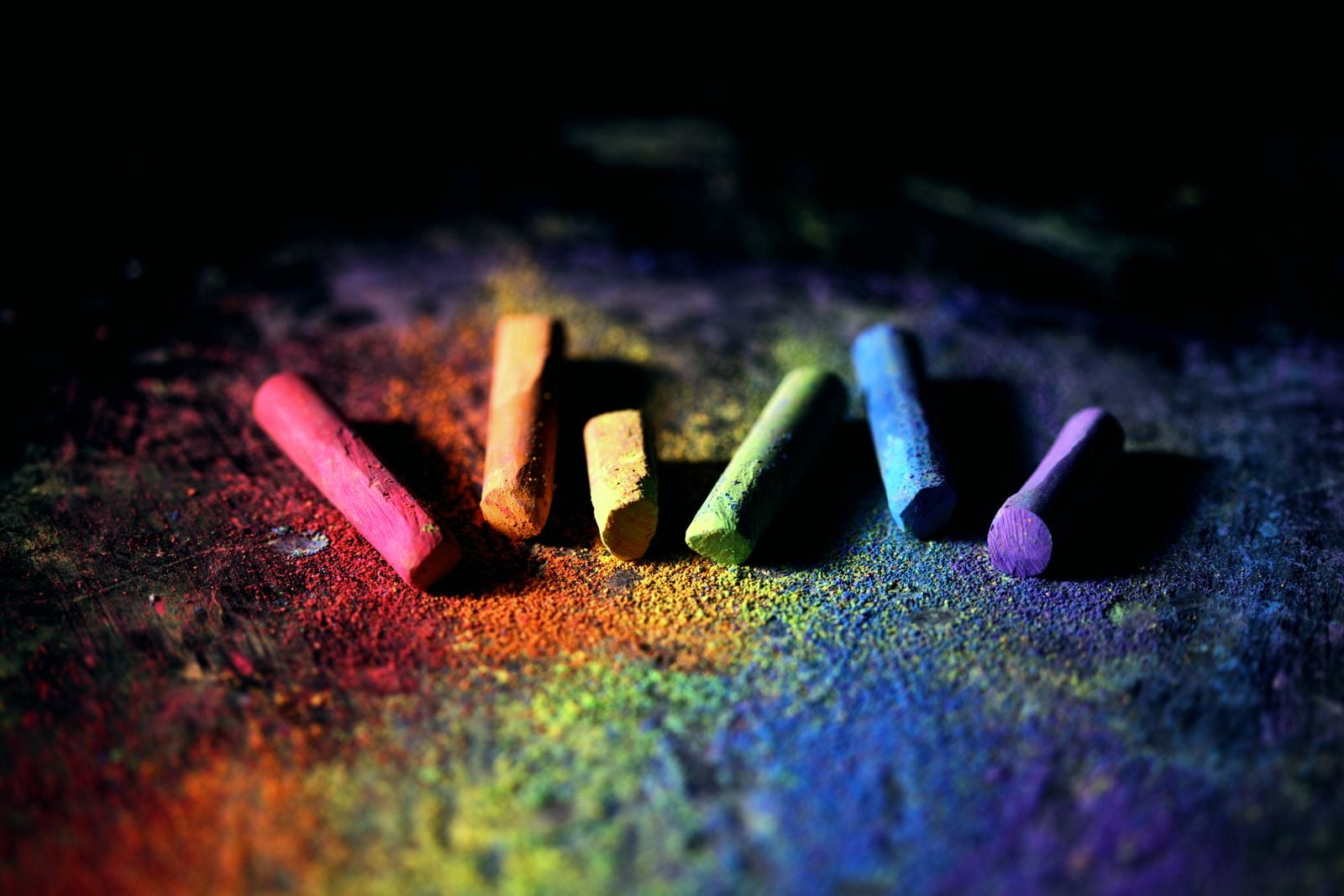
Every traditional art material can be described by the ratio of pigment to binder. Watercolour is heavy on gum arabic. Oil paint is heavy on linseed oil. Gouache adds chalk to watercolour for opacity. Tempera uses egg yolk. The binder decides how the mark behaves once it dries.
Conservation scientists have spent decades trying to identify binders in old paintings because the binder — not just the pigment — is what tells you how a work was made. The ratio of binder to filler determines whether a paint layer cracks, flexes, or holds pigment tight across centuries.
Researchers at the National Gallery in London used chemical imaging to identify egg and oil binders in Renaissance panels, an approach described by Chemistry World’s coverage of Renaissance artwork analysis.
All of this science exists because the binder is doing the structural work. In a pastel, that work is barely being done at all. Which is exactly what makes pastels feel so responsive under a child’s hand.
Why dark paper changes the game
Soft pastel on black or deep-blue paper is one of the most reliably magical experiences you can hand a small child. The reason is pigment load. Because a pastel is almost pure pigment, colours land opaque and bright even on a dark surface. Crayon, watercolour, and marker all rely on the white of the paper to make their colours read. Soft pastels bring their own light.
A pale-yellow pastel on black paper looks like a moon. A stroke of coral pink looks like a jet trail at sunset. There is no muddy transitional colour phase, the way there is with watercolour, where a child’s careful pink turns to grey the moment it meets a wet edge.
This is a small, cheap, ordinary art supply behaving like a light source. And the reason is not the design of the stick — it is the near-absence of anything in the stick except the pigment itself.
What the smudging teaches small hands
The pinch-and-drag motion a child uses to blend a chalk pastel — thumb pressed to one edge of a mark, index finger sweeping across — is a piece of fine motor development wearing the disguise of fun. Tactile inputs support sensory integration and fine motor skill development. Products marketed for exactly this purpose — the buckles, zippers, latches, and textured surfaces that appear on tactile pillows designed to help kids ages 3 to 7 develop fine motor skills and hand-eye coordination — trade on the same underlying idea: small, resistant materials in the hands build the pincer grip and the intrinsic hand muscles that later hold a pencil.
A pastel stick is a piece of that same curriculum, hidden inside an art supply. It resists in one direction, crumbles in another, dusts the fingers, and rewards varied pressure with visibly different marks. Parenting coverage of early sensory play, including Indy100’s roundup of toddler gifts, tends to lean on the same principle — young children learn through their fingertips, and the materials that give the richest tactile feedback tend to give the richest developmental return.
Where pastels sit in a larger family of process-art materials
Soft pastels belong to a small group of art materials whose behavior is best understood as physics rather than as technique. When a child squeezes a fistful of cornstarch and water, the long starch chains jam together and behave like a solid, then drip through their fingers like cream the instant the pressure eases. When a preschooler sprinkles salt onto a damp watercolour wash, the crystals disturb the drying paint and leave pale starbursts that change with timing, grain size, and colour.
Chalk pastels sit inside the same family. The child is not learning to render. The child is discovering that a material has properties, that pressure and angle and moisture change what the material does, and that the result is unpredictable in ways that are interesting rather than frustrating.
In process art, the medium matters more than the product. If the medium is too controlled — a fine-liner pen, a rigid coloured pencil — the child is stuck making representational marks or feeling like they have failed. If the medium is too chaotic — thin ink, watery paint on absorbent paper — the child cannot influence the result at all. Pastels sit in the middle. They respond to pressure. They respond to blending. They respond to layering. They accept correction if you brush them off. And they leave the child’s fingerprints — literally — in the artwork.
Practical notes from the kitchen table
A few things that follow from the physics.
Toothed paper matters. Smooth printer paper cannot hold pastel dust in its fibres, and the mark slides. Sugar paper, construction paper, and dedicated pastel paper all have enough surface texture to grip the pigment. Black or navy paper turns a set of ordinary pastels into a fireworks kit.
Fingers work better than tools. Blending stumps and soft rags exist, but a child’s fingertip has moisture and warmth that a paper stump does not. This also means pastel dust ends up on hands, cheeks, clothes, and — reliably — one nostril. A damp cloth deals with the mess in about eight seconds.
Fixative is optional. Adult pastel artists spray finished work with a light fixative to lock the dust down. For most kid drawings, a sheet of parchment or copy paper laid on top before storage is enough. Fixative can dull the intensity of a mark, which is the exact quality that made the child gasp when it went down.
Cheap sets are fine. Professional pastels (Sennelier, Schmincke, Unison) contain more pigment and less filler and cost a small fortune per stick. For a four-year-old learning that dragging yellow across blue makes green appear, a $10 box of student-grade soft pastels does everything the physics requires.
The thumbprint in the corner
Look closely at a chalk pastel drawing made by a small child and you can often see the ridges of their fingertip pressed into a smudge of colour. The pigment records the whorls of a hand that is still growing. There is no other art material that leaves a trace of the child’s actual skin inside the picture — not paint, not crayon, not marker.
The absence of binder is what makes this possible. A material with almost nothing holding it together will hold, briefly, the shape of whatever pressed on it last. In this case, that is a small hand learning what its own fingers can do.