
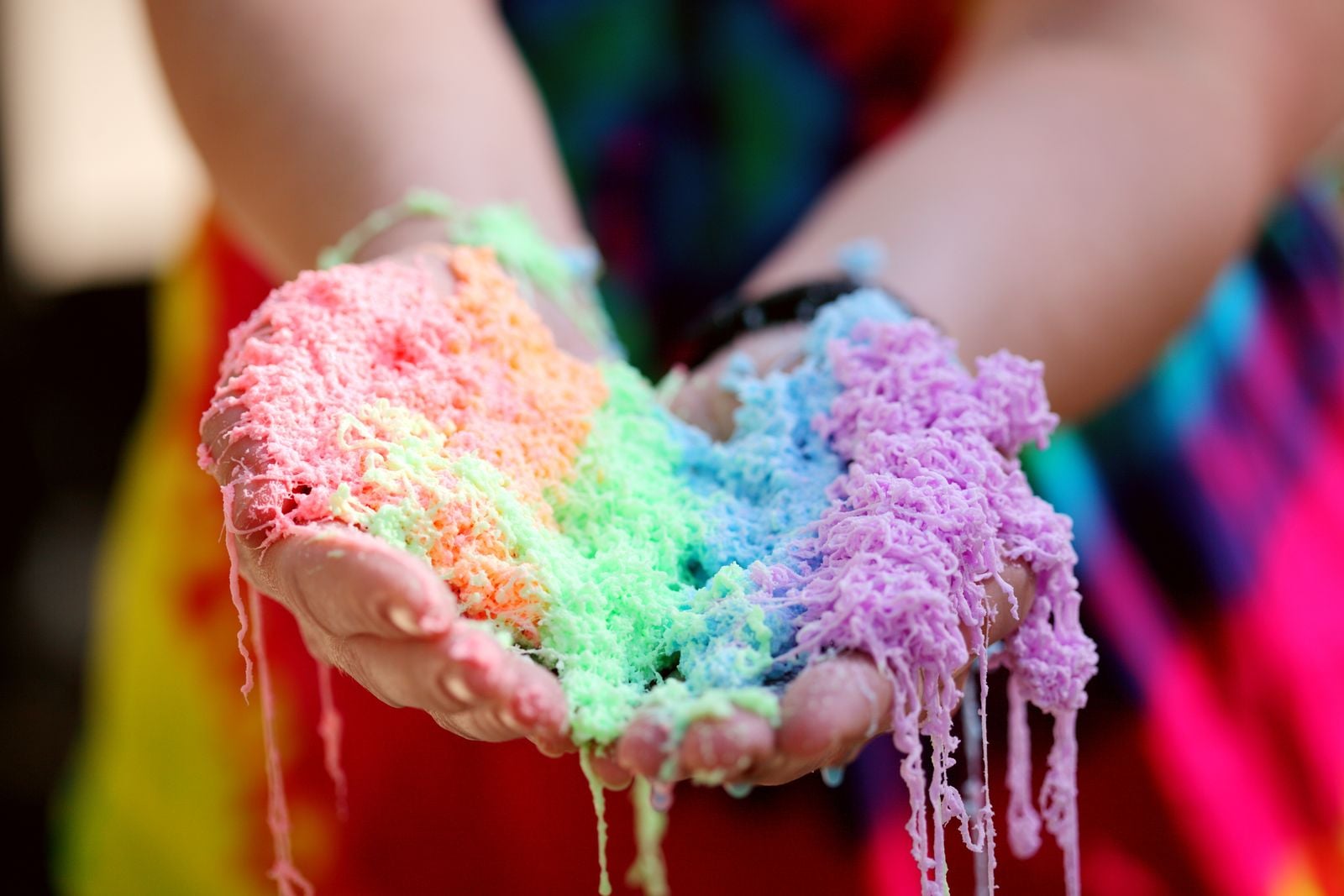
Stir a cup of cornstarch into half a cup of water on a kitchen counter and the mixture will pour off a spoon like heavy cream. Punch it, and your fist bounces. Slap it hard enough and the surface fractures like a cracker. Let your hand rest on that same puddle for three seconds and it swallows your fingers to the knuckle. The material has not changed. What changed is how fast you asked it to move.
This is oobleck, named after the sticky green precipitation in the Dr. Seuss book Bartholomew and the Oobleck. Chemists call it a shear-thickening fluid. It is one of the only substances a child can make in a mixing bowl that visibly breaks the rules most liquids follow.
The rule oobleck breaks
Water is a Newtonian fluid. So is olive oil, so is gasoline. Push them fast or push them slow and they resist you by the same proportional amount. Double the force, double the flow. That linear relationship is what Isaac Newton described, and it holds for almost every liquid a person encounters in a day.
The Artful Parent
Family-life ideas and sharp reads, in your inbox.
Cornstarch-and-water does not obey it. The faster you shear the mixture — the faster one layer of it slides past another — the more it resists. Past a certain speed, the resistance climbs so sharply that the fluid behaves, for a fraction of a second, like a solid slab. Physicists call the sharpest version of this effect Discontinuous Shear Thickening.
The Complex Flow Lab at Swansea University filmed the moment a corn-starch slurry stops flowing and starts cracking. Researchers there put the mixture in a narrow cell, forced pressurised air through it, and captured the invasion pattern with a high-speed camera. At low pressures, the air pushed through in wide finger shapes, the way it would through any thick liquid. At high pressures, the same slurry fractured — narrow, brittle cracks, the signature of a solid.
Same bowl. Same recipe. Two different materials, chosen by how hard you hit it.
What is actually happening between the grains
Cornstarch is not dissolved in the water. It is suspended in it. Each grain is small — about a fifth the width of a human hair — and a well-mixed bowl of oobleck is roughly half grain by volume, packed almost as tightly as the water will allow.
When you stir gently, a thin film of water coats every grain and lets them slide past one another. There is no direct contact. There is no friction. The mixture behaves like a slightly gritty cream.
Push harder and something changes at the scale of the grains themselves. In 2011, physicists Xiang Cheng and Itai Cohen at Cornell used high-speed 3-D microscopy to watch micron-sized particles inside a shearing suspension in real time. They saw that fast shear does not simply organise particles into tidy lanes, as an older theory had proposed. Instead it drives them together into clusters: particles get pushed past one another faster than the surrounding fluid can drain out of the way, so they move as a single locked mass rather than sliding freely.
Cohen’s group later ran a follow-up experiment to test what was doing the locking. They spun a cone in a dish of the fluid, measured the torque, and then suddenly reversed the spin. If clustering held together only by the fluid caused the thickening, the torque should stay high after the reversal. If friction between touching grains caused it, the grains should pop apart the instant the direction flipped, and the torque should collapse. The torque collapsed. The grains had been in direct, frictional contact.
The Swansea lab research showed that friction in cornstarch can be turned on or off like a switch. Gentle disturbance and the grains repel each other. They never touch. Forceful disturbance and they are shoved into contact, at which point sliding stops and the material behaves like a brittle solid.
The material only exists while you are touching it
Here is the strange part, and the part children pick up on instantly. The solid does not persist. The moment the force stops, the grains fall out of contact, the water film re-coats each one, and the whole cluster drips back into liquid within a heartbeat.
You cannot store oobleck’s solid form. You cannot save a slab of it. The material’s stiffness lives entirely inside the act of pushing on it, and vanishes when you let go. A punched puddle heals in less than a second. A fist withdrawn from the bowl comes out streaming pale ropes back into the surface. The solid was never a state the material occupied. It was a response the material gave.
This is why running across a swimming pool of the stuff works. Each footfall stays in contact with the surface for only a fraction of a second, which is enough time to jam the grains, launch off them, and lift the foot before the water has drained back and the surface has forgotten. Stop moving and you sink to your ankles like a slow bath.
Why the kitchen ratio matters
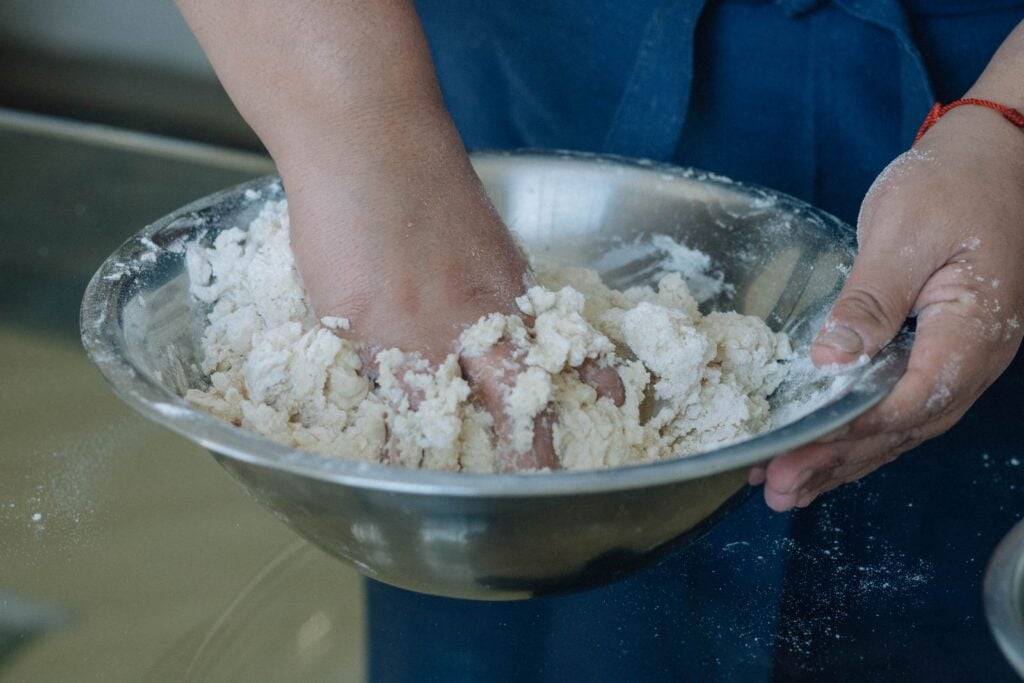
The classic recipe is roughly two parts cornstarch to one part water by volume. That ratio is not arbitrary. Below it, there is too much water between the grains and they never get pushed into contact — the mixture stays a thin slurry no matter how hard you hit it. Above it, there is not enough water to lubricate the grains at rest, and the bowl seizes up into a dry paste that will not flow at all.
The window between those two failures is narrow. When Science Friday’s education team published its home fluid-physics experiment, the instructions kept to a fixed two-to-one ratio of starch to water and told experimenters to measure by parts, because too much water tips the whole bowl out of the shear-thickening range. Corn flour and potato starch behave similarly. Table sugar, salt, and flour do not — their grains are the wrong shape and wrong size to jam.
Temperature matters a little. Time matters more. Left sitting on the counter, oobleck slowly separates: the denser starch grains sink, a layer of clear water rises. A quick re-stir brings it back. Left overnight in an uncovered bowl, the water evaporates and you are left with a chalky disc at the bottom that cracks when you touch it — which is, in a sense, the same fluid caught in its solid response with nothing to relax back into.
What children learn by squeezing it
A child pressing oobleck between their palms is running the same experiment as the Cornell physicists, only without instruments. Slow squeeze — the mixture oozes out between their fingers in pale strands. Fast squeeze — it forms a ball for the length of the squeeze, then collapses. Roll it quickly on a tabletop and it holds the shape of a sphere until the moment it stops moving, at which point it flattens into a coin of liquid.
What the hand is teaching itself, over and over, is that force and time are the same variable. Push slowly and material yields. Push quickly and material resists. Most substances do not make that distinction visible on the timescale of a human touch. Wood always feels hard. Honey always feels slow. Oobleck flips between the two responses inside a single hand movement, which is why children keep going back to it after the novelty of any other kitchen mixture has worn off.
Process-art play works, in part, because it lets a child run these tiny physical investigations without a right answer waiting at the end. The material gives the feedback. The Science Friday radio segment on oobleck opened by describing it as a common classroom demonstration that seems to defy the rules of physics — a reminder that this is one of the rare cases where the physics of a professional research lab is fully accessible to a five-year-old with a mixing bowl. The grain-scale mechanism captured under a Cornell microscope is the same mechanism operating under the child’s thumb.
Where the physics goes next
Understanding shear thickening is not only a kitchen curiosity. In 2021, researchers at North Carolina State University and Northeastern University captured detailed 3-D images of the particle networks that form during shear thickening, using a confocal rheometer that let them see through a flowing suspension while it stiffened. Their images showed the space-spanning contact networks that appear as particles are driven together, locking up the fluid, and how smooth and rough grains pack differently once that happens.
The applications the field is chasing are practical. Cement has to flow into a mould without seizing under the pump — so cement chemists work hard to keep their mixtures from shear-thickening. Paint has to roll off a brush without clumping — same problem, opposite sign. Meanwhile, shear-thickening fluids are being layered into soft body armour, so that a stab or a bullet fragment triggers the jamming response and spreads the force across the fabric. Chemical engineer Norman Wagner at the University of Delaware has a NASA-funded project developing spacesuits with a cornstarch-like fluid layered inside, so that a micrometeorite hitting the suit at kilometres per second finds a wall of instantly-jammed particles waiting for it, while an astronaut moving an arm feels only soft fabric.
It is one of the only kitchen experiments where the same physics the engineers are solving at Delaware turns up unaltered in a plastic tray on a picnic blanket.
The heartbeat of the fluid
What lingers, after the mess is cleaned up and the pale film has been washed off the counter, is the sense that a material can be conditional. Oobleck is not a solid that sometimes flows. It is not a liquid that sometimes hardens. It is a fluid whose stiffness is a live reply to whatever the world is currently doing to it — a response that begins the instant a finger touches it and dies the instant the finger lifts.
Every impact against the bowl is answered, briefly, by a grain-locked wall that lasts a few thousandths of a second and then dissolves back into cream. Rest a palm on the surface and the same wall never forms. The material is, in some small way, listening.