
Your granddaughter runs into the kitchen holding a painting she’s just finished, mostly purple, still wet. Before she’s said a word, you’re grinning at her grin.
Moments like this can make you curious about the grandparent bond. In 2021, researchers at Emory University compared how grandmothers’ brains responded to photographs of their grandchildren and familiar adults.
What the Emory study found
In a 2021 study in Proceedings of the Royal Society B, James Rilling and colleagues used fMRI to scan 50 grandmothers. Each had a biological grandchild aged 3 to 12. Women with several eligible grandchildren chose the one they felt closest to.
The Artful Parent
Family-life ideas and sharp reads, in your inbox.
They viewed photographs of that grandchild, an unfamiliar child, a familiar adult, and an unfamiliar adult, while trying to share the pictured person’s emotions. The familiar adult was usually the grandchild’s parent, sometimes another relative. In 32 cases, it was the grandmother’s biological child.
Grandchild photographs prompted stronger responses in regions associated with emotional empathy and movement than familiar-adult photographs. Familiar-adult photographs prompted stronger responses in several other regions, including one associated with understanding others’ perspectives. In Emory’s account, Rilling suggested emotional empathy may help explain grandmothers’ responses to grandchildren.
The scans captured present-day responses to photographs. They couldn’t show how these women responded to their children years earlier, or measure how much they loved anyone. The sample skewed toward healthy, highly involved grandmothers. Grandfathers weren’t studied.
The seven habits below are suggestions from our editorial team. The experiment didn’t test them. Pick one that fits your family and the time you have together.
1. Do something with your hands together
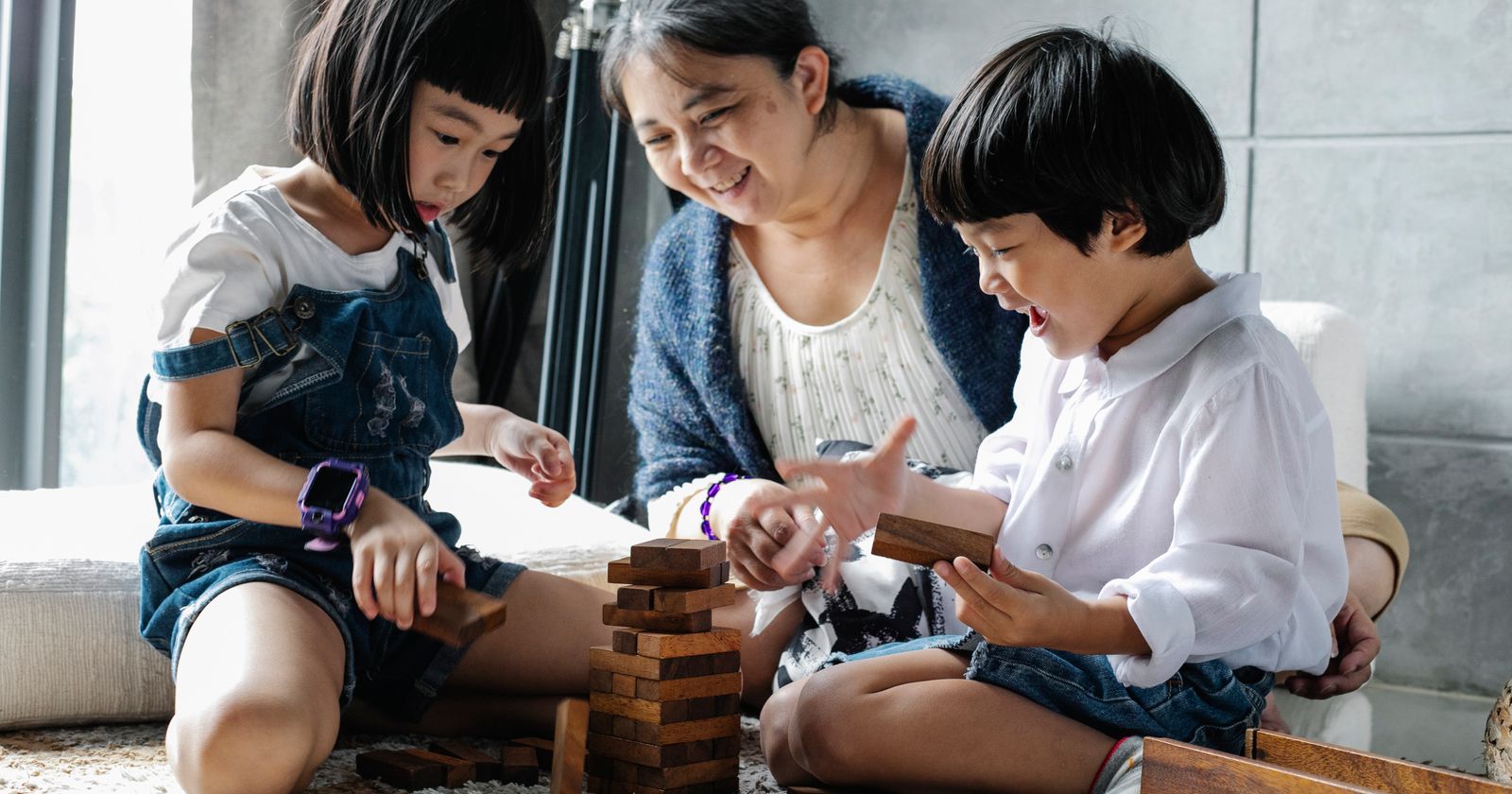
Some of the best grandparent time is side by side, making something. A painting at the kitchen table. A fort in the living room. Cookies that come out lopsided.
Put a few crayons and a sheet of paper on the kitchen table and ask, “What shall we make?” Ten minutes can be enough for a picture and a conversation.
2. Let their feelings land before you fix them
Your grandson’s tower falls over and he’s furious. Your first instinct might be to rebuild it for him, fast.
Try naming it first: “Oh no. You worked so hard on that.” Sometimes that’s all a child needs before they start building again on their own.
Then give them a moment. If they still want help, ask, “Shall I hold the bottom while you build?” They get to decide whether to try again or take a break.
3. Notice when their upset becomes yours
The flip side of feeling a grandchild’s distress is that it can be hard to sit through. A crying grandchild at bedtime can make you want to give in on the third story, the extra cookie, the rule their parents set.
It helps to notice that pull. A calm “I know, it’s hard. It’s still bedtime” can comfort a child and respect their parents’ rules at the same time.
If you find yourself regularly undoing the parents’ decisions because the tears are too hard to watch, that’s worth talking about with the parents, kindly and privately.
4. Let them teach you something
Your granddaughter knows the names of 40 dinosaurs. Your grandson can beat you at a video game you’ve never heard of.
Asking them to show you how something works turns the usual roles around. They get to be the expert, and you get to see what lights them up.
“How did you figure that out?” is a question most children are happy to answer at length.
5. Try to understand their parents, too
Raising young children is often exhausting, and parents may be making choices you don’t fully understand: about screens, food, sleep, or school. Before offering an opinion, try asking, “How’s this week been for you?” and listening to the answer.
A grandparent who understands the parents’ pressures is often easier for those parents to lean on.
6. Ask how you can help, instead of guessing
Offer something you can comfortably manage and check whether it would help. “I can take the kids Saturday morning until noon. Would that give you some time for what you need to do?” Or ask, “Would you like company while you get dinner ready?”
If the answer is “Not right now,” you can say, “Okay, let me know another time.” Agree on any food, sleep, or other routines before a visit so everyone knows what to expect.
7. Keep one small ritual
A Thursday trip to the library. A video call every Sunday at five. The same silly song every time you say goodbye.
Rituals don’t have to be elaborate. Their value is in repeating. A child knows it’s coming, and you both get something to look forward to.
If you live far away, try a postcard every month or a shared drawing you each add to by mail. For video calls, agree on a time that works with the family’s routines and follow the child’s interest. A quick look at their latest drawing might be plenty for that day.
Where to start
You don’t need a brain scan to know how you feel about your grandchildren. And not every grandparent feels the same rush, especially at first or from a distance. Bonds grow with time and attention.
Pick one habit this week. Get out the paints, ask a question about dinosaurs, or call their parents just to ask how they’re doing.