
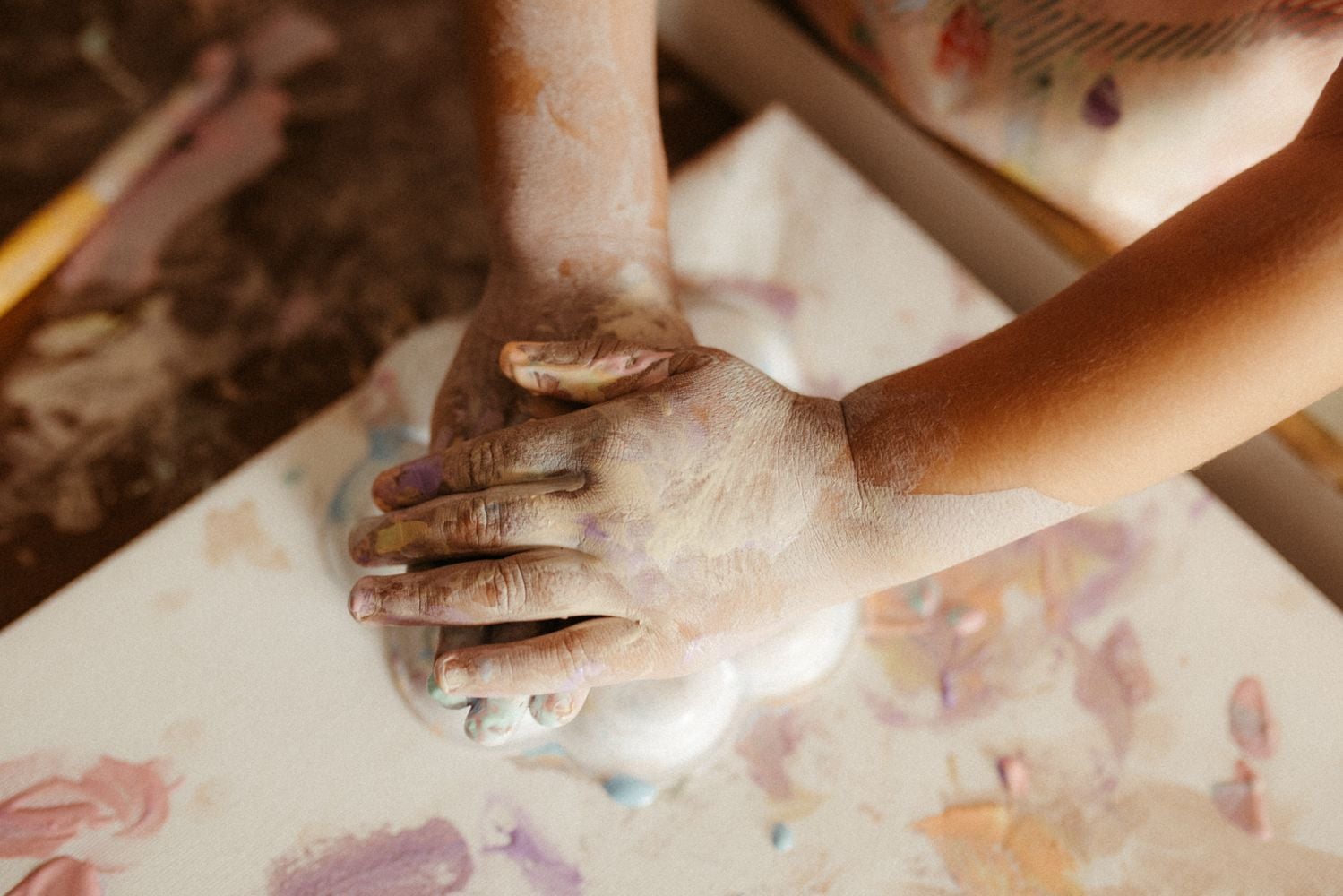
Open almost any article about kids and creativity and the same handful of words show up: STEAM, sensory, developmentally appropriate, brain-boosting, fine motor development. We use some of these words ourselves, carefully, because a few of them describe something real. But it is worth being honest about how much of this vocabulary is doing actual work, and how much of it is filler dressed up as expertise.
Researchers in the field are raising the same concern
We are not the only ones noticing this. A recent paper in the academic journal Contemporary Issues in Early Childhood, by the researchers Anna Günther-Hanssen, Sofie Areljung, Lena Magnusson, and Anna Lindqvist, examined how often early childhood education research itself leans on a specific set of buzzwords, among them innovation, creativity, and problem-solving, without examining what those words actually mean in a given study or classroom. The authors found these terms used recurrently across the literature, largely unchallenged, often standing in for a real explanation of what children are doing or what a given activity is claimed to build.
This is one paper’s analysis of a body of academic writing, not a verdict on every parenting article or classroom program that uses these terms. But it is a useful confirmation from inside the research world of something we have long suspected from the outside: a lot of language in this space sounds precise without actually being precise, and that includes plenty of the writing aimed at parents, not just academic papers.
The Artful Parent
Family-life ideas and sharp reads, in your inbox.
Where “fine motor skills” comes from, and what it can actually support
Take one of the most common phrases in kids-art writing: an activity “develops fine motor skills.” It gets attached to nearly everything, from squeezing playdough to threading beads to holding a paintbrush, often with no more explanation than the phrase itself.
There is real research behind part of this claim. A 2018 study in the Journal of Physical Therapy Science, involving 52 preschool-age children, found a meaningful correlation between measured fine motor precision, manual dexterity, and in-hand manipulation skills on one hand, and handwriting legibility on the other. Children who scored better on these specific motor tasks tended to write more legibly.
This is one study, with a modest sample, measuring a specific and narrow outcome, handwriting legibility, against specific and narrow motor tasks. It is not a study of art activities themselves, and it does not measure whether doing more art at home improves these particular skills over time. What it supports is something narrower and more honest than “this craft develops fine motor skills”: children’s existing fine motor precision is meaningfully related to how legibly they write, and activities that ask a child to grip, squeeze, cut, or manipulate small materials give them a chance to practice movements that plausibly overlap with those skills. That is a reasonable, modest claim. It is a different claim from promising that any specific activity builds or develops anything in a measurable, lasting way.
The same paper raised a second concern worth sitting with: STEAM and its associated buzzwords are often presented as automatically inclusive, as though labeling an activity STEAM guarantees every child benefits equally, without much research actually examining whether that holds up across differences in gender, background, or access to materials. The researchers were not arguing that STEAM-labeled activities are harmful. They were pointing out that a label doing this much promotional work deserves more scrutiny than it usually gets, from the people writing about it and the people reading about it.
“Sensory” has the same problem
The word sensory shows up constantly in kids-activity writing, usually attached to anything involving texture, water, sand, or goo. Used literally, it is accurate: a bin of dried rice genuinely engages a child’s sense of touch. Used as a label meant to signal developmental seriousness, sensory play with special equipment or a curated bin, it starts to do the same work as fine motor development or STEAM: sounding like evidence where there often is not much evidence attached to that specific activity at all. A child exploring textures with their hands is having a sensory experience in the plain sense of the word. That is worth saying directly, rather than reaching for the word as a badge.
Why the vaguer version of the claim spreads anyway
Part of the appeal of phrases like fine motor development, sensory play, and STEAM is that they sound like they are backed by something solid, even when the actual research behind any specific activity is thin or nonexistent. A phrase that sounds scientific gives a parent permission to feel good about an activity beyond simply enjoying it with their child. That is an understandable instinct. It is also exactly the pattern the Contemporary Issues in Early Childhood researchers flagged: a term repeated so often that it stops getting questioned, even by people who study this professionally.
What we try to do instead
In our own writing, we try to say what an activity actually asks a child’s hands and attention to do, rather than reaching for a label. A child squeezing and rolling playdough is practicing grip strength and hand control, which is a real, plausible side effect worth naming honestly. That is different from promising it builds fine motor skills, as though one session of playdough produces a measurable, lasting developmental gain.
The same goes for STEAM. If an activity genuinely involves a science idea, a bit of engineering thinking, or real math, we would rather say what that idea is, plainly, than slap a label on a craft and call it STEAM because it technically involves counting out five buttons.
What this does not mean
None of this means these activities are not worth doing, or that a parent needs a peer-reviewed citation before letting a toddler play with playdough. Children do not need an activity to be developmentally optimized to be worth their time. The making, the mess, and the time spent together are enough on their own. Cutting the jargon is not about adding more caution to an already anxious parenting culture. It is closer to the opposite: it means we can drop the pretense that every activity needs a scientific justification, and just say plainly what is actually happening when a child sits down to make something.