
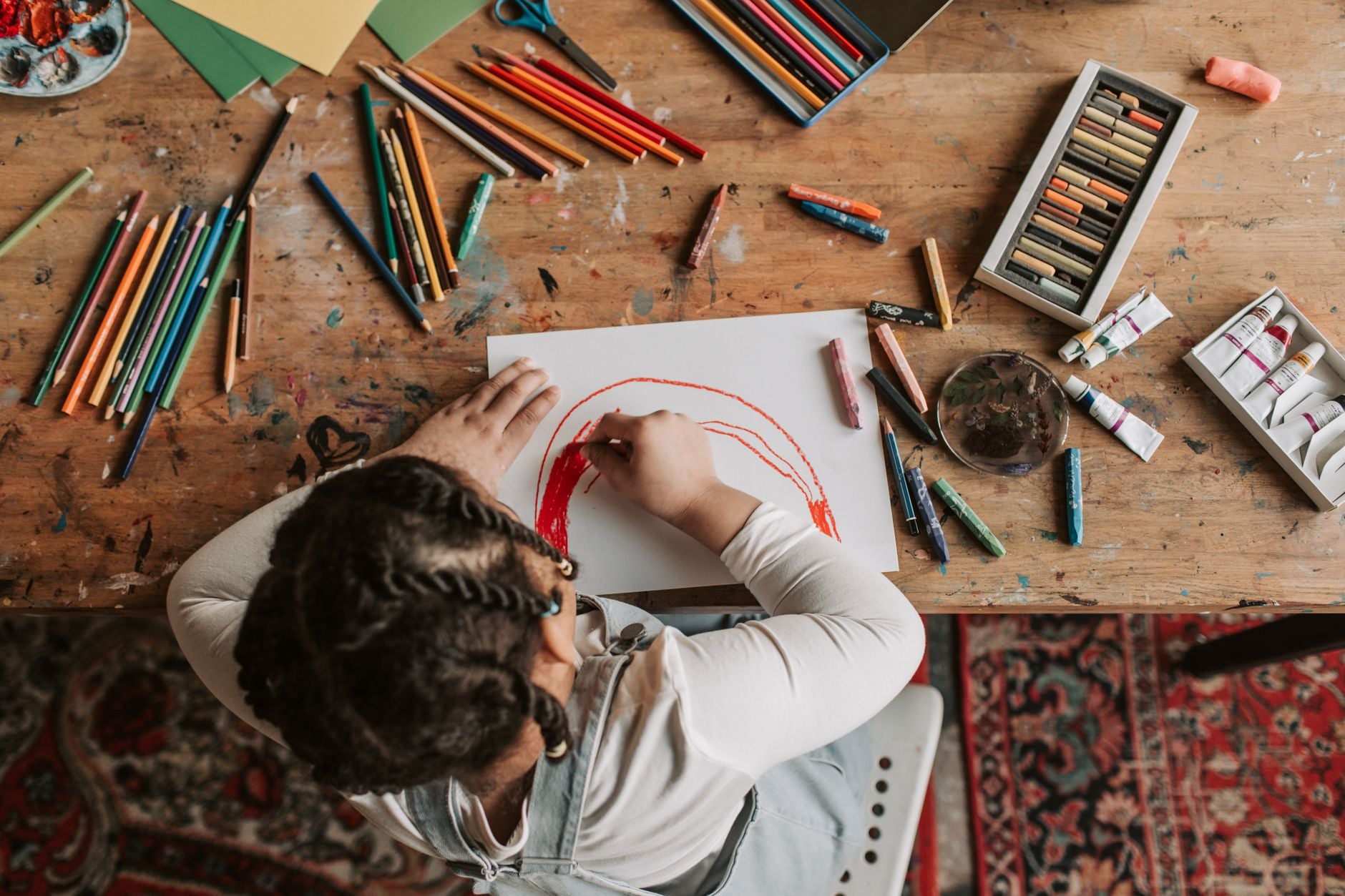
“Dare to be different” is the kind of line that shows up on a poster in a classroom, meant to nudge a child toward their own idea instead of the safe, expected one. It is a nice sentiment. It is also worth checking against what actually happens to children’s original thinking over time, and against what happens when a child copies someone else’s drawing instead of starting from a blank page.
A large dataset suggests something has been slipping
The most cited evidence for a real shift in children’s creative thinking comes from a 2011 study by the researcher Kyung Hee Kim in the Creativity Research Journal. Kim analyzed scores from the Torrance Tests of Creative Thinking, a widely used measure that has been given to hundreds of thousands of children since the 1960s and re-normed several times since. Comparing scores across decades, Kim found that measures of originality and elaboration, meaning how unusual and how developed a child’s ideas were, had been declining since around 1990, even as IQ scores over the same period were rising.
This is one dataset built from one test, not settled consensus about every measure of creativity, and Kim’s own analysis does not identify a single cause. Researchers who have written about the finding since have pointed to several plausible contributors, including less unstructured free play, more standardized testing in schools, and more scheduled time, without any one of these being confirmed as the actual cause.
The Artful Parent
Family-life ideas and sharp reads, in your inbox.
What this does and does not mean for one child’s art at the kitchen table
A national decline measured across hundreds of thousands of test scores says very little about what happens with any individual child on any individual afternoon. It is not a reason to worry that a specific three-year-old is somehow falling behind, and it is not a reason to grade a child’s drawing against a standardized test. What it does suggest, in a general sense, is that the conditions that seem to support original thinking, namely unstructured time and room to follow an idea without much interference, are worth protecting on purpose rather than assuming they will simply happen.
The complication: copying does not reliably kill originality
A common assumption in creative-parenting spaces, including our own instinct much of the time, is that copying an example or a coloring page is close to the opposite of daring to be different, and that a child left with nothing but a blank page will produce something more original. A 2017 study in the journal Cognitive Science, by the researchers Takeshi Okada and Kentaro Ishibashi, complicates that assumption directly.
In their experiments, adult participants who copied an unfamiliar artist’s drawing before making their own original piece went on to produce work that outside evaluators rated as more creative than participants who simply made an original drawing with no copying step first. The researchers’ explanation was that copying an unfamiliar style loosened participants’ existing habits and assumptions about how to draw, opening up new approaches rather than closing them down. A second experiment found this effect depended on the source material being genuinely unfamiliar. Copying a familiar style did not produce the same result.
This is one study, run with adult participants rather than young children, and it should not be read as a rule about every child copying every coloring page. But it is a useful, honest complication of a very common assumption: copying is not automatically the enemy of originality, and depending on what is being copied, it can be part of how a new idea actually gets built.
Age matters here in a way the study itself did not test. A toddler tracing over a printed outline is mostly practicing hand control, not building toward an original composition, and that is a perfectly good reason to do it, separate from any question about originality. An older child who has already drawn the same cat shape a hundred times, on the other hand, is closer to the kind of “familiar” condition Okada and Ishibashi’s second experiment found did not produce the same effect. The unfamiliar example that seemed to help adult participants was doing something specific: giving them a way of drawing they had not already worn into a habit, which is a different situation from a coloring page a child already knows by heart.
What this suggests for how we set up the table
Put together, the research points somewhere more specific than “always let them draw freely” or “never hand them an outline.” The declining-scores research suggests protecting real stretches of unstructured time is worth doing on purpose, since that is the kind of condition researchers have connected to more original thinking generally. The copying research suggests that offering an unfamiliar example, a style of art a child has not seen a hundred times before, is not automatically working against that goal, and may sometimes be exactly what nudges a child toward an idea they would not have reached from a blank page alone.
In our own experience, the activities that tend to produce something we did not expect are rarely the most tightly instructed ones or the most completely open ones. They tend to be somewhere in between: a genuinely new material or example to look at, and then enough unstructured time left over for a child to do something with it that was not on the instructions at all.
What this does not prove
Neither study measured what “daring to be different” actually feels like for a specific child, and neither is a guide for how to respond in the moment when a child wants to copy a sibling’s drawing exactly. Copying a sibling’s drawing is also a different situation from copying an unfamiliar artist’s work: it usually comes from wanting to belong to what someone else is doing rather than from a search for a new approach, and neither study here was designed to speak to that particular, very common kitchen-table moment.
What the research does support, modestly, is that the blank page and the model to copy are not simple opposites, and that protecting unstructured time matters more than which of those two starting points a particular afternoon happens to use.