
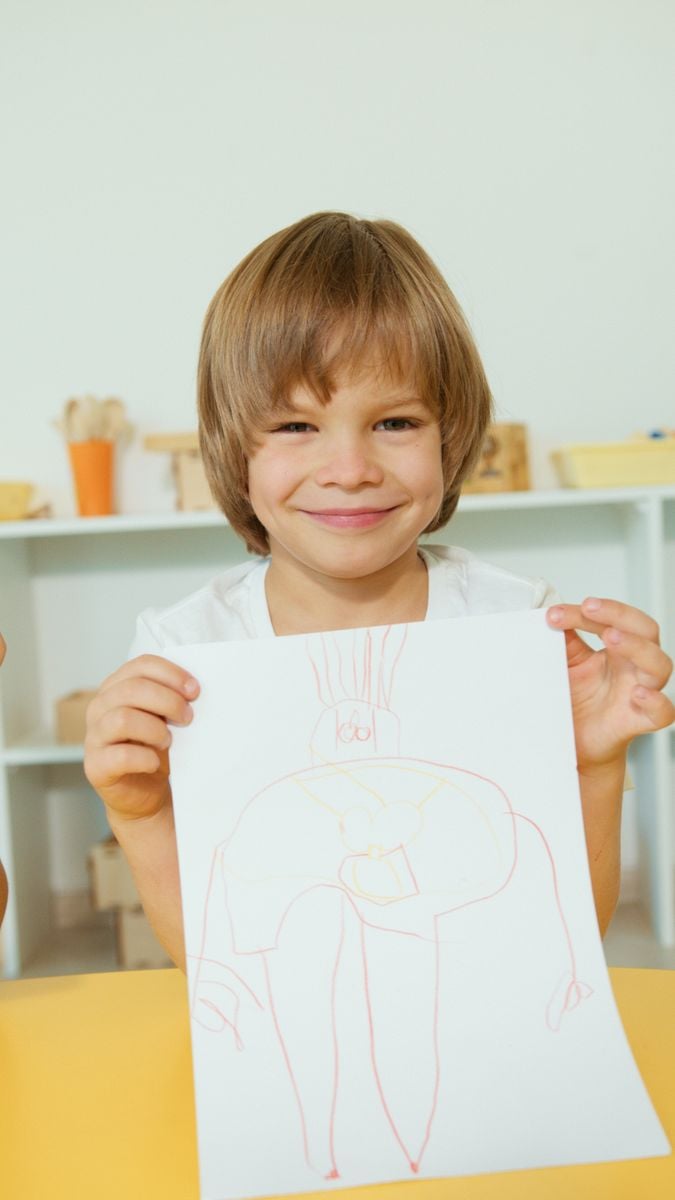
Stand tall, hands on hips, chin up, like a superhero. It is a common piece of advice before a school recital, a first day of show-and-tell, or the moment a child has to stand next to their painting at the art show and answer questions about it. The idea usually traces back, whether the parent giving it knows this or not, to “power posing,” one of the most famous psychology findings of the last twenty years, and also one of the more instructive cautionary tales about how quickly an appealing result can outrun the evidence behind it.
We are parents and writers, not psychologists, and this is a case where the plain history of one line of research is more useful than any advice we could add to it.
What the original study claimed
In 2010, the psychologists Dana Carney, Amy Cuddy, and Andy Yap published a study in the journal Psychological Science based on 42 adults. Participants held either an expansive, open posture, standing with hands on hips or leaning back with feet on a desk, or a contractive, closed posture, arms wrapped in or shoulders hunched, for two minutes. The expansive-posture group showed higher testosterone, lower cortisol, and reported feeling more powerful and more willing to take a risk afterward, compared with the contractive-posture group. The finding became famous partly through Amy Cuddy’s TED talk, one of the most watched in the platform’s history, which framed the result as something anyone could use before a stressful moment: a job interview, a presentation, a big ask.
The Artful Parent
Family-life ideas and sharp reads, in your inbox.
This is one study of 42 people, not settled consensus, and it did not stay unquestioned for long.
Where the story gets complicated
In 2015, a team led by the economist Eva Ranehill published a replication in the same journal using a much larger and more evenly split sample, 200 adults instead of 42. They found that people did report feeling more powerful after an expansive pose, matching the original result. But they found no measurable effect on testosterone, cortisol, or actual risk-taking behaviour, the parts of the original claim that had made it so striking.
The most notable turn came in 2016, when Dana Carney, the lead author of the original 2010 paper, posted a public statement laying out exactly why she no longer believed the hormone and risk-taking effects were real. She described a small sample, a data-collection process that checked results in small batches until a pattern appeared, and several after-the-fact choices about which statistical test and which self-report questions to use, the kind of choices that can make a fragile effect look sturdier than it is. She wrote plainly that she did not think power pose effects on hormones and behaviour were real, and that she had stopped teaching or studying them.
What is left standing
The part of the finding that has held up across studies, including the 2015 replication, is the simple one: many people say they feel a bit more confident or capable right after standing in a more open, expansive way, at least in that moment. What has not held up is the more dramatic version, that a two-minute pose measurably shifts hormones or changes real decisions. That gap between the popular version of a study and what a closer look actually supports is common in psychology, and power posing has become one of the field’s clearest examples of it.
This matters for the advice itself. Telling a child to stand tall before they read their piece aloud or stand next to their art at the show is not harmful, and there is nothing wrong with a small ritual that helps a child feel ready. But it is worth being honest, with ourselves as much as with a child, about what that ritual is actually doing. It is far more likely to be a small, in-the-moment confidence boost, similar to any comforting routine, than a scientifically demonstrated shift in the body’s chemistry.
What this looks like at different ages
For a younger child, four to seven or so, the pose itself matters less than the ritual around it: a favourite stretch, a deep breath, a hand squeeze from a parent right before their turn. At that age a child is unlikely to grasp or care about the underlying claim, and the value is entirely in the small, repeated routine feeling familiar. For an older child, eight and up, the framing matters more, because this is an age when children start picking up confident-sounding claims from videos and older siblings and treating them as settled fact. That is a reasonable moment to say, plainly, that the pose is a nice habit and not a proven trick, and that the more solid confidence usually comes from having practised the thing they are about to do.
It is also worth naming what the research adjacent to power posing has actually held up reasonably well. A smaller, older body of work on embodied cognition, the general idea that physical state and felt emotion influence each other in both directions, has fared better under scrutiny than the specific power-pose claims did, though it too varies by exact effect and should not be treated as a single settled finding. That broader idea, that how your body is arranged can nudge how you feel in modest ways, is a much more modest claim than “changes your hormones in two minutes,” and modest is closer to what the evidence actually supports.
What this does not prove
None of this means posture or physical presence are irrelevant to how a child, or an adult, comes across. It means the specific, dramatic version of that claim, the one involving testosterone and cortisol and a TED talk’s worth of confidence, has not survived closer scrutiny. A child who stands up straight because it feels steadier to them is doing something reasonable. A parent who tells them the pose will change their hormones is repeating a claim the field itself has mostly walked back.
For the everyday moment, the art show, the recital, the nervous show-and-tell, what actually seems to help is closer to the ordinary and less dramatic: knowing what you made and why, having practised saying it out loud once, and a parent standing somewhere in view. The pose can be part of a small pre-show routine if a child likes it. It is just not doing the work the famous version of the story claimed it was.