
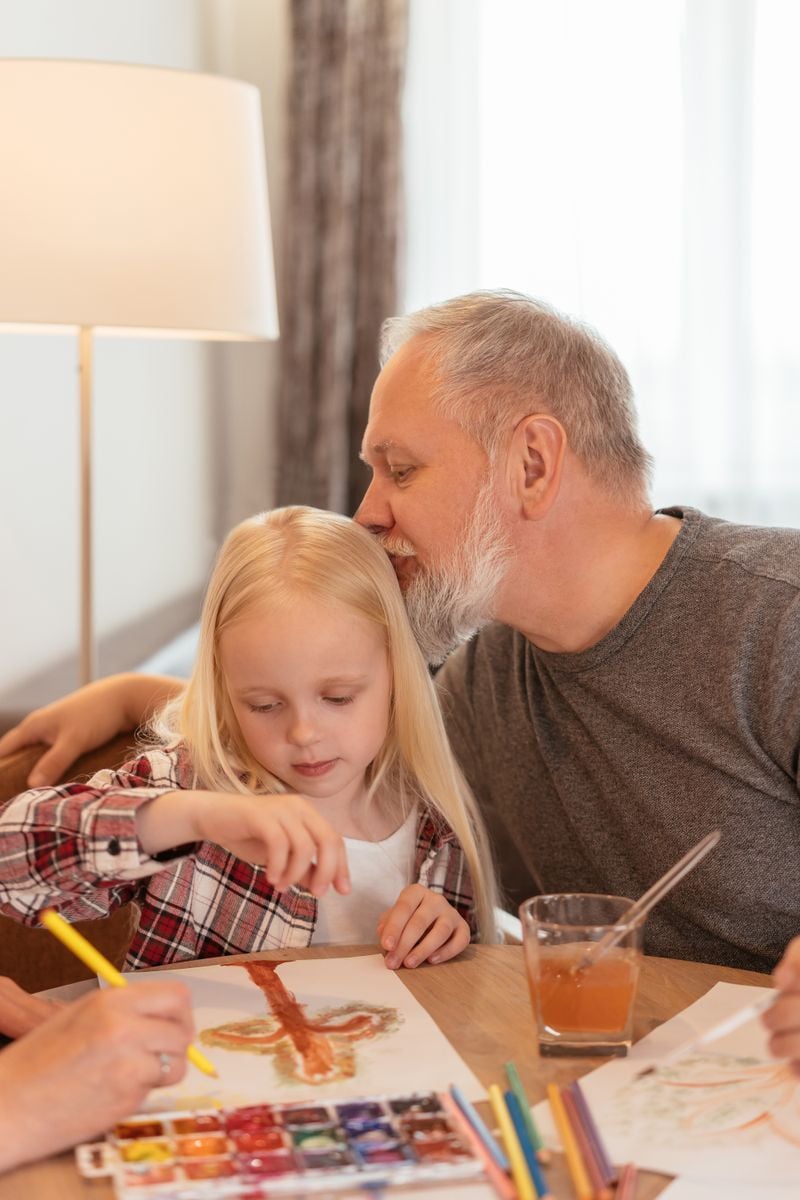
There is no single secret that makes a person wiser once they hit a certain age, and the research on aging and wisdom is a lot messier than that framing suggests. But there is a well-studied, decades-old body of research that explains something a lot of families notice anecdotally: a grandparent covered in glitter and finger paint often seems to have more patience for the mess than the exhausted parent standing next to them. That difference has a name in psychology, and it is worth understanding what the research actually supports before handing it more credit than it has earned.
We are parents and writers, not psychologists, and what follows is our reading of research that has been developed and tested over several decades, not one study or a tidy life hack.
What the aging research actually shows
The Stanford psychologist Laura Carstensen developed what is called socioemotional selectivity theory to explain a consistent pattern researchers keep finding in older adults: as people sense that their remaining time is more limited, whether because of age or another kind of ending, they tend to shift their attention and energy toward emotionally meaningful goals and relationships rather than new experiences or information-gathering. One well-documented result of this shift is what researchers call the positivity effect. Compared with younger adults, older adults tend to remember positive information more than negative information, and they generally get better at regulating their emotional reactions in the moment, even as other cognitive skills, including how quickly they process new information, decline.
The Artful Parent
Family-life ideas and sharp reads, in your inbox.
This is a large and mostly consistent body of research built up over more than two decades, not a single striking study. Older adults are not simply “calmer” as an unexplained personality trait. The pattern reflects a shift in what people are motivated to prioritize once their sense of time left starts to feel different, and it is not only about age in years. Researchers have found the same motivational shift in younger people facing an ending of another kind, such as a serious illness or a planned move to a new country, which is part of why the theory is framed around a perceived time horizon rather than age alone.
Where “wiser” oversells it
It would be a stretch to say this research proves aging makes someone wiser in any complete sense. A recent review of the broader wisdom research found a genuinely mixed picture: wisdom does not reliably rise with age across the board. Depending on how researchers measure it, some components, including certain kinds of quick decision-making and processing speed, tend to decline with age, while others, including emotional regulation, empathy, and the ability to reflect on lived experience, tend to hold up well or even improve. “Wisdom” as a single word flattens a set of separate skills that do not all move in the same direction as a person gets older. That review also notes a real limitation worth naming plainly: most of the underlying research has been done with Western study samples, so how universally these patterns hold across different cultures and family structures is still an open question rather than a settled one.
So the honest version is narrower and more useful than “aging makes you wiser.” It is closer to: aging tends to improve a specific, well-studied set of emotional skills, particularly the ability to stay regulated under stress and to focus on what matters rather than every passing irritation, while other skills plateau or decline. That is a real and well-supported finding. It is not a secret, and it does not apply evenly to everyone.
What this looks like at the kitchen table
Translated into an ordinary afternoon of painting, playdough, or a project that is going sideways, the relevant piece of this research is the emotional regulation part specifically. A grandparent who has, over decades, become somewhat better at staying calm when a project does not go as planned, or when three colors of paint end up mixed into brown, is drawing on a real and researched shift in how people manage their emotional reactions as they age. That is different from a grandparent simply having more free time, though that plays a role too, and different from any claim that older adults have unlocked some general wisdom about creativity or child development that younger parents lack.
In our experience, what actually makes a grandparent a good art partner for a young child usually comes down to fewer competing demands in the moment and a genuine willingness to let the child lead, more than any special insight into the activity itself. The emotional regulation research helps explain why staying calm through the mess might come more easily to an older adult on an average day, not why they are automatically a better creative-play partner in every case.
It is also worth noting what this research does not say about a parent who is not a grandparent yet and still finds themselves short on patience some afternoons. A parent juggling a work deadline, a toddler, and a pot of glitter has a lot more actively competing for attention than a grandparent settling in for a planned visit, and that difference in the immediate situation likely explains at least as much of the patience gap as anything about age itself. Reading a bad craft afternoon as a personal failure of patience, rather than a predictable outcome of a genuinely demanding moment, is the kind of comparison this research does not support.
What this does not prove
None of this means every grandparent is patient, or that every younger parent is not. Individual temperament, stress levels, sleep, and the specific relationship between a particular adult and child matter more than any age-based average. The socioemotional selectivity research describes a pattern that shows up across many older adults studied as a group, not a guarantee about any one grandparent, parent, or caregiver in your own family.
What is left, once the oversold version is set aside, is a modest and genuinely interesting fact: getting older reliably changes what people pay attention to and how well they manage their reactions in the moment, in ways that can make some kinds of shared creative time easier. That is not a secret. It is just one small, well-documented piece of what growing older tends to do.