


Last Monday morning, I’d just settled at my desk with a hot coffee and finally gotten into the flow of writing when a notification appeared on my phone.
Our two-year-old daughter’s daycare had sent a message. Emilia had a fever and needed to come home.
My husband, Matias, was tied up in meetings, so I picked her up. The following day, she was feeling better but still needed to stay home. Matias worked from home, and we took turns looking after her while attempting to get some work done.
The Artful Parent
Family-life ideas and sharp reads, in your inbox.
By Wednesday, things were finally back to normal. Emilia was at daycare, our nanny was looking after our three-month-old, Laura, and I had a wonderfully productive day.
Then everything fell apart again.
Matias had a professional course until 10 p.m., so I was alone with both girls that evening. I gave them their baths, relied heavily on television to entertain Emilia while I cared for Laura, and eventually got them both to sleep. Except Laura had developed a fever, too.
By the following morning, her temperature had reached 39°C, she wasn’t eating, and we ended up at the hospital’s urgent care. Our nanny came with me and promptly fell sick herself.
By Friday, we had two sick children, no childcare and two full-time jobs to keep up with. Matias worked from home so we could share the load. Then he got sick, too. And with a public holiday on Monday, there would be no daycare or nanny, although I still had work to do.
By Tuesday, I could finally sit down at my desk again and return to this article.
Its subject, rather ironically, was how much time fathers spend caring for their children.
According to a 2013 Pew Research Center report, American fathers nearly tripled their weekly childcare hours between 1965 and 2011, from 2.5 to 7.3 hours.
It’s a remarkable change. But after the week we’d just survived, I wasn’t sure how much those numbers really told us about what it takes to raise children together.
A revolution at home
In 1965, American mothers spent an average of eight hours a week in paid employment. By 2011, that figure had risen to 21 hours.
Fathers, meanwhile, were spending considerably more time caring for children and doing housework. Their weekly housework hours had increased from approximately four to ten, while mothers’ had fallen from 32 to 18.
The changes were so substantial that by 2011, mothers and fathers were performing almost identical amounts of total work when paid employment, childcare and housework were combined.
Pew calculated 54 hours per week for fathers and 53 for mothers.
I’d like to stress here that the distribution remained different. Fathers spent more time earning money, while mothers spent more time on children and household responsibilities. But the traditional division between a father who provided financially and a mother who managed family life had become considerably less pronounced.
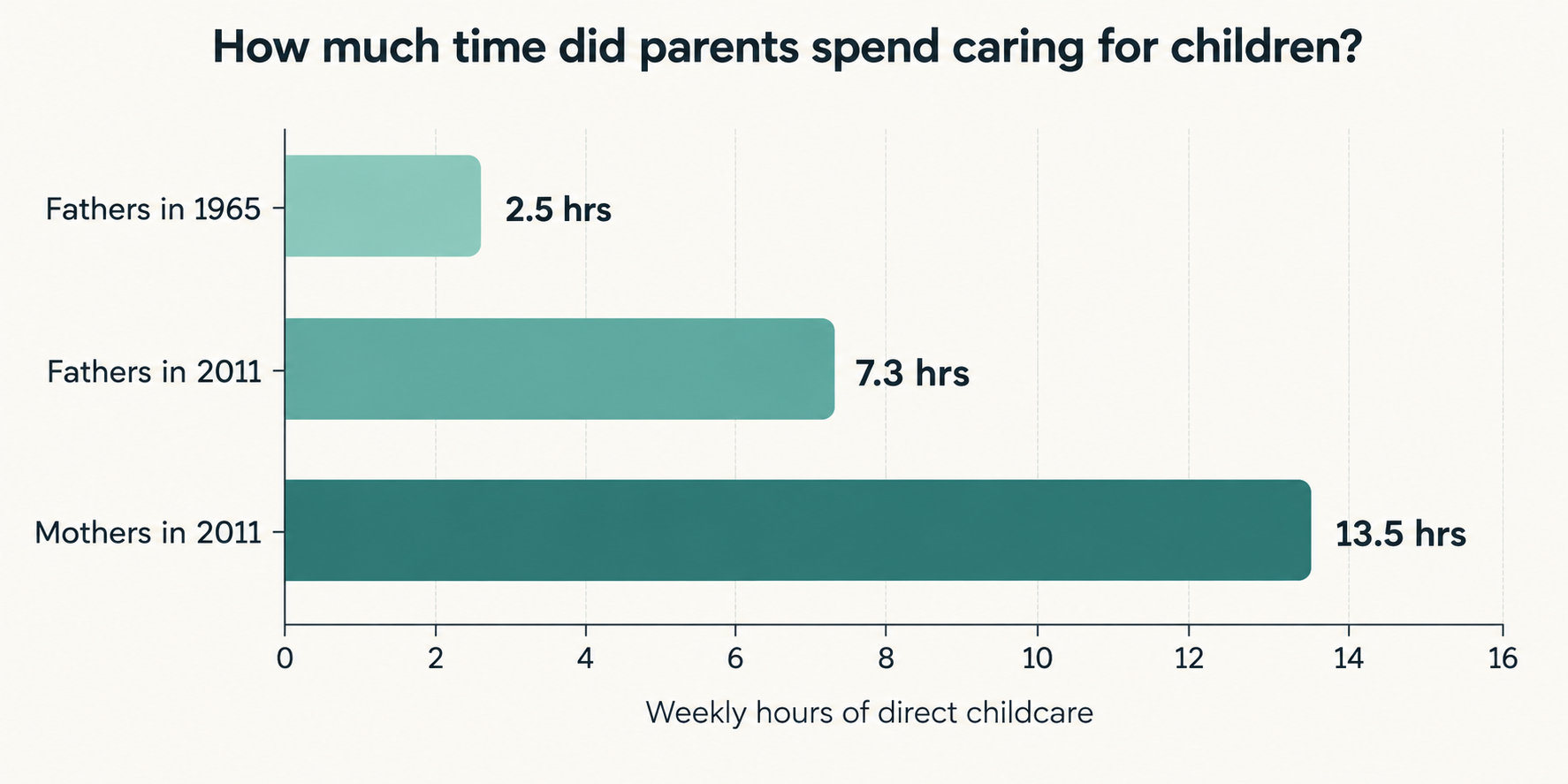
Figure 1. Weekly direct childcare hours among U.S. parents, 1965 and 2011. Data: Pew Research Center, Modern Parenthood (2013).
In an accompanying survey, 46% of fathers with children under 18 said they spent too little time with them. Among mothers, that figure was just 23%.
Fathers were devoting nearly three times as many hours to childcare as men had in 1965, yet almost half still felt it wasn’t enough.
This rings true in my household too. By the time Matias gets home from work, he has about 30 minutes with our three-month-old before she falls asleep. He gets a good two hours with our toddler, but by then she’s already winding down and just wants her bath, book and bed.
The survey doesn’t tell us whether fathers in the 1960s felt similarly. But I wonder whether expectations had changed alongside their behavior. For example, growing up, I often saw fathers praised for working long hours and staying late at work. That was what made someone an outstanding father. Childcare was traditionally considered a woman’s responsibility. The ironic part was that mothers worked, too.
By 2011, providing financially was no longer the only expectation. Fathers were increasingly expected to be present for school activities, meals, bedtime routines and the ordinary, repetitive work of raising children.
I came across a discussion on Reddit about how involved millennial fathers have become. One comment in particular made me realize how differently some men from older generations viewed childcare.
“My father in law actually bragged that he never changed his kids diapers. Like that made him more of a man or something. My wife and I shared it equally. It’s really not that big a deal.”
But not everyone agreed that involved fathers were a recent phenomenon. Another commenter remembered:
“My dad was born in 59 and played with me all the time growing up.”
I think both comments make a good point. Involved fathers certainly existed decades ago, just as uninvolved fathers still exist today. What seems to have changed is what society expects from them. Changing diapers or knowing your child’s teachers is increasingly seen as ordinary parenting, rather than something a father deserves special praise for.
The 7.3 hours Pew reported only covered time spent directly caring for children, such as feeding, bathing, playing and helping with homework. It didn’t capture all the time fathers spent being responsible for their children.
A father cooking dinner while supervising a toddler wouldn’t necessarily have all that time counted as direct childcare.
It’s a distinction that matters when you consider how much of parenting involves being responsible for someone while doing something else.
Fathers do more, but what exactly are they doing?
In a 2015 study, researchers Sandra Hofferth and Yoonjoo Lee pointed out that American fathers were already spending approximately 6.8 hours a week on childcare by 2000.
Compared with 7.3 hours in 2011, that suggests most of the increase since 1965 happened before the turn of the millennium.
But fathers’ behavior continued to evolve.
Hofferth and Lee found that fathers increased their time in certain childcare activities between 2003 and 2013, including playing with children and managing their needs.
More recently, the pandemic may have accelerated some of those changes.
In a study published in the Journal of Marriage and Family, Jennifer March Augustine and Kate Prickett examined American parents’ time use between 2017 and 2024.
They found that fathers spent 16% more time on general childcare in 2024 than in 2019.
But that progress hadn’t extended to every aspect of parenting. The gaps between mothers and fathers in developmental childcare and secondary caregiving, meaning being responsible for children while doing other activities, had returned to their pre-pandemic levels.
The latest figures from the Bureau of Labor Statistics offer a more detailed look at what men and women living with children actually do.
In 2025, men living with children under 18 averaged about 14 minutes a day playing or doing hobbies with them, compared with 17 minutes for women.
That’s a relatively small difference.
But the gap widened when it came to physical care, including feeding, bathing and dressing children. Men averaged around 19 minutes a day, while women averaged 39.
For education-related activities, the figures were approximately two minutes for men and ten for women.
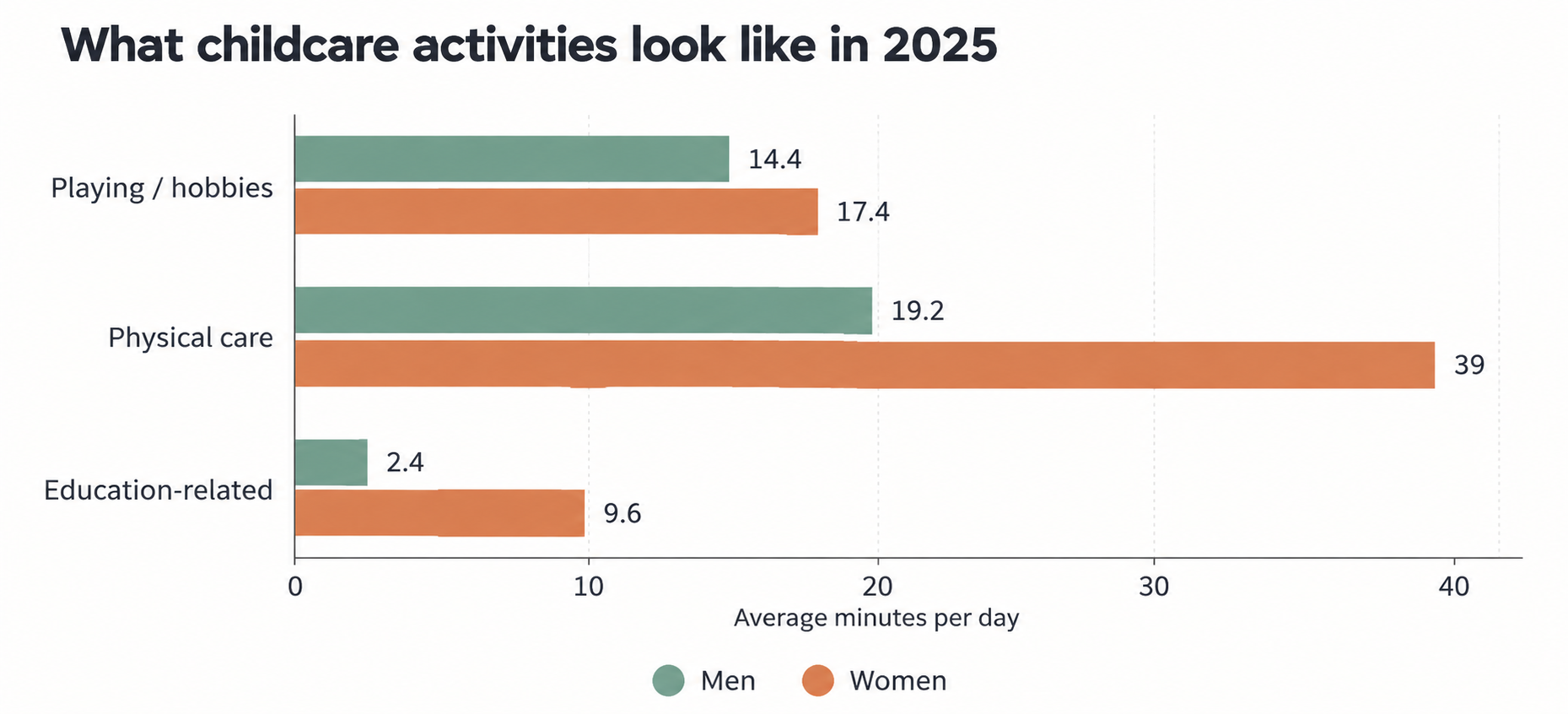
Figure 2. Daily childcare activities among U.S. adults living with children under 18, 2025. Data: U.S. Bureau of Labor Statistics, American Time Use Survey, Table 9.
These averages include parents with children of different ages, as well as days when no time was spent on a particular activity. They aren’t directly comparable with Pew’s historical weekly figures.
And they don’t mean fathers are unwilling to provide routine care. Work schedules, employment arrangements and children’s ages can all influence how parents spend their time.
Still, the distinction between play and physical caregiving is revealing.
A father who spends an hour playing with his child and a father who spends an hour feeding, bathing and getting that child ready for bed are both involved parents.
But the responsibilities are different.
And there is another kind of parenting work that neither example fully captures.
The parenting work nobody sees
In our family, Matias and I have never thought of him as someone who helps me raise our daughters.
He’s their father, just as much as I am their mother. We made a conscious decision to have both children and discussed how we wanted to share parenting responsibilities long before they were born.
Matias took a month of paternity leave after each birth. He’s present at daycare events, pediatrician appointments and, before the girls were born, pregnancy consultations and ultrasounds.
At night, I care for Laura while he looks after Emilia, who still wakes and sometimes needs help falling asleep again.
He also handles Emilia’s morning routine. He cooks her eggs, gives her milk, helps with her hygiene, brushes her hair and drops her off at daycare.
But the night before, I’ve already checked the weather, selected her clothes, prepared her fruit and packed her lunch.
He handles the morning. I’ve prepared much of what makes a smooth morning possible.
The difference became particularly obvious before a recent family trip to Chile.
We were traveling for a month with two young children.
Matias was responsible for buying our plane tickets.
I researched passport renewals and border documents, worked out what medicines we could bring, packed five suitcases for a different climate, planned meals and hygiene supplies for the journey, and arranged airport transportation with appropriate car seats.
Once we arrived, we shared the childcare equally.
But a considerable amount of work had happened before we boarded the plane.
In December 2024, researchers Ana Catalano Weeks and Leah Ruppanner published a study of 3,000 American parents examining what they called domestic cognitive labor.
It’s the thinking, planning and organizing that keeps a household functioning.
The researchers examined 21 responsibilities, including remembering appointments, organizing children’s activities, monitoring groceries and noticing when children’s clothes need replacing.
They identified two broad categories: daily mental work and less frequent, episodic responsibilities.
Mothers reported handling a much greater share of daily planning, while fathers reported more responsibility for episodic tasks, particularly finances and household maintenance.
Across all 21 tasks, mothers reported primary responsibility for an average of 71%, compared with 45% for fathers. These were separate self-reports about responsibility for tasks, so the percentages aren’t expected to add up to 100.
The findings help explain why parents might spend similar amounts of time physically caring for children while still carrying different responsibilities.
But they also made me question whether an unequal division of mental work is necessarily an unfair one.
Because in our house, it isn’t quite that simple.
An unequal division doesn’t always feel unfair
Matias is at a particularly demanding stage of his career.
He manages shipments and makes decisions involving clients and ports, often outside ordinary working hours. He can’t simply close his laptop at six and stop responding to messages.
I also work full time, work hard and earn well. But my job currently allows me to step away more easily once my working day ends.
We’ve discussed this openly and agreed that right now, his career growth is a priority.
Not because my career matters less, but because we don’t believe two people can devote themselves completely to demanding jobs while raising a two-year-old and a three-month-old without something giving way.
Someone has to be thinking about home.
And I’m comfortable taking on more of that responsibility at this stage.
Matias’s career benefits our entire family. It influences where we live, the schools our daughters attend, the childcare we can afford and the opportunities we can give them.
I want him to succeed.
I also know that our arrangement doesn’t have to last forever. My time will come.
Perhaps most importantly, Matias knows how much work I put into keeping our family organized. He sees it, acknowledges it and appreciates it.
That recognition makes a big difference to me. It motivates me to do my best for the family. And it appears to matter in other relationships, too.
In a 2022 study published in Psychological Science, Amie Gordon and colleagues examined household labor and relationship satisfaction across three samples involving 2,193 people, including 476 couples.
As previous research had suggested, people who did more household work and perceived the division as unfair generally reported lower relationship satisfaction.
But the negative association disappeared among participants who felt appreciated by their partners.
The study doesn’t prove that appreciation makes every unequal arrangement healthy, or that it removes the burden of doing more work.
It does suggest that the way partners recognize one another’s contributions can matter considerably.
I found this reassuring because I don’t want to suggest there’s something inherently wrong with a couple choosing to divide responsibilities according to their circumstances.
An arrangement that looks unequal from the outside may be one both people have consciously agreed upon.
And an equal division of visible tasks doesn’t necessarily mean both partners feel equally supported.
Of course, even arrangements that work well can fall apart when real life intervenes.
As our recent week of fevers demonstrated rather spectacularly.
What happens when nobody can stop working?
During that difficult week, Matias and I kept rearranging our working days around the girls. When Emilia had to stay home, he worked remotely so we could take turns looking after her. When Laura needed to go to the hospital and our nanny fell sick, we had to rearrange everything again.
Neither of us was unwilling to look after our daughters.
The problem was that two jobs and two sick children didn’t fit neatly into the same 24 hours.
According to a June 2026 Pew Research Center survey, 60% of full-time working American parents felt they spent too little time with their children. Work obligations were the most frequently cited reason.
Among different-sex couples where both parents worked full time, 70% said flexibility at work was a major factor in deciding who would take time off when a child was sick or childcare unexpectedly fell through.
In those same families, 48% said the mother would be more likely to take that time off, compared with 22% who said the father would. Another 29% said both were equally likely.
It made me think about our own situation. When one of our girls needs us during working hours, the question is much more complicated than “who wants to take care of a sick kid”. The reality is more brutal: whose work can be interrupted?
My job currently gives me more flexibility than Matias’s, so that person is often me. I can work after the girls go to bed, he is needed by his clients during the commercial hours, and often urgently.
And I know we’re fortunate to have hired childcare and jobs that sometimes allow us to adjust our schedules. Without those options, our already difficult week would have been considerably harder.
For families without that flexibility or support, the choices can be much more limited.
Sometimes she just wants Papai
Sometimes, when I offer to read Emilia a bedtime story, she refuses.
She wants Papai.
Not every night. Sometimes she’s perfectly happy for me to read to her. But occasionally she has decided that only her father will do, and there’s very little I can say to change her mind.
Matias has been involved since the girls were born. He didn’t suddenly become interested in parenting when Emilia was old enough to play with him or hold a conversation.
He wanted to be this kind of father long before she arrived.
Our daughters are growing up with a father who cooks breakfast, brushes hair, changes diapers, gets up at night, attends pediatrician appointments and makes room for them in a demanding working life.
And perhaps that is one of the most meaningful changes reflected in Pew’s historical numbers.
Things that might once have been described as a father helping his wife are increasingly understood as ordinary parts of being a parent.
Of course, that doesn’t mean every household has reached an equal arrangement, or that the responsibilities of raising children are distributed fairly everywhere.
But I don’t think equality necessarily means dividing every task into two identical halves.
In our family, it means recognizing that we’re both responsible for our daughters, even when our contributions look different. It means supporting one another’s ambitions and adjusting when family life demands more from one of us.
The nearly threefold increase in American fathers’ childcare time is a remarkable social change.
But it doesn’t tell us how close fathers feel to their children, whether responsibilities are shared fairly, or what happens when a family is suddenly left juggling two jobs, two sick children and no childcare.
Those things are much harder to measure.
And when Emilia asks me to let Papai read her bedtime story instead, I doubt she’s thinking about how many hours either of us has spent caring for her that week.
She just wants her dad.
Sources
Pew Research Center (2013). Modern Parenthood: Roles of Moms and Dads Converge as They Balance Work and Family.
Hofferth, S., and Lee, Y. (2015). Family structure and trends in US fathers’ time with children, 2003-2013. Family Science.
Augustine, J. M., and Prickett, K. C. (2026). Gender Norms in Transition? Parents’ Housework and Childcare Time in the COVID-19 Era. Journal of Marriage and Family.
U.S. Bureau of Labor Statistics (2026). American Time Use Survey: 2025 Annual Averages, Table 9.
Weeks, A. C., and Ruppanner, L. (2025). A typology of US parents’ mental loads: Core and episodic cognitive labor. Journal of Marriage and Family.
Gordon, A. M., et al. (2022). Feeling Appreciated Buffers Against the Negative Effects of Unequal Division of Household Labor on Relationship Satisfaction. Psychological Science.
Pew Research Center (2026). How Working Parents Divide Family Responsibilities.
Milkie, M. A., Nomaguchi, K. M., and Denny, K. E. (2015). Does the Amount of Time Mothers Spend With Children or Adolescents Matter? Journal of Marriage and Family.
Cano, T., Perales, F., and Baxter, J. (2019). A Matter of Time: Father Involvement and Child Cognitive Outcomes. Journal of Marriage and Family.
r/Millennials (2025). Millennial Dads are so much more involved than previous generations of dads. Props to them. Reddit discussion (verbatim excerpts).