

I recently came across a phrase on Instagram that went something like this: “You teach the children you cannot live without how to live without you.”
It touched something in me.
Raising children is hard work. When a baby is born, they require your all and more. Hours upon hours of physical care. Changing, feeding, contact napping, then doing it all over again.
The Artful Parent
Family-life ideas and sharp reads, in your inbox.
And then, as months and years go by, you start noticing that they no longer depend on you for everything. They can hold their own bottle, feed themselves, walk without holding your hand. Little by little, they start doing things on their own.
It’s a relief and grief at the same time.
They’re still living beside you, but the amount of time you spend actively caring for them changes dramatically.
According to the 2025 American Time Use Survey, adults living in households with children under six spent an average of 2.3 hours a day providing primary childcare. In households where the youngest child was between six and seventeen, that figure dropped to just 47 minutes.
That’s a difference of 91 minutes a day.
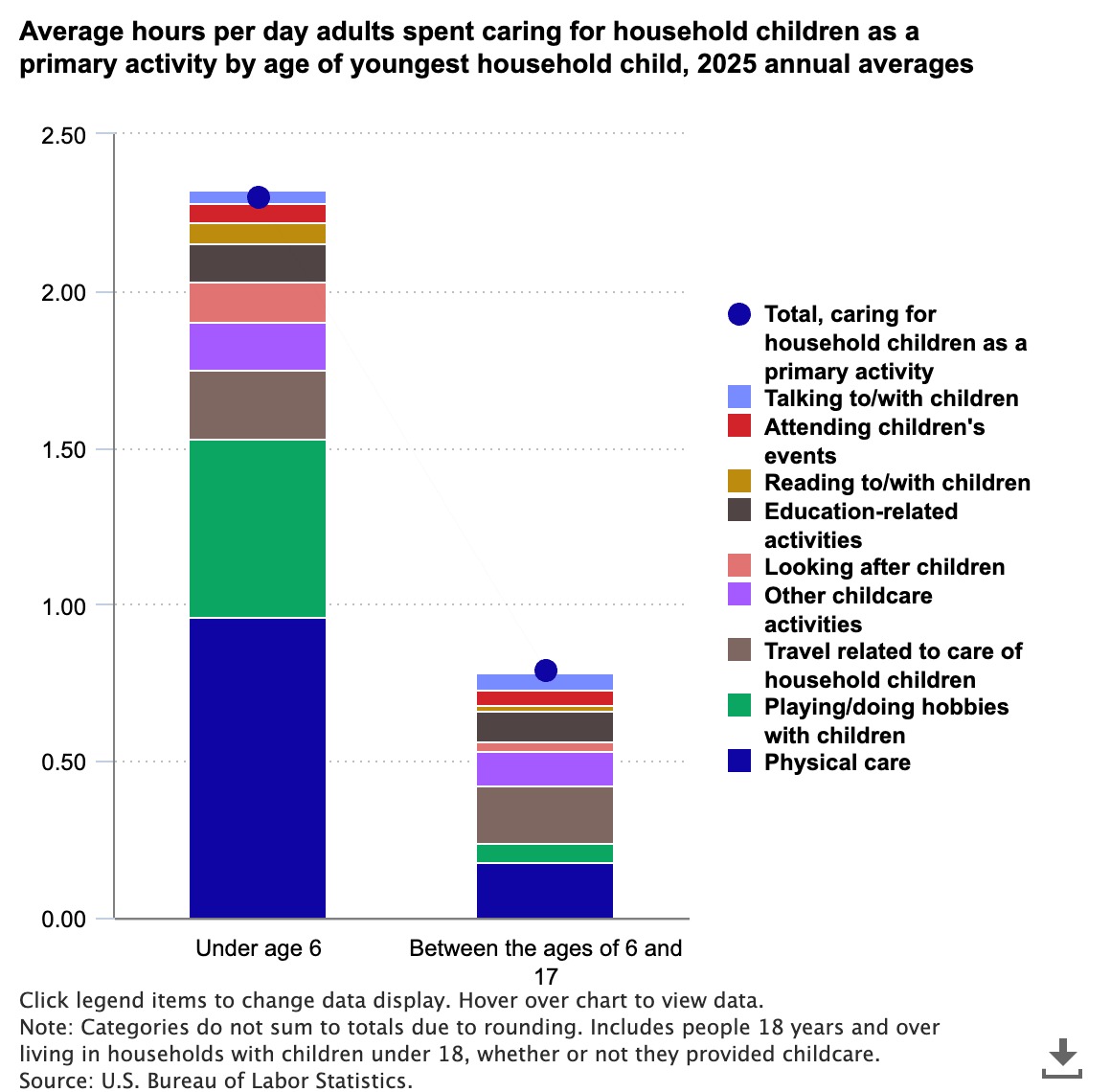
Average time spent on primary childcare among U.S. adults in households with children under six and those whose youngest child was aged 6-17, in 2025. Physical care and play accounted for much of the difference. Source: U.S. Bureau of Labor Statistics, American Time Use Survey, Table 9. Public domain.
What actually disappears from a parent’s day?
I remember one particular day shortly after Emilia was born when everything I ate amounted to a cracker, a cold piece of chicken breast pulled straight from the fridge, and a protein bar.
I simply couldn’t put my newborn down long enough to eat a proper meal.
My husband’s parents had gone home, taking the extra help with them. Matias was back at work, and we were inexperienced first-time parents. Emilia cried whenever I put her down.
When I wasn’t changing her, breastfeeding her or talking to her, I was pacing around the house with her in my arms, showing her the rooms. I couldn’t wash the dishes, get out of my pajamas or take a shower until Matias came home.
Almost two years later, things look completely different.
Emilia no longer needs me to hold her bottle, spoon-feed every bite, carry her everywhere or burp her after a meal. She can walk around the house, entertain herself for short periods and participate in the things I’m doing.
She’s still a toddler, so there’s plenty she needs help with. But the difference between caring for her as a newborn and caring for her now is enormous.
In 2025, adults living with children under six spent an average of 58 minutes a day providing physical care, including activities such as bathing and feeding. Among adults whose youngest child was six to seventeen, that fell to eleven minutes.
Playing or doing hobbies with children dropped from 34 minutes to approximately four.
But other activities changed far less. Travel related to children’s care averaged thirteen minutes for the younger group and eleven for the older one. Education-related activities averaged approximately seven minutes and six minutes respectively.
The survey didn’t follow the same parents as their children grew older. It compared adults living in different households, including those who provided no childcare on the surveyed day.
The childcare that doesn’t get counted as the main activity
If someone compared only the time I spend directly caring for Emilia now with my newborn days, they might think I’d become a negligent mother who barely interacts with her child.
But the survey measures primary childcare separately from time spent caring for children while doing something else.
Last night, Matias spent about thirty minutes roughhousing with Emilia on the sofa. That would count as primary childcare if he reported playing with her as his main activity.
Later, he was washing dishes while Emilia made “soup” beside him from leftover yoghurt and tap water.
He was doing the dishes, keeping an eye on her, talking to her and letting her invent something of her own.
The dishwashing would be recorded as his main activity, rather than primary childcare. But because Emilia was in his care, that time could count as secondary childcare.
Most of our evenings look something like this. We’re a normal working family, and when our jobs finish, there’s still dinner to make, dishes to wash and a house to look after.
We involve Emilia in whatever we’re doing or let her play nearby. It’s something we couldn’t manage in quite the same way when she was a newborn.
The BLS records secondary childcare as time when an adult has a child under thirteen in their care while doing something other than primary childcare.
According to Table 10 of the 2025 survey, adults in households with children under six averaged 5.26 hours of secondary childcare per day.
Where the youngest child was between six and twelve, the figure was still 4.86 hours.
That’s a difference of only 24 minutes, although these are separate groups of households and the figures don’t establish a trend as individual children age.
Secondary childcare doesn’t mean giving a child your undivided attention. It measures responsibility for a child while doing something else. And because the survey collects this measure only for children under thirteen, it cannot tell us how much comparable supervision parents provide teenagers.
I can’t speak for the school-age years yet. My daughters are still a long way from them.
But I imagine the amount of hands-on care will decrease further as they grow older. They’ll need less help with ordinary tasks and increasingly want to do things by themselves.
What children do when adults step back
I asked Peter Gray, a research professor of psychology and neuroscience at Boston College, to imagine two ten-year-olds whose parents spend very little time directly playing with them.
One child spends the afternoon organizing games with neighborhood friends. The other stays home waiting for an adult to arrange something.
Both families might report similar childcare hours, but the children’s experiences are very different.
“Childcare hours are appropriately understood as indicators of how much ‘work’ parents are putting into childcare,” Gray told me by email. “They are not good measures of how much freedom or play or benefit the child has.”
Gray has spent years studying children’s play and independence. In his 2014 TEDx talk, The Decline of Play, he argues that American children have lost opportunities to play without adult direction.
He describes a gradual shift away from children organizing their own games and activities toward childhoods increasingly structured and supervised by adults.
My children’s childhood looks quite different from mine.
I was born in 1992 in Kazakhstan, and from the time I was around five, much of my free time was spent on the playground outside our apartment building, together with the neighborhood children my age.
My mother told me to remain where she could see me from the window and not wander farther.
We all obeyed, and it worked.
We figured out our own games, invented rules and settled disagreements without our parents constantly directing us. Time disappeared because we were enjoying ourselves so much.
Then we’d come home for dinner and tell our parents everything about our adventures.

Caption: Children playing “ring around a rosie” in a Chicago neighborhood, April 1941. Photograph: Edwin Rosskam, Farm Security Administration/Office of War Information Collection, Library of Congress. Public domain.
I do recognize some of what Gray describes in my own children’s lives.
Granted, Emilia is only two. I wouldn’t expect her to have the independence I enjoyed at five.
But so much of her day involves activities that adults choose and organize. Where we go, what we play, what we do next.
Sometimes I catch myself trying to guide her through an activity when perhaps she would be perfectly happy figuring something out on her own.
I sometimes wish I could simply put her in a backyard with a bunch of sticks and mud and let her figure out what to do.
I’m sad at the thought that my daughters might not experience the same freedom I had.
But I’m also happy that I can spend so much time by their side, more than my parents were able to spend with me.
Julie Lythcott-Haims, a former Stanford dean and author of How to Raise an Adult, makes a related argument in her TED talk, How to Raise Successful Kids Without Over-Parenting.
She describes how parents can become so preoccupied with managing children’s achievements, schedules and difficulties that they leave them too little room to develop confidence in their own abilities.
Her examples include parents who micromanage homework, grades and extracurricular activities, trying to organize childhood around a checklist of achievements.
But children also need opportunities to make decisions, take responsibility, make mistakes and see the results of their own efforts.
Not every family lives somewhere children can safely play outside, and not every child is ready to manage the same tasks at the same age.
Sometimes helping children become independent requires more patience and supervision at first, not less.
A child learning to make breakfast, for instance, might take longer than a parent who could prepare it themselves in five minutes.
But gradually, the child learns to do something without help.
Does the amount of time together actually matter?
A 2015 study published in the Journal of Marriage and Family examined the relationship between mothers’ time with children and their behavioral, emotional and academic outcomes.
Sociologists Melissa Milkie, Kei Nomaguchi and Kathleen Denny analyzed time-diary and survey data involving 1,605 children aged three to eleven and 778 adolescents aged twelve to eighteen.
They distinguished between time mothers spent actively engaged with their children and time when they were present and available.
For younger children, the researchers found no consistent association between the overall amount of maternal time and the outcomes they measured.
Among adolescents, however, more engaged time with mothers was associated with fewer delinquent behaviors. Time spent engaged with both parents together was also associated with better outcomes, including behavioral and academic measures.
The findings were observational and couldn’t establish cause and effect. The study also didn’t directly measure how warm, responsive or enjoyable individual interactions were.
And the results shouldn’t be interpreted as proof that time with parents doesn’t matter. They suggest that counting the hours alone isn’t enough to tell us what children are getting from them.
A teenager who spends an evening studying independently might still want to talk to a parent about a difficult friendship before bed.
That conversation would be a very different form of involvement from feeding and dressing a toddler, but it could matter enormously to the teenager.
The part that can’t be measured in minutes
In a 2023 Pew Research Center survey, 45% of American parents described themselves as tending to be overprotective, while 20% said they tended to give their children too much freedom.
The survey doesn’t tell us how much freedom those children actually had. It shows how parents viewed their own approach.
I can understand the hesitation.
At the moment, with a baby and a toddler, I know exactly what my children need from me most of the time.
They need to be fed, bathed, comforted, entertained and watched closely.
The responsibilities can be exhausting, but they’re familiar.
What I don’t yet know is how I’ll recognize the right moment to step back.
When will Emilia be ready to go somewhere without me? When should I let her solve a problem instead of immediately offering help? And how will I feel when she starts choosing her friends over spending an afternoon with her parents?
The American Time Use Survey can’t answer those questions.
Its numbers describe how adults spend their days, not whether their children are happy, secure or becoming more independent.
I think about those afternoons on the playground outside my childhood home.
My parents weren’t there to see every game we invented or every little adventure we had. We had a whole world of our own, within the boundaries they had set for us.
I’d like Emilia and Laura to have something like that, too.
And I’d like to be there when they come home to tell me about it.
Sources and methodology
U.S. Bureau of Labor Statistics, American Time Use Survey – 2025 Results, released June 25, 2026.
BLS Table 9: Primary childcare by age of youngest household child.
BLS Table 10: Secondary childcare.
BLS Technical Note: Definitions and survey methods.
Milkie, Nomaguchi and Denny (2015), Does the Amount of Time Mothers Spend With Children or Adolescents Matter?, Journal of Marriage and Family.
Pew Research Center, Parenting in America Today, 2023.
Peter Gray, personal email correspondence with the author, October 22, 2026.
Peter Gray, The Decline of Play, TEDxNavesink, 2014.
Julie Lythcott-Haims, How to Raise Successful Kids Without Over-Parenting, TED.
Methodology note: The 2025 ATUS was affected by a federal government shutdown that prevented diary collection from September 30 through November 11, 2025. BLS applied its usual weighting method but says the possible effect of the missing observations cannot be quantified. The results are cross-sectional averages, not measurements of how the same parents’ time changed as their children grew.