
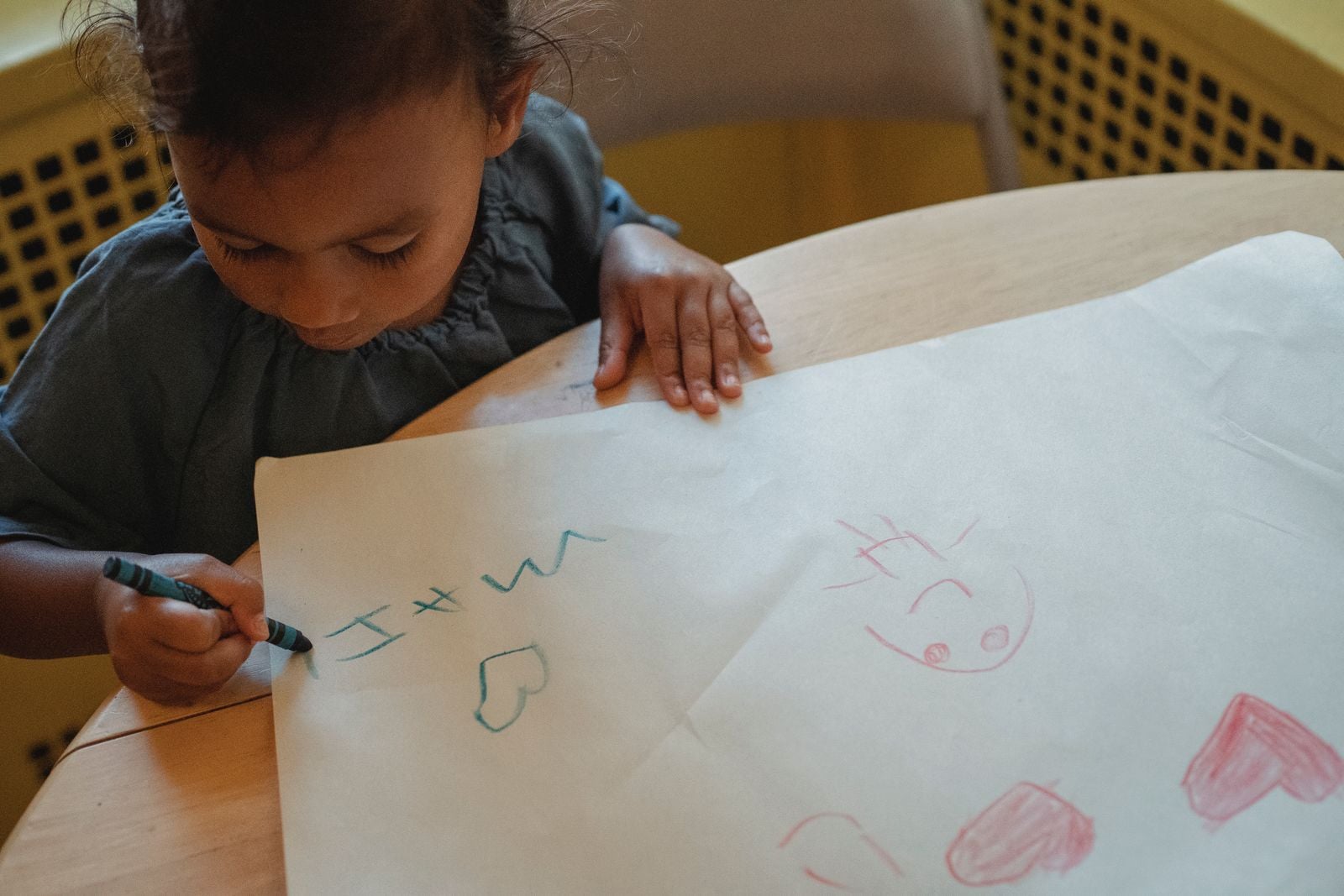

Ask many three- or four-year-olds to draw a person and the result will look instantly familiar: a large circle, two lines for legs, a face, and perhaps arms attached somewhere near the head. Adults often notice the missing torso first, but developmental researchers recognize the drawing as a common early form known as a tadpole or cephalopod figure. It is not a polished anatomical diagram, but it is usually a deliberate and recognizable person.
The pattern appears often enough that psychologists have studied it for decades. A cross-cultural study of tadpole self-drawings found the same basic structure in children from several very different communities, while also showing that culture affects details such as size, facial features, and expression. That does not mean every child follows the same timetable or produces the same drawing.
What a tadpole figure looks like
The simplest version is a closed round shape with two vertical lines extending from it. Eyes and a mouth may sit inside the circle, while arms can emerge from the sides of the circle or from the upper parts of the legs. Hair, hands, feet, clothing, and other details may appear, but there is no separate shape for the trunk.
That definition matters because children’s early drawings vary widely. One child may produce a nearly empty circle with legs, while another fills the same basic form with eyelashes, buttons, shoes, and a dramatic hairstyle. Both can still be tadpole figures if the head and trunk have not yet been separated on the page.
Why the torso disappears
There is no single settled explanation for the missing body. Some early theories treated the drawing as evidence that young children had an incomplete mental picture of a person, but later work showed that children often know more about body parts than their pictures reveal. The challenge may lie less in knowing that a torso exists and more in turning a complicated body plan into a sequence of marks.
Drawing a person requires several decisions at once. A child has to choose which part to draw first, remember what comes next, control the pencil, leave space for later features, and connect those features to the right places. A circle with limbs attached is an efficient solution because it turns a complicated figure into one main shape and a few lines.
Hand control and mental planning are still developing throughout the preschool years, although that does not by itself explain the tadpole figure. A 2025 manual dexterity training study involved children aged five to six and found gains in manual dexterity, working memory, and selective attention after a four-week program. The study is useful background on the connection between hand skills and cognitive demands, but it was not a review of preschool drawing and did not test why children omit torsos.
Experiments summarized in the tadpole-drawing literature point more directly to a planning effect. When children were given different-sized head and trunk shapes and asked to add arms, they tended to attach the arms to whichever shape was larger. That suggests the classic head-with-limbs arrangement can grow from the spatial rules children are using while they draw, not simply from a belief that people have no bodies.
The original comparison with human evolution also needs a clear limit. A Nature paper on the Jebel Irhoud fossils did describe a mosaic of more modern and more primitive cranial features, but it provides no evidence about children’s art. At most, it offers a loose metaphor for the way complex forms can become differentiated over time.
What cross-cultural research actually found
The 2015 study examined 183 tadpole self-drawings by children aged three to six from seven cultural groups. The samples included urban children in Germany, Sweden, Turkey, Costa Rica, and Estonia, along with rural children in Cameroon and India. Across those groups, the basic relationship between the head and legs followed similar patterns.
The details were not identical. Children in different settings varied in how large they drew themselves, how many facial features they included, and whether the face was smiling or neutral. The finding is more interesting than a claim of perfect universality because it shows two things happening at once: a recurring developmental structure and visible cultural influence.
It also means the tadpole should not be described as something every child everywhere produces on the same schedule. In the larger pool used for the study, only a portion of the children’s drawings met the researchers’ tadpole criteria. The form is widespread and recognizable, but individual experience, drawing practice, age, and culture still matter.
When the tadpole appears and changes
Tadpole figures often begin to appear around age three, although some children reach the form earlier or later and some barely use it. In a cross-sectional and longitudinal study of 42 children aged two to four years and eleven months, researchers categorized drawings as scribbles, distinct forms, tadpoles, transitional figures, or conventional figures. Their results supported a sequence in which the tadpole came before the conventional human figure.
The move toward a separate body is usually gradual rather than sudden. A child may place a belly button between the legs, add a line that begins to divide the round form, or stretch the figure until an upper and lower section become visible. Later, a distinct trunk appears and the arms shift onto it, while the head often remains much larger than adult proportions would suggest.
The belly-button experiment
One study offers a useful glimpse into how children may understand their own drawings. Researchers asked 73 preschoolers to draw a person and then to draw a person with a belly button. They expected children who drew tadpoles to add a separate body so the belly button would have somewhere anatomically correct to go.
Instead, many children simply placed the belly button on the existing figure without changing its structure. The researchers concluded that tadpole figures may not look as incomplete to the children who draw them as they do to adults. The circle may be doing more than one job in the child’s symbolic system, carrying the face while also standing in for the central body.
What parents can take from the stage
A single tadpole drawing is not a verdict on a child’s intelligence, imagination, or knowledge of the body. Developmental researchers reach conclusions by looking at patterns across many children and many drawings, not by judging one picture on a refrigerator. The missing torso is better read as part of an evolving drawing system than as an error that needs immediate repair.
Parents and educators can respond with curiosity instead of supplying the missing anatomy. “Tell me about this person” leaves room for the child to explain the picture, while a correction such as “people need bodies” shifts attention toward the adult’s finished product. Open-ended questions protect the child’s authorship and often reveal details that are present in the story even when they are absent from the page.
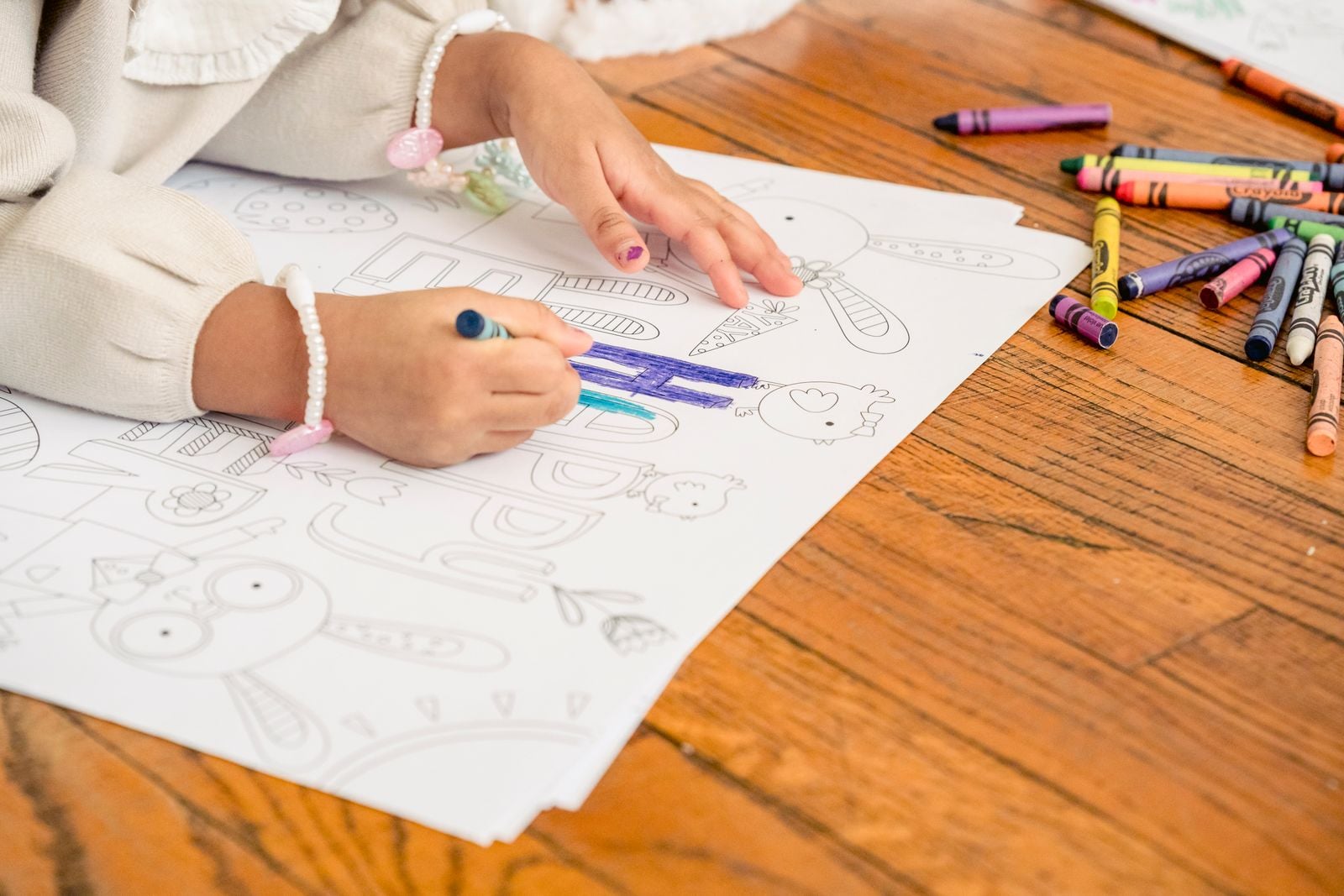
It also helps to keep materials easy to reach. A Hospital for Special Surgery guide for ages three to five includes art supplies and pretend play among activities that support practice and coordination. Thick crayons, washable markers, chalk, pencils, large paper, and drawing boards give children repeated chances to turn ideas into marks without making realism the goal.
A stage worth saving
The tadpole figure is brief, distinctive, and easy to overlook once a child’s drawings become more conventional. Over time, the torso arrives, limbs gain joints, hands collect fingers, and clothes begin to carry patterns and pockets. The earlier head-with-legs can suddenly look much stranger than it did when it first appeared.
Save a few and write the date on the back. They capture a moment when a child had enough graphic control to make a person recognizable, but was still inventing a workable visual language for the body. The drawing is not a failed adult figure; it is a successful early solution to a difficult representational problem.