
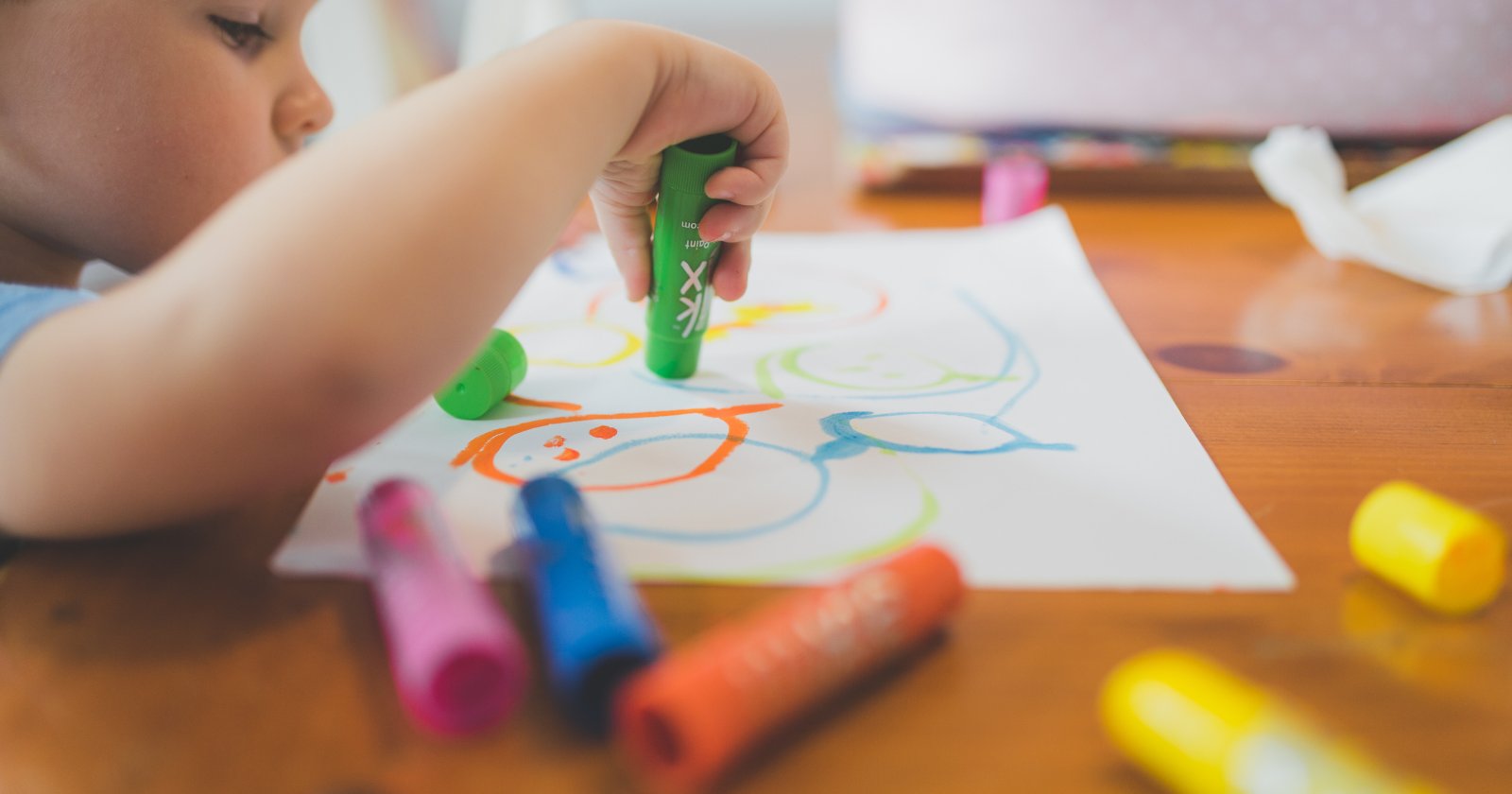
A child walks over holding a sheet of paper covered in red lines and looks up, waiting. Most adults say the first warm thing that comes to mind: “Good job!” or “I love it!” or “That’s so beautiful!” It’s kind, it’s quick, and the child usually smiles and runs off.
Those phrases come from a good place. Some early childhood educators suggest that they also miss an opportunity, and that a different kind of response can tell you far more about what the child was doing and keep them talking, drawing and thinking about their own work.
What one educator noticed
Ron Grady, an early childhood educator, author and illustrator, made the case in an article for the National Association for the Education of Young Children. Its title sums up his point: “A Scribble Is Never Just a Scribble.”
The Artful Parent
Family-life ideas and sharp reads, in your inbox.
Grady describes conversations with children about marks that looked meaningless to an adult and turned out to be anything but. In one, a child explained that her lines were the names of her family members. He reflects on how the exchange would have gone if he had responded differently: “How different our conversation might have been had I said only something like ‘Nice work’ or ‘It’s so beautiful!’”
The problem with “good job” isn’t that it’s wrong. It closes the conversation. It tells the child the adult has finished looking.
What to say instead
Grady’s suggestions are simple, and none of them require any art knowledge.
The first is an open invitation: “Tell me about what you have here.” He notes that this phrasing “does not demand a particular right answer, offer a value judgment, or seek to change the process or product.”
The second is to describe what you see, without judging it, and then ask: “I see a lot of lines going really far across the page. It’s all in red. Tell me more.” Describing the work shows the child you actually looked at it. You don’t need to know what it is to notice that it’s red, or big, or crowded into one corner.
The third is to comment on how they worked rather than on the result: “It looks like you worked hard on it,” or “That was all done really fast. You seemed focused on it.” This puts the attention on effort, choices and concentration, which the child controls, rather than on whether the picture is “good.”
Grady also writes the child’s own words directly on the artwork when they explain it. That turns a drawing into a record of what they meant, and it tells the child their explanation mattered enough to keep.
Why the focus on process
We’re not child psychologists, but research on praise points in the same direction as educators like Grady.
In a 1999 study published in Developmental Psychology, Melissa Kamins and Carol Dweck compared different kinds of feedback given to young children during role-played tasks. Some children received praise aimed at them as a person, such as being called good at something. Others received praise about the process, such as the effort or strategy they used.
When the children later faced a setback, those who had received person-focused praise showed significantly more “helpless” responses than those praised for process. The authors concluded that “person feedback, even when positive, can create vulnerability and a sense of contingent self-worth.” In other words, praise aimed at the child may tie feeling good about themselves to succeeding.
The study was small and didn’t involve drawing specifically, so it isn’t a rulebook for the fridge door. But it supports the same idea: comments about what a child did hold up better than verdicts about how good they are.
You don’t have to stop saying “I love it”
None of this means a parent can never say they love a drawing. Neither Grady’s article nor the praise research argues against warmth. The suggestion is to add something more specific, so the child knows you actually looked.
In practice, it can be as small as swapping one sentence. Instead of “Good job,” try “Tell me about this part,” or “You used so much blue.” Then wait. The answer is often the most interesting part of the drawing.