
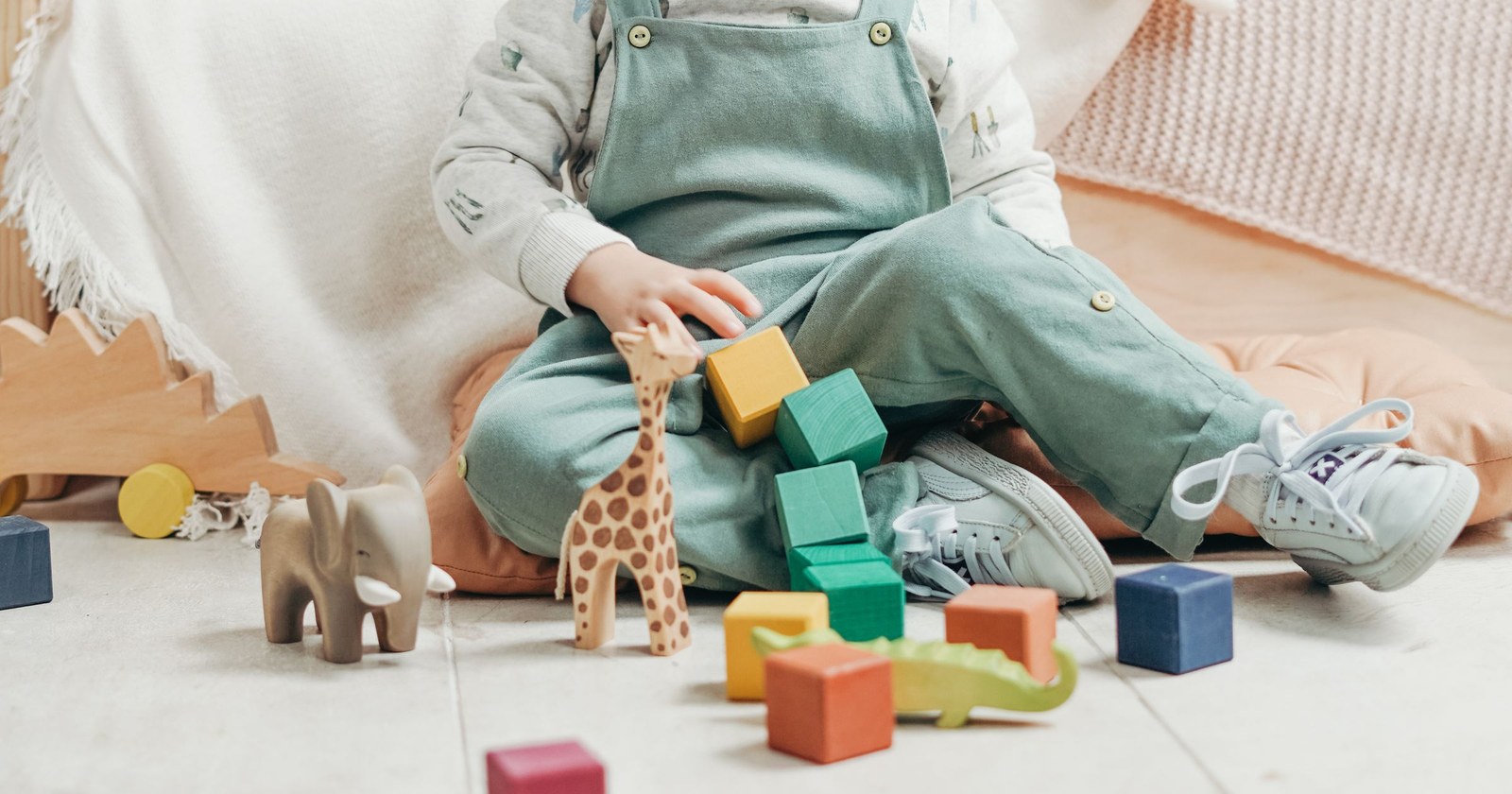

If you have ever stood in the living room at the end of the day, looking at a floor covered in toys your child barely touched, this study is for you. It does not say you bought the wrong toys. My reading of it is that most of us put too many of them out at once.
In 2018 a team at the University of Toledo tested something most parents suspect and few of us act on: that a toddler with fewer toys in front of them plays better with each one. The study, by Carly Dauch, Michelle Imwalle, Brooke Ocasio and Alexia E. Metz, was published in Infant Behavior and Development, and the full text is free to read. It is short. I read it twice.
What the researchers measured
The setup was simple. Thirty-six healthy toddlers aged 18 to 30 months each came to a plain, almost empty room with a small table, a chair and a shelf. A researcher sat in the room but never started any play, joining in only if the child came to them. A parent could come in if the child got upset. Each child visited twice within two weeks. One time the room held four toys. The other time it held 16. Which came first was decided at random, every session was filmed from several angles, and the first 15 minutes of play were scored later.
The Artful Parent
Family-life ideas and sharp reads, in your inbox.
With 16 toys, the children darted. Pick up, put down, pick up the next one. Roughly 20 separate bouts of play in those 15 minutes, each lasting 56 seconds on average. With four toys, they settled. About 10 bouts, each lasting 117 seconds on average, more than twice as long. They also found more to do with each toy. Eleven different ways of playing with a toy on average, against seven when the room was crowded. Drumming on it, dumping it out, pretending with it, fitting things into it.
What makes this worth taking seriously is the design. The same 36 children did both sessions, so each child was compared with themselves rather than with a different group of kids who might simply have been calmer. The researchers found no measurable effect of which session came first, and the effect held across the whole age range.
Here is why I think it matters more than the numbers alone suggest. Of the 31 parents who could put a number on how many toys they had at home, the average was 87. The smallest collection was 10. The largest was 300. Five other parents just answered “a lot.” If four toys beat 16 by this much, nobody has measured what 87 does to a two year old on a wet afternoon. The authors are honest that the gap between their quiet room and a real living room could cut either way: a home full of familiar toys might be less distracting than a room of new ones, or far more.
I will own up to a bias. My daughter is 15 months old, three months younger than the youngest child in this study, so I cannot claim she proves anything. But I have watched her on a floor covered in toys, flitting from one to the next without finishing with any of them, and I have watched her on a different afternoon with a single thing in her hands, turning it over and over for what felt like a very long time. One child on one floor is an anecdote. It was enough to send me looking for the study.
What toy quality adds
For an outside view I emailed Jeffrey Trawick-Smith, Professor Emeritus at the Center for Early Childhood Education at Eastern Connecticut State University. He led the TIMPANI toy study, which watched how three and four year olds played with toys in preschool classrooms. That is an older age in a different setting, and his study never tested how many toys were out. What it did was watch, over weeks, which toys children kept coming back to.
In his reply he said that for some toys, though not all, play faded over time. “Some toys, however, inspired high quality play over an extended period, suggesting that some toys have holding power. These tended to be simpler, nonrealistic materials that could be used in many different ways.” His examples were building toys such as Magna-Tiles and plain hardwood blocks. This was his first and strongest piece of advice for parents: pay attention to the quality of toys and which ones spark your child’s interest, not just how many are provided.
On the question of numbers, he was careful to say his own study never measured it. “I do think the numbers of toys can make a difference, although we did not study this directly. One theory I have is that for very young children, still developing a working memory, too many toys may result in cognitive overload.” That is his theory, not a finding. With so many choices, he suggested, a child may not even notice a toy they would have loved, because it is sitting among so many others.
Then he described something I suspect every parent will recognize. In the classrooms his team studied, when a toy that drew good play was put away for a time and then brought back, children treated it as though it were brand new. He watched children excitedly show friends a “new toy” that had been in the room only a week or so earlier.
Trying fewer toys at home
The Toledo authors land in the same place. When there is an abundance of toys, they write, “small collections can be rotated into play while the majority is stored away”. Neither source tested a particular routine, so treat what follows as an experiment you run on your own child rather than a formula.
- Put a small selection out and store the rest where your child cannot see them, if you have the space. The study used four toys. I would start somewhere near that and adjust.
- Watch what happens over a few play sessions. Which toys does your child return to, and which get a glance and nothing more? That is the question Trawick-Smith would have you ask.
- Swap something out when interest fades. There is no need to interrupt play that is still going well.
- Bring stored toys back after a while. Trawick-Smith’s observation suggests they may get a second life, and it costs nothing to find out.
- Expect the simple, open ended things to be the ones with staying power. Blocks, cups, boxes, anything that can be ten different things.
Where the findings stop
The study has limits and the authors say so. It was two small rooms, a university playroom and a spare bedroom in a volunteer’s house, not a home full of familiar things. The toys were new to the children, and new toys invite switching all on their own, which is awkward when switching is what you are measuring. Each child saw different toys in the two sessions, so the researchers could not fully separate the number of toys from the appeal of the particular toys that happened to be out. Each child did one session per condition, so nobody knows what happens on day 30 of a rotation. Twenty-seven of the 36 children were girls, and the families were mostly white and middle class. And bout length varied enormously, so a handful of very long bouts pull that 117 second average up.
What survives all of that is still useful, and the honest reading is modest: fewer toys out, in that room, on that day, meant longer and richer play with each one.
What I take from it as a parent is simpler still. The toys my daughter needs are almost certainly already in the house. My guess is that the thing standing between her and a long, absorbed stretch of play is not a missing toy. It is the other 80. So I am going to put fewer out and watch which ones she returns to. If she is still absorbed in something, it stays.
Trawick-Smith put the balance this way: “Numbers of toys matter, but so do the types of toys that inspire play, and the novelty of toys that have not been available for awhile.”