

Ask adults what they remember about their fathers and the answers are rarely about a single piece of advice. They tend to be about how a dad made them feel, what they did together, and whether he was there. Long-term research on fathers points in a similar direction. Across several large studies, a father’s affection, his play and his steady involvement have each been linked with how children fare years later, from their self-esteem as adults to their mental health in their thirties.
None of these studies can prove that a father’s behavior caused the outcome, and none of them describe every family. But read together, they say something useful about what children seem to carry forward.
Affection that is remembered
One of the more striking findings comes from a study of twins. Riley Marshall, Colin Harbke and Lisabeth Fisher DiLalla, working at Southern Illinois University and Western Illinois University, looked at 1,328 American adults, including 345 pairs of identical twins. They asked each person how much affection they remembered receiving from their mother and their father growing up, and measured their self-esteem as adults. The results were published in 2021 in the journal Behavior Genetics.
The Artful Parent
Family-life ideas and sharp reads, in your inbox.
Across the whole group, remembered affection from both parents was linked with higher adult self-esteem. The twins allowed a sharper test. Identical twins share all their genes and usually the same home, so when one twin remembers a warmer relationship with a parent than the other does, the difference is less likely to be explained by genetics or family background.
In those comparisons, the twin who remembered more affection from their father tended to have higher self-esteem. Differences in remembered affection from mothers did not show the same link. In a write-up for the Greater Good Science Center, psychologist Maryam Abdullah noted the researchers’ suggestion that because fathers often spend relatively more of their time with children in play rather than caregiving, their affection may stand out more in a child’s sense of self-worth.
There are limits here. The study relied on adults’ memories of childhood, which can be colored by how they feel about themselves now. The participants were overwhelmingly white Americans. And a 2023 study by the same research group, using a larger sample of adult twins, found that remembered affection from mothers mattered for self-esteem too. The lesson isn’t that mothers count for less. It is that a father’s warmth appears to leave its own mark.
Play that teaches self-control
Many fathers express affection through play, and that play may be doing more than it seems. In 2020, researchers at the University of Cambridge and the LEGO Foundation, led by Annabel Amodia-Bidakowska with Professor Paul Ramchandani, published a review of 78 studies carried out between 1977 and 2017, mostly in Europe and North America.
They found that father-child play tends to be more physical than play with mothers, and that across almost all the studies, there was a consistent link between fathers’ play and children’s later ability to manage their feelings and behavior. Ramchandani’s explanation is that rough-and-tumble play gives children a safe place to practice self-control: holding back their strength, noticing when things have gone too far, and recovering when someone gets an accidental bump.
There was an important exception. Fathers who were intrusive or controlling during play, taking over rather than following the child’s lead, were linked with poorer self-regulation in their children. Warm, child-led play seems to be the kind that helps.
Ramchandani was careful to add that the impact of father-child play should not be overstated, and that children who live only with their mothers need not be at a disadvantage. Play builds these skills; it is not the only way to build them.
Being there, year after year
The longest view comes from Britain’s National Child Development Study, which has followed thousands of people born in a single week in March 1958. Eirini Flouri and Ann Buchanan, then at the University of Oxford, used data on 8,441 of them to look at how involved their fathers had been and how they fared later.
“Involved” was measured in everyday terms: whether a father read to his child, took the child on outings, helped manage the child and was interested in the child’s schooling. Father involvement at age 7 was linked with fewer emotional and behavioral problems in adolescence among children from separated families. Father involvement at 16 was linked with less psychological distress at age 33 among women. Both findings held after accounting for how involved mothers were.
Flouri said in the announcement of the research that an involved father does not have to live with the child’s mother, or even be the child’s biological father.
A broader 2008 review in Acta Paediatrica, led by Anna Sarkadi at Uppsala University in Sweden, pulled together 24 papers from 16 long-term studies covering about 22,300 people, from newborns to young adults. In 22 of the 24 papers, fathers’ involvement was linked with positive outcomes. Regular, active engagement was associated with fewer behavior problems in boys, fewer psychological problems in young women, and better cognitive development.
The review also found something reassuring for fathers who worry about doing it right: no single form of engagement had been shown to work better than another. What seemed to matter was regular, active involvement of some kind.
What these studies can’t show
All of this research is observational. Fathers who are more involved may also differ in income, health, education or the quality of their relationship with the child’s mother, and those differences can shape children’s lives too. The Sarkadi review made this point directly, noting that it could not tell whether children living with a father figure did better because of the father himself or because the mother had more support at home.
Several of the studies also rely on reports collected decades ago, from families living very different lives from families today. And there are many children who grow up without a father nearby and thrive, often because other adults, including mothers, grandparents and stepparents, give them the same warmth and steady attention.
The findings are best read as a pattern across several studies, not a rule for every child.
The ordinary things that add up
What stands out, reading these studies side by side, is how ordinary the measures are. Affection remembered years later. Wrestling on the living room floor. Reading at bedtime, a day out, a question about school. None of it requires a perfect father, and none of it is a one-time lesson.
If there is one thing these children seem to carry with them, it is not a particular thing their father said. It is the experience of a dad who was warm, who played, and who kept showing up.
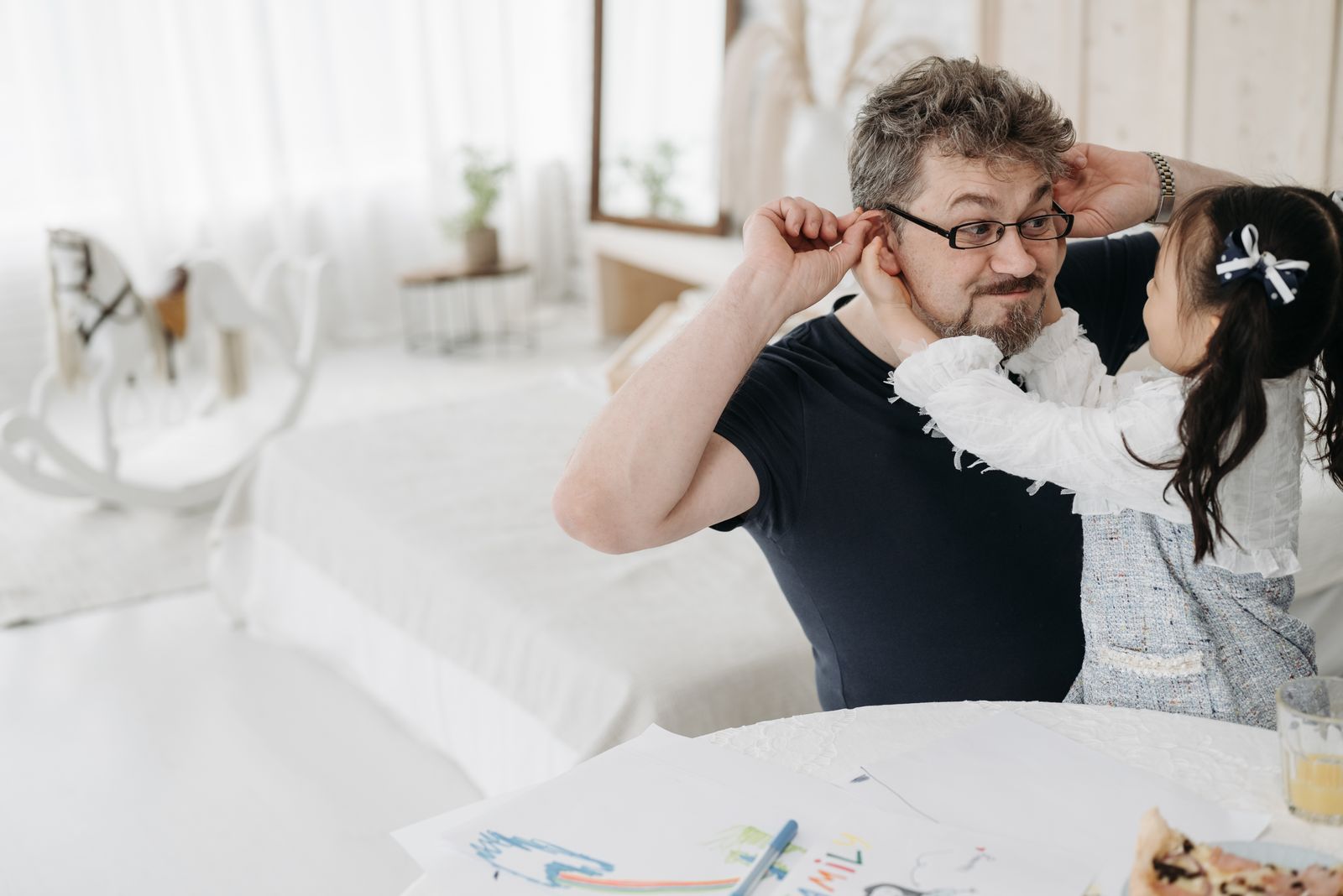
Representative image. Photo: Pavel Danilyuk / Pexels.