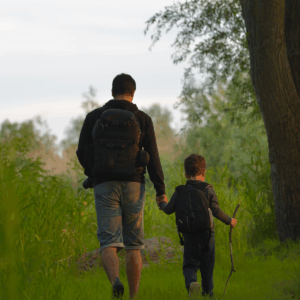

We were sitting at the kitchen table last week, my son and I, just talking the way we do now that he’s in his thirties and we’ve figured out how to actually talk. He said it casually, like he was just filling in a gap in the conversation. His favorite childhood memory, he told me, wasn’t the bike I bought him. The one I worked overtime for. The one I was so proud to wheel out on Christmas morning.
It was a Saturday I called in sick — genuinely couldn’t face going in — and spent the whole morning building a fort with him in the living room using couch cushions and every blanket we owned.
I didn’t know what to do with that for a moment.
I’d spent thirty years in human resources watching people navigate the hardest moments of their working lives. I thought I understood something about what people value. But sitting there listening to my son, I realized I’d completely missed something close to home. I’d been measuring my love in the wrong currency for years, and I never even knew it was happening.
The currency we think counts
When you’re in the middle of raising kids, you’re operating on a kind of autopilot logic. Provide. Protect. Give them what you didn’t have, or what you think they need. For me, that meant working hard, bringing home a decent income, and making sure there was something under the tree at Christmas that showed I’d made an effort.
That’s not a bad thing in itself. Kids need stability. They need a roof and food and someone keeping the lights on. But somewhere in that logic, I’d started equating effort with money and time at work — as if the hours I wasn’t home were proof of how much I cared, not evidence of what I was missing.
My wife Linda said something to me years ago that I didn’t fully hear at the time. She told me that what she needed wasn’t for me to fix things — it was for me to be there. I filed that away and told myself I was being there. I was providing. I was present enough.
But providing and being present aren’t the same thing. I know that now. I wish I’d known it at thirty-five.
What kids actually remember
I’ve been a grandfather for about eight years now. Four grandchildren, ranging from three to eleven. And one of the clearest things I’ve noticed is that kids don’t experience time the way adults do. They’re not thinking about mortgages or quarterly reviews or what happens if the car needs a repair. They’re in the afternoon. They’re in the blanket fort.
When I take my local grandchildren to the park on weekend mornings — something I protect pretty fiercely in my week now — it’s rarely the planned activity they talk about afterward. It’s the moment we stopped to watch a dog try to catch a stick in the pond. It’s me getting confused about the rules of whatever game they invented. It’s the unstructured stuff.
I’ve watched my own sons become fathers and I see them making their own versions of the same mistakes I made — different details, same shape. Every generation figures it out their own way, and I try not to say too much. But if there’s one thing I’d want to pass on, it’s this: the memory your child carries forward is almost never the thing you planned. It’s the moment you showed up without an agenda.
Related Stories from The Artful Parent
- I told my son I was doing it all for him, and at 63 he told me he would have traded every dollar for one conversation where I wasn’t half-asleep — a child will always choose connection over provision, but I built my entire identity on the opposite
- Psychologists say a child will always crave the thing they didn’t get — which is why people who grew up with critical parents spend their entire lives chasing validation, and people who grew up with absent parents can’t stop trying to earn love through service
- I’m 63 and I keep waiting for my kids to thank me for the sacrifices I made, but a child will always resent the sacrifices you remind them of — because it turns love into a debt they never asked to owe
The cost of keeping score the wrong way
Here’s something I learned in three decades of HR work: most conflict between people isn’t really about the thing they’re arguing about. It’s about feeling unheard. Feeling like they don’t matter enough to someone who should know better.
I think the same thing applies in families. When a child grows up feeling like your attention was always somewhere else — always on the job, always on the next thing — they don’t resent the job exactly. They just quietly absorb the message that they weren’t the priority. That the bike was a substitute for something that couldn’t be bought.
I pulled back from my boys during their teenage years. Work had gotten more demanding and I told myself they needed me less. I got that wrong. I know I got it wrong because they told me, eventually — when they were adults and we’d built enough trust for honesty. Those conversations were painful. But they were also some of the most important I’ve ever had, because apologizing for specific things you got wrong opens doors that staying defensive keeps permanently shut.
My son didn’t tell me the fort story to hurt me. He told it warmly, with a laugh. But it landed somewhere tender anyway, because I immediately thought of all the Saturdays I didn’t call in sick. All the mornings I chose the office over the living room and told myself I was doing the right thing.
How I’m trying to do it differently now
I can’t go back. That’s the plain truth of it, and I’ve had to sit with it. You can’t rebuild the Saturdays you missed or take back the overtime that kept you away. What you can do is pay attention to what you actually have.
Since retiring, I’ve had to completely rethink how I measure a good day. For most of my adult life, a good day meant I’d been useful. Productive. I’d solved something. That’s a hard wiring to undo. I went through a genuine rough patch in the first months after I stopped working — fell off a cliff, honestly — until I started building meaning from scratch instead of waiting for it to show up.
- The people who eat lunch alone at work and the people who can’t stand to eat alone at work are rarely arguing about lunch. They’re arguing about what rest means, and they’ll never agree because their nervous systems are solving completely different problems. - Global English Editing
- I’m 65 and the most frightening thing about losing my joy wasn’t losing it — it was how long it took me to notice it was gone, like a light that dims so slowly you keep thinking the room is fine until one day you can’t read anything anymore - Global English Editing
- Cognitive scientists say the reason old wounds get triggered by completely unrelated situations isn’t a sign of weakness. The brain stores pain not by content but by emotional signature, so a dismissive comment from a coworker can activate the exact same neural pathway as a parent’s rejection thirty years earlier - Global English Editing
What I came back to was pretty simple. The walk in the morning. Lunch with Linda, which I never had time for when I was working and now consider one of the better parts of my day. The grandchildren on weekend mornings. And the writing, which I started because Linda suggested I had something worth putting down, and which has turned out to be one of the more useful things I’ve ever done with my quiet hours.
None of that scores points on any external measure. No one’s handing out awards for a good park afternoon or a proper conversation over lunch. But that’s exactly the point. The currency that actually counts doesn’t show up on a payslip.
The things that cost nothing and mean everything
My son’s favorite memory was a blanket fort and a Saturday morning with his dad. He didn’t need the overtime hours. He needed me.
I can’t change what I got wrong. But I can make sure I understand it clearly enough not to repeat it — with my grandchildren, with Linda, with the relationships I still have time to tend properly. Presence over productivity. It took me until my sixties to really feel the truth of that, but I feel it now.
If you’re still in the middle of it — the busy years, the providing years — I’m not here to tell you that you’re doing it wrong. You’re doing what you can with what you have. But maybe check the currency you’re spending in. Make sure the people you love are getting the thing that actually matters to them, not just the thing you worked hard to give.
Sometimes the fort is worth more than the bike. Almost always, actually.