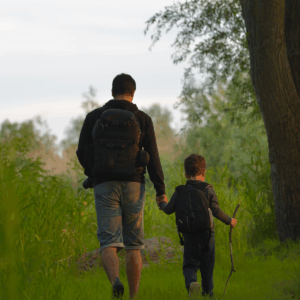
My granddaughter climbed into my lap last Saturday and told her dad — my son — that Grandpa Tony is “the patient one.” She said it so matter-of-factly, like it was just a known fact, like the sky being blue. And I smiled. I hugged her. I didn’t say a word.
But on the inside, I flinched.
Because my son was standing right there, and I know he heard it, and I know he knows — maybe better than anyone — that patient is not the first word he would have used to describe me when he was growing up. Not even close.
That moment has been sitting with me ever since. Not in a dramatic, can’t-sleep kind of way. More like a quiet ache that comes and goes. The gap between who I am now and who I was then is something I think about more as I get older. And I’m not sure I’ve ever really dealt with it properly.
What exhaustion does to a person
I spent over thirty years in human resources. I sat with people on the worst days of their working lives — terminations, grievances, personal crises. I was good at it. Patient, measured, calm. People told me that all the time.
And then I’d come home.
And whatever was left of me after a day of absorbing other people’s stress — which, by the time the boys were teenagers and work was at its most demanding, wasn’t much — that’s what my family got. The leftover version. The version that was too tired to engage, too depleted to ask real questions, too wound up to sit with discomfort without trying to fix it or shut it down.
I told myself I was providing. I told myself the long hours were for them. I told myself that working hard was its own kind of love language.
I was wrong. Or at least, I was incomplete. Because what my sons needed wasn’t just a provider. They needed a dad who showed up in the room — actually showed up, not just physically present while mentally still at the office.
The specific ways I got it wrong
This is the part I’ve had to sit with. Not vague guilt, but the specific stuff. Because vague guilt is just noise. It doesn’t change anything. The specific stuff — that’s where the real work is.
I pushed my older son toward a career path that made sense to me, on paper, and not enough sense to him as a person. I thought I was helping. I thought experience gave me the right to steer. It took years — and him telling me directly — before I really accepted that I’d been wrong about that.
My younger son once told me that my advice felt like constant criticism. That landed hard. Because I genuinely thought I was being helpful. I thought sharing what I’d learned was a gift. I didn’t understand that unsolicited wisdom isn’t wisdom — it’s noise with good intentions.
And the patience thing. The patience I’m apparently famous for now, with my grandkids at the park on a Saturday morning, following their lead with no agenda — I didn’t give that to my boys when they needed it. I gave them the version of me that had something else to do, somewhere else to be, a problem to solve before I could fully relax.
Why it’s harder to apologize to your kids than to strangers
One thing my time in HR taught me — something I believe to my core — is that most problems between people come down to unspoken expectations and poor communication. I’ve said that to a lot of people over the years. I believed it.
And yet, I avoided the most important conversations for a long time.
I think apologizing to your children, specifically, carries a particular weight that apologizing to anyone else doesn’t. Because the relationship is so loaded. Because part of you is still holding onto an identity — I was a good dad, I did my best, I worked hard for this family — and a genuine apology requires you to put that down. To say: yes, and I still got some important things wrong.
That’s hard. It doesn’t matter how old you are or how self-aware you think you’ve become. It’s still hard.
I started therapy for the first time in my sixties — later than I should have. One of the things I had to confront was that my reputation for being easy-going, being calm, being the one people could bring their problems to — a lot of that at home was actually conflict avoidance. I kept things smooth by not addressing things. And that had costs I hadn’t been honest with myself about.
What I’ve learned about apologizing to adult children
I’ve learned — slowly, and not without difficulty — that apologizing to your adult children for specific things you got wrong opens doors that staying defensive keeps closed.
Not a general “I wasn’t perfect, I did my best.” That’s not an apology. That’s self-protection wearing an apology’s clothes.
I mean sitting with your son and saying: I pushed you toward something that wasn’t right for you because I thought I knew better, and I didn’t, and I’m sorry. I mean saying: when you told me my advice felt like criticism, you were right, and I wish I’d heard that differently. I mean the actual thing.
My sons talk to me more now than they did when they were younger. I think that’s partly because I ask more questions and offer fewer opinions. But it’s also because I’ve shown them — not perfectly, not all at once — that I can hear hard things without shutting down or getting defensive. That I’m not too proud to be wrong.
That’s not something I could have done in my forties. I was too busy. Too tired. Too wrapped up in being right.
The gap between who I was and who I’ve become
Here’s the strange thing about being the “fun grandpa” — the patient one, the one who listens. It’s not fake. I genuinely am more patient now. I genuinely do love the slow Saturday mornings at the park, following a seven-year-old’s completely unpredictable logic about where we should walk next. I’m not performing it.
But I also know that the reason I can show up this way now is partly because I have fewer demands on me, and partly because retirement forced me to figure out who I was without a job title carrying me. That took longer than I expected and was harder than I admitted at the time.
The man my grandkids know is a real version of me. But so was the man my sons grew up with — the tired one, the distracted one, the one who thought fixing problems was the same as being present.
I can’t undo that. What I can do is close the gap between those two men honestly. Not by pretending the first one wasn’t real, but by being clear-eyed about where he fell short and saying so to the people who were most affected by it.
The apology I still owe
I haven’t said all of this to my son yet. Not in full. There are pieces I’ve started and pieces I haven’t found the right moment for — though I know, if I’m being honest with myself, that “waiting for the right moment” is sometimes just a softer way of putting it off.
What I know is this: the gap between who I was and who my grandkids think I’ve always been — that’s not something I can resolve in my own head. It has to be spoken, at least some of it.
Being older teaches you that time doesn’t actually solve things on its own. It just gives you more of it to either use or waste. And pride costs more than apologizing ever does. I learned that the hard way once already, with my brother, during a falling-out that went on for years longer than it ever needed to.
I don’t want to make that mistake again.
My son deserves to hear the real version of what I know now — not to make me feel better, but because he earned it. He lived through the exhausted years. He got the leftover version of his dad for longer than he should have.
That’s worth saying out loud. And I think I’m finally ready to say it.