


At about eighteen months old, a toddler sitting on the kitchen floor stacking cups is building roughly a million new neural connections every second. The figure comes from developmental neuroscience summarized by early-childhood researchers, and it is not a metaphor. Synapses — the tiny gaps where one brain cell hands a chemical signal to the next — are forming at that rate as the child watches your face, hears the cup clatter, feels the cold tile, and files all of it away.
Then, around age three, something quieter happens. The pace slows. The brain begins pruning.
What a million connections a second actually looks like
A million per second is the kind of number that slides off the brain like water. So translate it. In the time it takes a toddler to say “more,” perhaps half a second, five hundred thousand synapses have formed. In the length of a lullaby, thirty million. In one nap.
By the child’s second birthday, the cerebral cortex may hold more synapses than it ever will again in life. Peak synaptic density in a human brain happens in early childhood, not adulthood. A three-year-old may have roughly twice as many synapses as their mother.
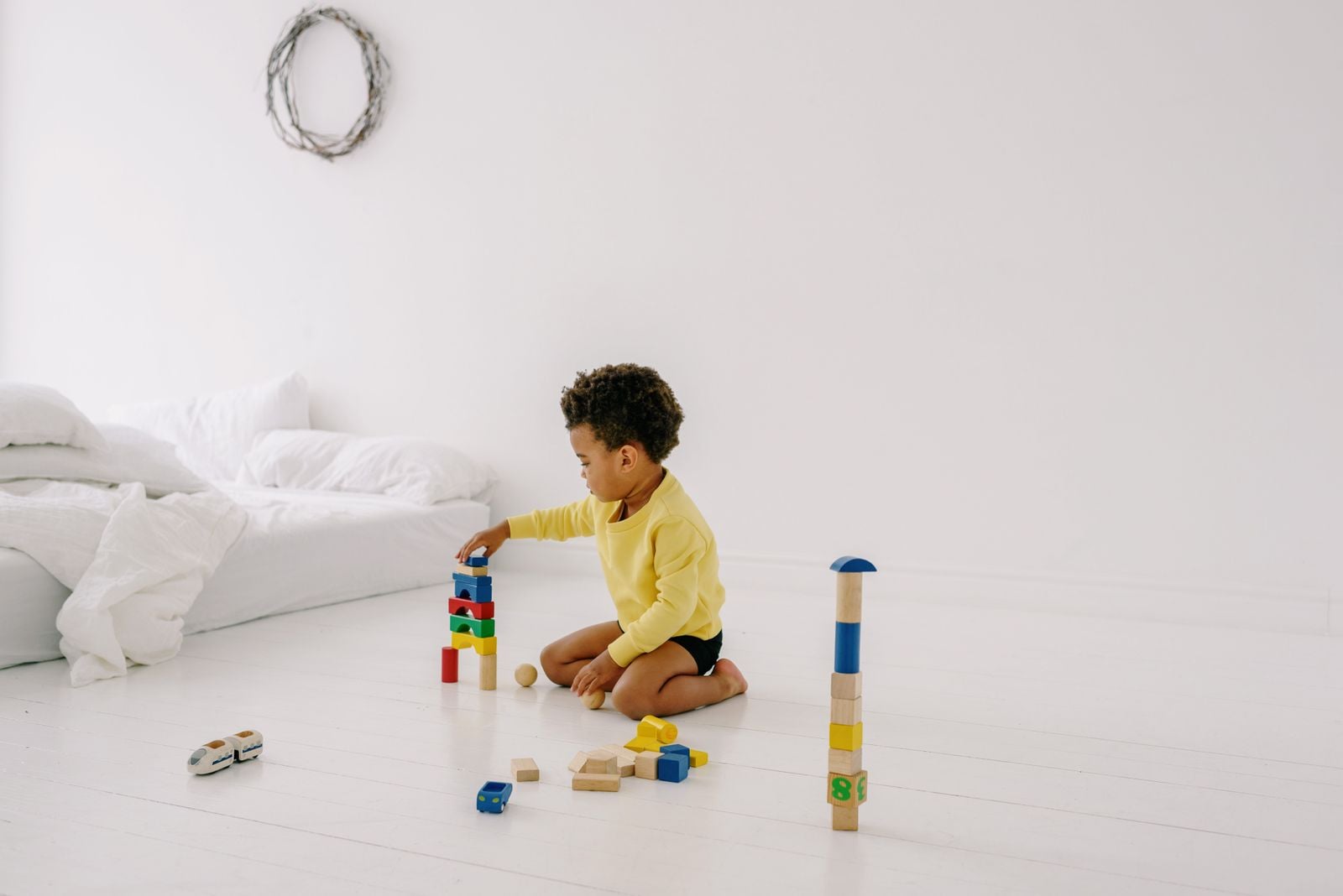
This is why the first five years get called irreversible. Public-health researchers presenting on early childhood development have pointed out that the brain’s structural development is largely complete by age five. The scaffolding gets built early. What happens after is mostly renovation.
The connections are not random
A synapse is not a light switch flipping on in isolation. Each one is shaped by what the child is actually doing — hearing a specific voice say a specific word, seeing a specific face crinkle in a specific way, feeling a specific hand catch them when they fall.
When a caregiver responds to a baby’s babble by babbling back, both people are wiring the baby’s brain in real time. The technical term for it is serve and return. The baby serves a sound or a look, the adult returns it, and the child’s auditory cortex, visual cortex, and social-processing regions all fire together and lay down a pathway.
Absence of that back-and-forth matters just as much. In children who experience chronic neglect, stress hormones like cortisol flood the developing brain and disrupt the areas responsible for memory, attention, and emotional control. The wiring still happens. It just gets shaped by cortisol rather than by connection.
Why the brain overbuilds on purpose
The million-a-second figure sounds wasteful until you understand the strategy. Human brains overbuild deliberately. A toddler’s brain is essentially throwing up scaffolding in every direction at once, then waiting to see which parts of the scaffolding get used.
The physics of it are startling. A 2023 review in Frontiers on the physical biology of human brain development describes how mechanical forces, cell migration, and molecular signals all coordinate to fold and wire the cortex during this window. It is one of the most complex construction projects in biology, and it happens on a timeline of months.
Networks form early too. Research on neonatal brain networks shows that even at birth, the brain already has recognizable wiring patterns — hubs and highways that will be strengthened or abandoned depending on what the child encounters in the first years outside the womb.
And then the pruning starts
Around age three, the brain shifts strategy. Instead of adding connections at maximum speed, it begins cutting the ones it decided it doesn’t need.
Synaptic pruning is exactly what it sounds like. Pathways that fire often get thicker, faster, more myelinated. Pathways that sit unused get dismantled. The cells that make up a synapse detach, the little bridge dissolves, and the material gets recycled. By adolescence, many of the peak synapses in some cortical regions will be gone.
This sounds alarming until you notice the payoff: the pathways that remain run faster and cleaner. A pruned brain is not a diminished brain. It is a specialized one. The child who heard English every day for three years now has a brain optimized for English phonemes. The child who heard Mandarin has one optimized for tonal distinctions an English-hearing brain will struggle with for life.

What pruning means for the messy kitchen table
If the first three years build the scaffolding and the years after prune it, then the ordinary business of childhood — the finger painting, the sandpile, the endless “why” questions — is not decoration. It is the input that decides which million-a-second connections stay.
Open-ended sensory play is unusually well-suited to this. When a toddler mashes a fist into cold blue paint, the tactile cortex fires, the visual cortex fires, the motor cortex fires, the language centers fire if a caregiver names the color, and the emotional-regulation networks fire because the child is deciding whether to be delighted or overwhelmed. Every one of those simultaneous firings tags the involved synapses as keep.
Compare that to a screen playing bright shapes at the same child. The visual cortex fires. Almost nothing else does. There is no serve, no return, no hand catching a falling cup, no caregiver naming what happened. The synapses involved in passive watching get reinforced. The others sit idle and get flagged for pruning.
This is not an argument that screens ruin brains. It is an argument that the child’s brain is, in a very literal sense, becoming what it practices.
The economics nobody expected
Because the window is so brief and so consequential, economists have started running the numbers on early childhood in ways that used to belong to neuroscientists. The results are strange. Reporting on the latest cognitive-development science suggests that quality early experiences shape not just school readiness but adult outcomes including income, health, and social behavior decades later.
Analyses of early-childhood programs have cited substantial returns on investment, with some suggesting returns as high as 300 percent. The reason is straightforward: it is cheaper to shape a brain during the million-a-second phase than to remediate one after pruning has locked in patterns you’d rather it hadn’t. As the saying goes: “It is easier to build strong children than to repair broken adults.”
What accelerates it, what slows it down
The pace of connection formation is not evenly distributed across children. It responds to conditions.
Things that appear to keep the rate high: responsive caregiving, being talked to and read to, unstructured play with real materials, safe exploration, adequate nutrition, sleep, and the presence of at least one adult who consistently notices the child. Programs like Brain Builders in Texas that coach young parents on these interactions exist because the mechanism is well enough understood to teach.
Things that appear to slow it or distort it: chronic stress, food insecurity, isolation, prolonged screen exposure without human mediation, and — importantly — the absence of consistent adult attention rather than the presence of any particular “enriching” activity. The brain does not need flash cards. It needs a face.
Premature birth changes the calculus too. Research on neonatal brain networks in preterm infants has documented how being born early alters the wiring constraints the brain works within — not fatally, but measurably, which is why the developmental support given to preemies in the first years matters so much.
What happens when pruning goes sideways
Pruning is delicate. When it works, it produces a fast, efficient, specialized brain. When it doesn’t, the consequences can be lifelong.
A review in Frontiers in Pharmacology on the neurobiology of autism spectrum disorder describes atypical synaptic pruning as one of several mechanisms implicated in ASD — either too little pruning in some regions, leaving the brain with an excess of connections that ordinarily would have been thinned, or unusual patterns in which connections get kept and which get cut. The million-a-second phase and the pruning that follows are not just background biology. They are where a great deal of what makes each brain particular gets decided.
The window is not a deadline
Because these numbers get repeated in policy briefings and parenting books, they sometimes calcify into panic. If 90 percent of the brain develops by age five, does the fifth birthday close a door?
Not quite. Pruning continues into the mid-twenties. The prefrontal cortex, the part responsible for planning and impulse control, is still being refined when a person is old enough to vote. New synapses form throughout life, particularly in the hippocampus, which is why adults can still learn languages, instruments, and skills. The rate is different. The mechanism is not gone.
What the early window does is set the foundation the rest of the brain builds on. A child whose earliest million-a-second years included consistent attention, varied sensory input, and language-rich exchanges enters kindergarten with wiring already tuned for learning. A child whose earliest years included chronic stress and little responsive interaction enters with wiring tuned for vigilance. Both brains keep developing. They are just working from different starting points.
Why any of this matters at the breakfast table
The temptation with a fact like a million connections per second is to feel either awestruck or terrified — awestruck at the machinery, terrified of doing it wrong. Neither reaction is especially useful at 7:14 on a Wednesday morning when a two-year-old is refusing oatmeal.
The more usable version of the fact is this: the ordinary interactions are the mechanism. The naming of the spoon, the answering of the tenth “why,” the mess of blueberry on the high-chair tray, the small negotiation about the sock. Each of those is a firing pattern the child’s brain is either strengthening or pruning based on how often it happens.
Recent editorial coverage on the counterproductive drive toward perfectionism is worth holding next to this. The developing brain doesn’t need optimized enrichment. It needs presence, repeated. A caregiver who shows up messy and attentive is doing more for the pruning process than one who shows up polished and distracted.
What eighteen months looks like from the inside
Try to picture it. The child on the kitchen floor is holding a wooden cup. She has decided the cup is a hat. She looks up to check whether you noticed. In the roughly two seconds this takes, her brain has formed something on the order of two million new synaptic connections. Some of them will survive to become the neural basis of her sense of humor. Some will encode the exact tone of your laugh. Some will be pruned by Tuesday.
She puts the cup back on her head. She waits again. The pace will slow soon enough. For now, the cup is a hat, and the wiring is being decided in real time, and the most important instrument in the room is your face.