

A two-year-old dragging her fingers through a puddle of yoghurt on a highchair tray is doing more neurological work than she will during any worksheet you hand her at four. Her hand is registering temperature, viscosity, and pressure. Her nose is sampling the sour top-note of the dairy. Her inner ear is tracking the small shifts of her torso as she leans forward. Her shoulder and elbow are feeding proprioceptive data back to a cortex that is, at that exact moment, still writing the map of what a body is and where it ends.
Occupational therapists watching this scene see four sensory systems firing at once: tactile, olfactory, proprioceptive, and vestibular. A worksheet activates roughly one — visual attention, with a thin ribbon of fine-motor control if a crayon is involved. The difference is not stylistic. It is structural, and it maps onto how the toddler brain is physically wired during the second and third years of life.
What “multi-sensory” actually means at the cortex
The word gets thrown around loosely. In neurological terms it has a specific meaning: separate streams of sensory information, arriving from different receptor systems, converging on overlapping regions of cortex and being bound into a single experience of the world.
The primary somatosensory cortex holds a map of the body — the sensory homunculus — with disproportionate real estate given to the hands, lips, and tongue. That map is not fixed at birth. Researchers using paediatric neuroimaging have documented that global remapping of the sensory homunculus emerges early in childhood development, establishing the body’s cortical map early rather than treating it as settled from birth. The map is shaped by early experience.
A yoghurt-smeared tray gives the fingertips something the crayon grip cannot: variable resistance, temperature gradient, sticky-to-slick transitions. Each of those is a distinct signal traveling up the median and ulnar nerves into a cortex that is still deciding how much space to assign to each fingertip.
The four systems in a single smear
Take the tactile system first. Skin receptors — Meissner corpuscles for light touch, Pacinian for vibration, Ruffini endings for stretch, Merkel discs for pressure — all fire at different rates depending on what the hand is doing. Yoghurt at fridge temperature versus yoghurt warmed by a palm activates thermoreceptors on a gradient. A worksheet does none of this.
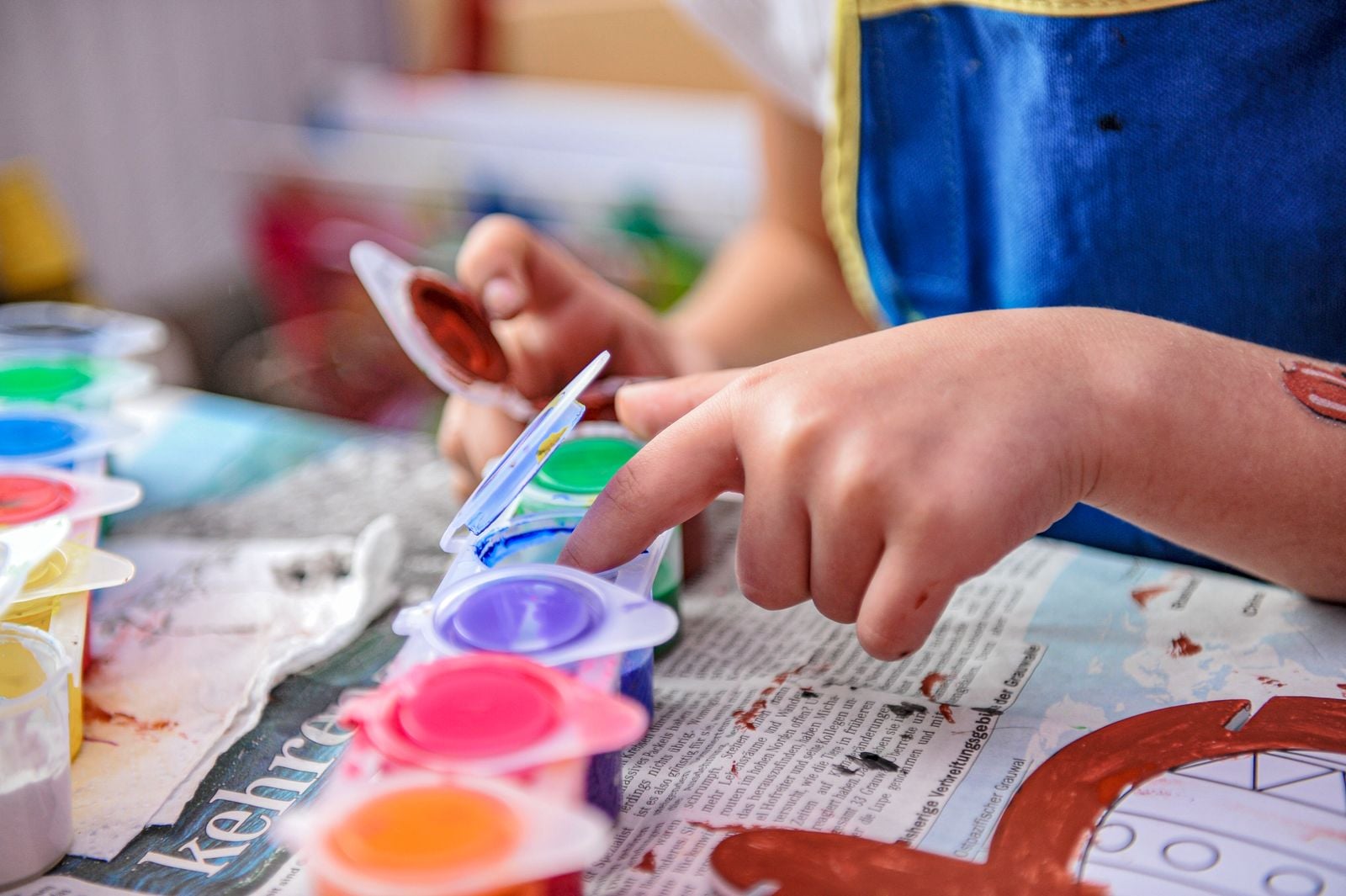
Proprioception is the second stream. This is the sense of where the limbs are in space, fed by receptors in muscles, tendons, and joints. When a toddler pushes her whole forearm through the smear, the shoulder girdle registers resistance and the elbow reports its angle. Occupational therapists call this “heavy work” input, and it is one of the most calming and organizing forms of sensory data a young nervous system can receive.
The vestibular system sits third. The inner ear detects head position and acceleration. A seated toddler leaning to reach the far corner of a tray is generating small vestibular signals continuously. Even a modest lean forward tells the brainstem which way is down and how the trunk is compensating.
And smell — often forgotten in play discussions — is the fourth. Olfactory input takes a uniquely short path to the limbic system, bypassing the thalamus that filters most sensory data. The sour hit of yoghurt or the earth-smell of finger paint reaches the amygdala and hippocampus almost directly, which is why sensory play memories tend to lodge so vividly.
Why the timing matters
The toddler cortex is not a small adult cortex. It is in the middle of a specific and time-limited process: synaptic overproduction, followed by pruning based on which connections get used. Synaptic spine density in the human prefrontal cortex remains elevated well into adolescence and beyond, with the frontal cortex continuing to develop into the third decade of life. The early years, though, are when the raw material is laid down thickest.
Pruning is not passive. Connections that fire together survive. Connections that sit idle are cleared. A child who spends her mornings running fingers through shaving foam, sand, cooked spaghetti, and wet leaves is casting a much wider net of “used” synapses than one whose sensory input is limited to a screen and a spoon.
Developmental neuroscience makes the same point at a population level: the character and richness of a child’s early environment shows up in measurable differences in cortical maturation.
What the worksheet is doing (and not doing)
A tidy worksheet — trace the line, circle the apple — recruits visual attention, a narrow fine-motor loop, and some working memory. That is not nothing. It is just narrow. The child is holding a crayon in a tripod grip that has not yet fully developed, on paper that gives uniform resistance, in a posture that requires no vestibular adjustment.
The neurological bandwidth in use is small. Compare that to the yoghurt tray: tactile discrimination, bilateral coordination, olfactory input, postural control, and the executive function required to decide whether to swirl, poke, or lick. Occupational therapists look at those two scenes and see wildly different levels of neurological engagement, even though the worksheet looks, to an adult eye, more like “learning.”
The role of unpredictability
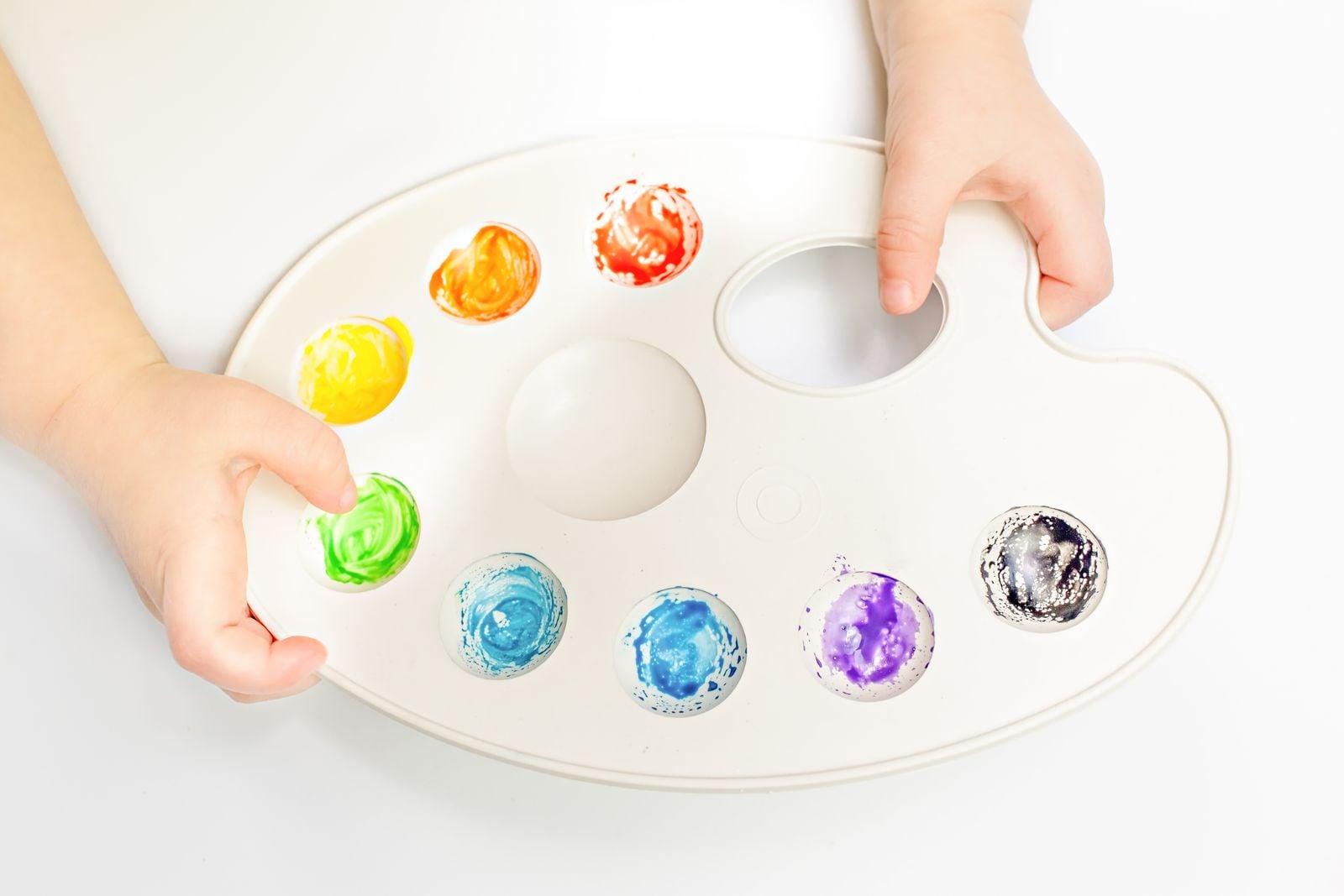
Messy play is unpredictable in ways a worksheet cannot be. Yoghurt behaves differently when it is cold versus room temperature, when it is thick versus thinned by a splash of water, when it hits a smooth surface versus a textured one. The child cannot know in advance what her hand will do to the material or what the material will do back.
That unpredictability is where prediction error lives, and prediction error is one of the strongest drivers of learning in a developing brain. The cortex updates its internal models when reality does not match expectation. A worksheet, by design, minimizes surprise. A tray of shaving cream maximizes it, within a safe frame.
Writing in The Conversation, developmental neuroscientists have emphasized that consistent, predictable parental behavior anchors optimal brain development — the caregiver is the stable reference point. The material itself, though, can and should be unpredictable. The child needs a reliable adult and unreliable yoghurt, not the other way around.
Why free, messy play seems to matter for mental health too
The neurological argument for sensory play sits alongside a longer-running argument about unstructured play more broadly. As children’s free play declined from the 1950s onward, measures of anxiety, depression, and helplessness rose across the same decades. The correlation is not proof of cause, but the pattern is hard to ignore.
The mechanisms proposed for that link — self-directed problem solving, emotional regulation practice, sensory integration — all overlap with what a toddler is doing at the yoghurt tray. Motherly has covered why unstructured play is treated as critical for brain development by pediatric researchers, and the through-line is the same: children need to encounter mess, make choices about it, and receive real feedback from the material world.
What occupational therapists actually watch for
When a pediatric OT observes a toddler in sensory play, the checklist is specific. Does the child cross the midline of her body with a smeared hand, or stay one-sided? Bilateral integration is a marker of maturing corpus callosum function. Does she tolerate the wet texture, or pull back sharply? A strong pull-back can be one of the earliest signals a therapist notes when tracking how a child processes sensory input.
Does her posture hold when she leans to reach? Trunk control feeds into vestibular processing. Does she bring both hands to the tray, or use one as a helper? Hand dominance is still being sorted at two, but the pattern of use tells a story. Does she notice when the yoghurt drips off the edge and adjust? That is prediction and correction — early executive function.
None of that is legible in a worksheet. A child either completes the tracing or she does not. The OT sees a binary. The tray gives a spectrum.
The neoteny problem
Human children have unusually long developmental windows compared to other primates. The extended plasticity of the human prefrontal cortex, which continues restructuring well into the twenties, is the trade-off for the flexibility that defines the species — it also means the input a child gets during the toddler years shapes an unusually long stretch of downstream development.
Clinical intervention work with children who have coordination and neuromuscular differences points to the same mechanism: repeated, targeted multi-sensory and movement input can drive measurable change in how the developing cortex organizes itself. The same principle — multi-sensory input driving cortical reorganization — is at work in a neurotypical two-year-old squishing playdough. The dosage is just different.
What this looks like at the kitchen table
The takeaway is not that worksheets are bad. Fine motor practice matters, and children benefit from moments of focused visual-motor work. The takeaway is that a two-year-old’s brain is designed to learn from mess, and the mess is doing more than the tidy activity looks like it should.
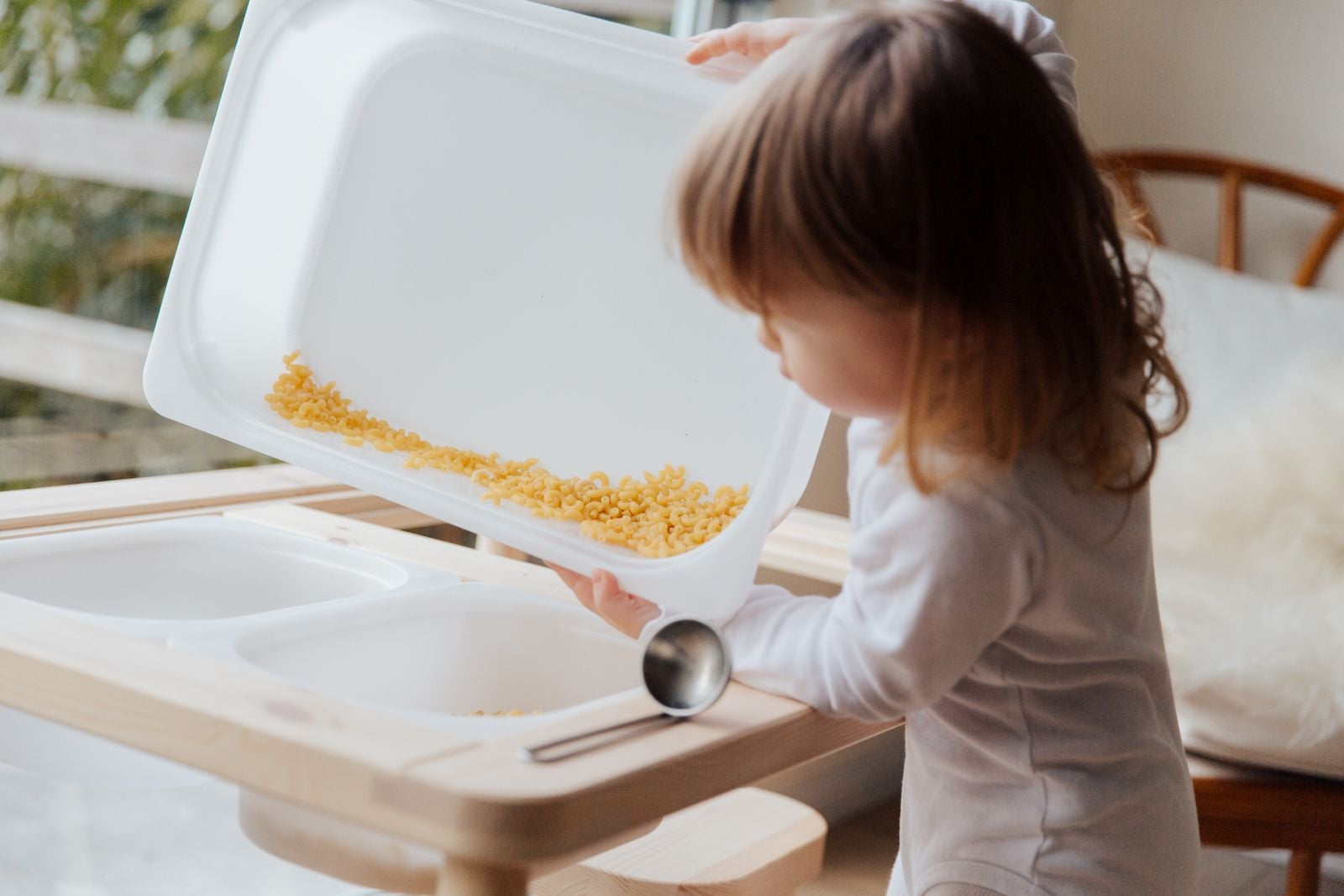
A tray of dry rice with a scoop. A shallow dish of cornstarch and water. A pile of wet leaves on a plastic mat. Cooked pasta, cooled. Shaving cream. Frozen berries in a bowl of warm water. Each of these lights up more of the cortex in five minutes than a workbook page will in twenty.
The yoghurt on the highchair tray is not a mess to clean up between real activities. It is the real activity. The cleanup is the interruption.