
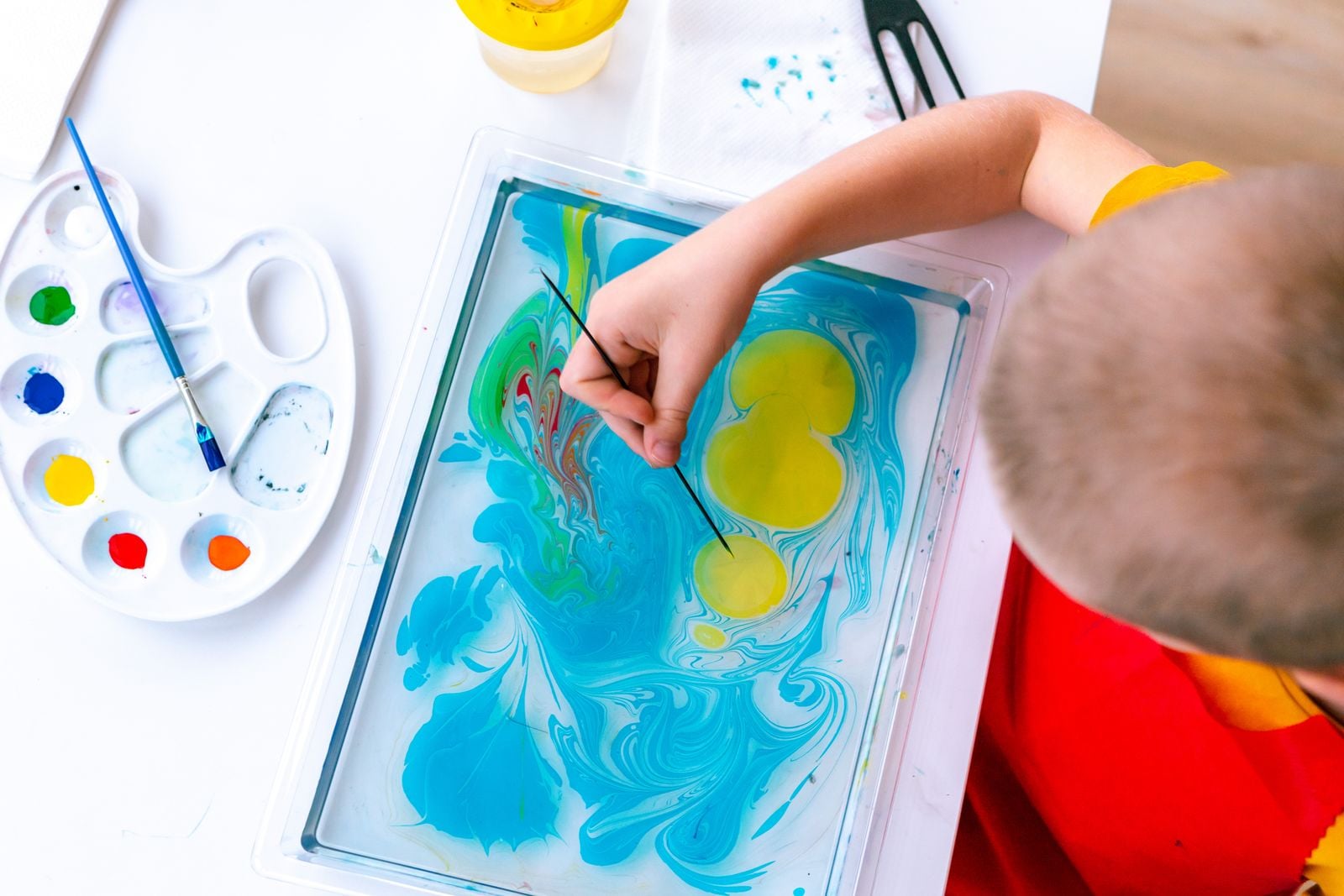

Whipped shaving cream on a tray is mostly gas held inside a concentrated liquid foam. When liquid food colouring lands on it, the dye does not instantly disappear into the cream. It remains close enough to the upper surface for a child to pull it into loops, ribbons and branching lines with a blunt craft stick.
The useful explanation is not that the colouring lacks the force to burst through millions of bubbles. Food colouring is water-based and hydrophilic, while soap molecules contain both water-attracting and water-repelling regions. A chemistry demonstration from Tennessee Tech explains that these interactions limit the dye’s mobility in shaving cream. When absorbent paper touches the pattern, its cellulose fibres readily take up the coloured water.
What surface tension actually is
Water molecules attract one another. A molecule inside a body of water is pulled in many directions, but a molecule at the surface experiences an unbalanced inward pull. The result is an air-water boundary that resists being stretched and behaves, within limits, like a flexible film.
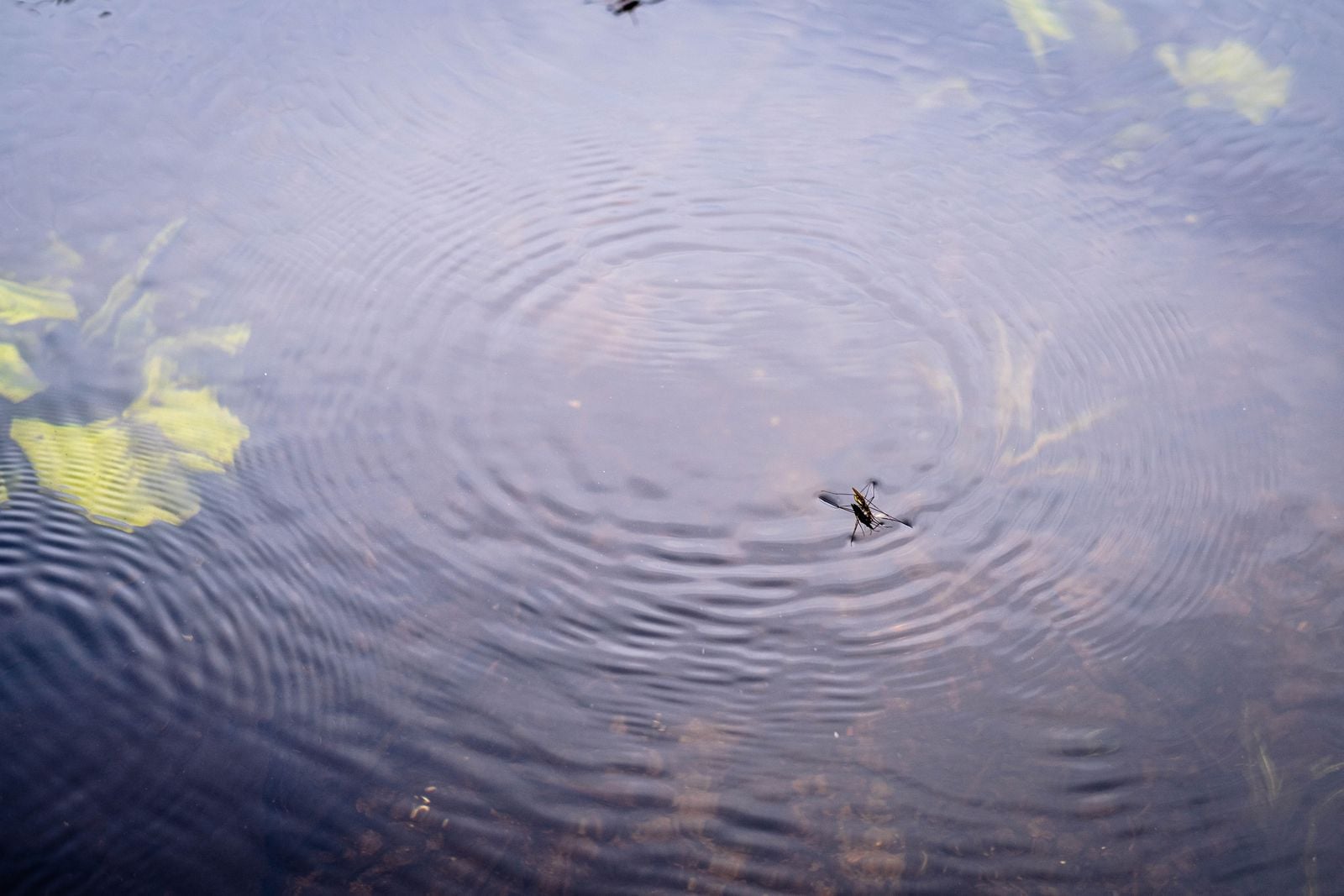
A water strider makes use of that boundary. Its long legs are covered in water-repelling microscopic hairs that help keep them from becoming fully wetted. The legs press downward and create visible dimples in the water without immediately breaking through it. Surface tension around those curved depressions supplies an upward force that helps support the insect.
Shaving cream is different. It contains thousands of air-water interfaces, but it also contains surfactants that lower the surface tension of water. Those surfactants make it easier to create bubbles and help keep neighbouring bubbles from merging too quickly. Research described by Drexel University notes that shaving-cream solutions combine low surface tension with high bulk viscosity, both of which contribute to stable foam formation.
Why the pigment stays near the top
Shaving cream is a dense liquid foam. Its bubbles are separated by thin films of water and surfactant, while the packed structure resists slow movement rather than flowing immediately like ordinary water.
Food colouring is usually dye dissolved in water. When a drop lands on the cream, it can enter the wet parts of the foam, but its movement is slowed. The dye therefore remains concentrated near the point where it landed long enough to be dragged across the upper layer.
A craft stick does not simply stir the colour into an open pool. It pushes and shears the foam, rearranging bubbles and carrying the concentrated dye along the path of the tool. A fast movement can leave narrow streaks, while a slower sweep may produce wider bands.
Paper changes the situation again. Cellulose fibres attract and absorb water, so the coloured liquid transfers readily when a sheet is pressed against the foam. The bulk of the air-filled cream remains on the tray or is removed with a ruler, while part of the dye stays inside the damp paper.
Water striders and the robots built to copy them
Surface tension becomes a much more direct supporting force when engineers build machines that must stand or move on open water. At Washington State University, Néstor O. Pérez-Arancibia, engineering PhD student Conor Trygstad and their colleagues developed a 22-millimetre robotic water strider supported by four disc-shaped feet.
The robot uses a tiny nickel-titanium shape-memory actuator. When an electrical current heats the alloy, it contracts; when it cools, it returns toward its previous shape. Cycling the current allows the device to flap its arms up to 40 times per second and paddle across the surface at about 6 millimetres per second.
Another collaboration involving UC Berkeley, Ajou University and Georgia Tech studied water striders in the genus Rhagovelia, often called ripple bugs. These insects live around moving water and possess collapsible, fan-like structures on their middle legs.
The fans open after entering water in roughly 10 milliseconds. Surface tension and the flexible ribbon-like structure provide the force that spreads them. The process is passive at the moment of deployment, although muscle action helps keep the fans positioned during a stroke and assists with folding them.
The insects can turn through 90 degrees in about 50 milliseconds and reach roughly 120 body lengths per second. Their robotic counterpart, Rhagobot, carries two flat-ribbon fans weighing about one milligram each. Each fan deploys when it contacts water, improving the robot’s thrust and ability to turn.
The connection to shaving-cream marbling is therefore real but narrower than it first appears. Both involve liquids, surfactants or air-water boundaries whose behaviour depends partly on forces acting at interfaces. The foam keeps a pattern workable by slowing the dye, while a strider relies on the shape and strength of an open water surface to support its body.
What young children can notice
Shaving-cream marbling looks like an open-ended art activity because that is exactly what it is. It also gives children immediate, visible feedback from every movement they make.
A child may notice that a fresh drop begins as a compact bead before spreading. A straight pull creates a different mark from a circle. Passing through two colours brings them together only along the route of the tool. Pressing paper onto the same tray twice produces two related but different prints.
None of these observations needs to become a formal lesson. The activity works because cause and effect remain visible. The hand moves, the foam shifts, and a pattern changes.
For very young children, use a blunt craft stick, the handle of a paintbrush or another age-appropriate tool rather than a toothpick or wooden skewer. An adult should supervise the activity, keep shaving cream away from mouths and eyes, and check the product label for any relevant warnings.
The strider’s cousin, upside down
Surface tension can also help support an animal from the other side of the boundary. Behavioural biologist John Gould documented a water scavenger beetle in Australia walking upside down along the underside of the water’s surface.
Gould’s video showed an air bubble along the beetle’s upturned belly. Researchers proposed that the bubble’s buoyancy might help hold the beetle against the underside of the interface while its feet press into the water film. The precise mechanics remain uncertain, but Science News reported that the beetle could scuttle beneath the surface as if it were solid.
The boundary is the same. The beetle simply approaches it from below.
What the soap is doing
Plain water has a surface tension of roughly 72 millinewtons per metre near room temperature. Soap lowers that value, which is why soapy water spreads across many surfaces more readily than clean water.
Lowering surface tension does not automatically destroy a foam. Surfactant molecules gather at the air-water interfaces around each bubble. Their water-attracting portions remain in the liquid, while their water-repelling portions point toward the air.
This arrangement helps thin films form around the bubbles and slows the process by which neighbouring bubbles merge. Viscosity, drainage, evaporation and the elasticity of those films also influence how long a particular shaving cream remains stable.
The food colouring is compatible with the watery parts of the foam, but it does not travel through the dense structure as freely as it would through a glass of water. That delay is what gives a child time to shape the colour before making the print.
What the paper catches
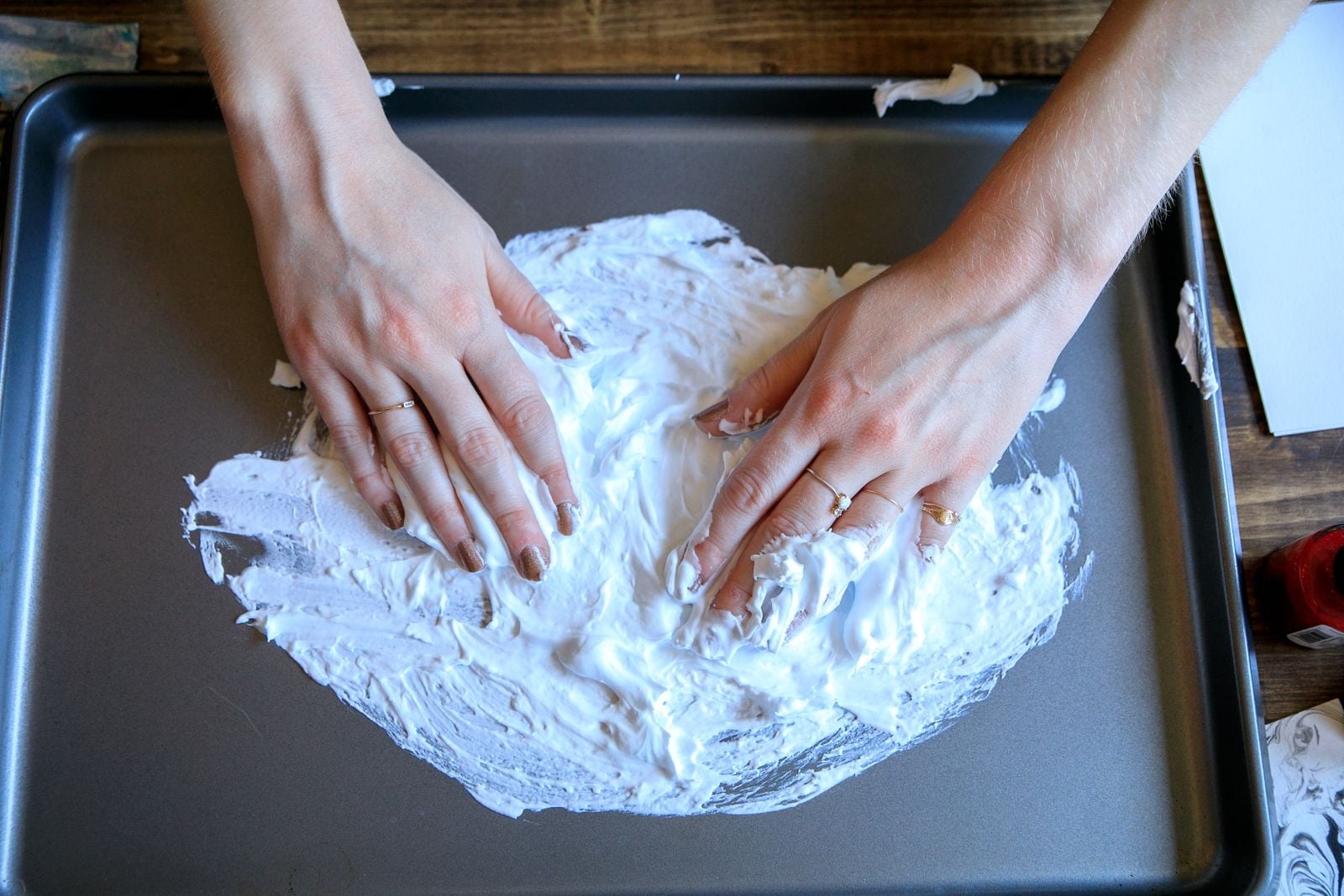
When paper touches the foam, its fibres begin absorbing the coloured water present near the contact points. The transfer is not a perfect map of every bubble. It is a record of where the dye was concentrated when the sheet met the upper surface.
After the paper is lifted, the remaining shaving cream can be removed with the flat edge of a ruler or a piece of cardboard. The dye that entered the fibres stays behind as the sheet dries.
A second print from the same tray is often lighter because some of the available colour has already transferred. If the foam sits for a long time, drainage and collapsing bubbles can also blur the design.
Where the physics becomes useful
Water-surface robots are not being developed only as demonstrations. The Washington State University team has discussed possible uses in environmental monitoring, artificial pollination, search and rescue, microfabrication and extremely small robotic devices.
Researchers from Seoul National University, Harvard and collaborating institutions have also studied how water striders jump without wasting their force by breaking the surface too early. Their work produced a 68-milligram jumping robotic insect that uses a carefully controlled impulsive mechanism to transfer momentum to the water.
Carnegie Mellon researchers were exploring similar questions in the 2000s. In 2007, the university described a spider-like robot developed in its NanoRobotics Laboratory under Metin Sitti’s leadership. The project aimed to create a microrobot able to stay and manoeuvre on water by drawing on principles observed in real water striders.
These machines show why engineers care about effects that can seem almost invisible at human scale. A force that barely changes the behaviour of a hand-sized object can determine whether a milligram-scale robot floats, turns or sinks.
The kitchen bench, one more time
Spread shaving cream across a rimmed tray and level it with the back of a spoon. Add small drops of two or three liquid colours. Give the child a blunt craft stick or paintbrush handle and let the pattern develop without requiring a particular result.
When the surface is ready, lower a sheet of sturdy paper onto it and press gently. Lift the paper, scrape away the remaining foam with a ruler, and leave the print flat to dry.
The result comes from several processes working together. Soap helps maintain the foam, its packed structure slows the water-based dye, and the paper absorbs the coloured liquid when it touches the surface. Elsewhere, an insect uses surface tension in another way entirely, pressing against open water without falling through.
On the tray, those forces leave behind something simpler: a pattern made by one set of hands that cannot be reproduced in exactly the same form again.