

Wealth and fame can make it easy to give children whatever they want. Yet some of the world’s best-known parents have described running their homes with surprisingly ordinary, even old-fashioned, rules: no phones until the teenage years, no television on school nights, chores before pocket money and fewer presents under the tree. Their rules are not evidence in themselves, and every family is different. But when those rules are set alongside the research, several of them hold up well.
Bill Gates: no phone until 14, and none at the table
In a 2017 interview with the British newspaper the Mirror, Microsoft co-founder Bill Gates said that he and his then-wife Melinda did not give their three children mobile phones until they turned 14, even though the children complained that their friends got phones earlier. He also said the family kept phones away from the table during meals and often set a time in the evening after which there were no screens, which he said helped the children get to sleep at a reasonable hour.
What the research says about waiting. The evidence on when children should get their first smartphone is still developing. In 2023, the nonprofit research group Sapien Labs published a report based on an online survey of 27,969 young adults aged 18 to 24 in dozens of countries. Those who said they had received their first smartphone or tablet at an older age tended to report better mental wellbeing as young adults, with the pattern strongest among women. Among women who got a phone at age 6, 74 percent were classed as distressed or struggling, compared with 46 percent of those who got one at 18.
The Artful Parent
Family-life ideas and sharp reads, in your inbox.
The report has important limits. It was not peer reviewed when released, it relied on people volunteering to take an online survey, and it shows an association rather than proof that early phones cause harm. A smaller Stanford Medicine study that followed about 250 children over five years found no link between the age children got their first phone and their sleep, symptoms of depression or school grades. Researchers broadly agree that more evidence is needed, and that what children do on their phones, and what it replaces, may matter as much as the age they start.
What the research says about phones at meals. The evidence for Gates’s dinner-table rule is clearer. In a study published in the Journal of Experimental Social Psychology, Ryan Dwyer, Kostadin Kushlev and Elizabeth Dunn of the University of British Columbia sent 304 people to share a restaurant meal with friends or family. Some were asked to keep their phones on the table, while others put them away. Those with phones at hand felt more distracted and enjoyed the meal less. A second study that tracked people through their daily lives found a similar pattern whenever they used their phones during face-to-face time with others.
The effect was modest, and the researchers said occasional phone use will not ruin a family dinner. But for families who want mealtimes to be a time of connection, putting devices away appears to help.
The Obamas: chores and no weeknight screens, even in the White House
Barack and Michelle Obama spoke often about keeping life as normal as possible for their daughters, Malia and Sasha, during their years in the White House. Michelle Obama said in several interviews that the girls had to make their beds and tidy their rooms, had regular chores, and received their small allowance only once they had shown that the chores were done. She also said the family did not allow television or computer use on school nights unless it was for homework. Barack Obama summed up the family’s approach in a 2014 CNN interview as giving children unconditional love along with some structure and rules.
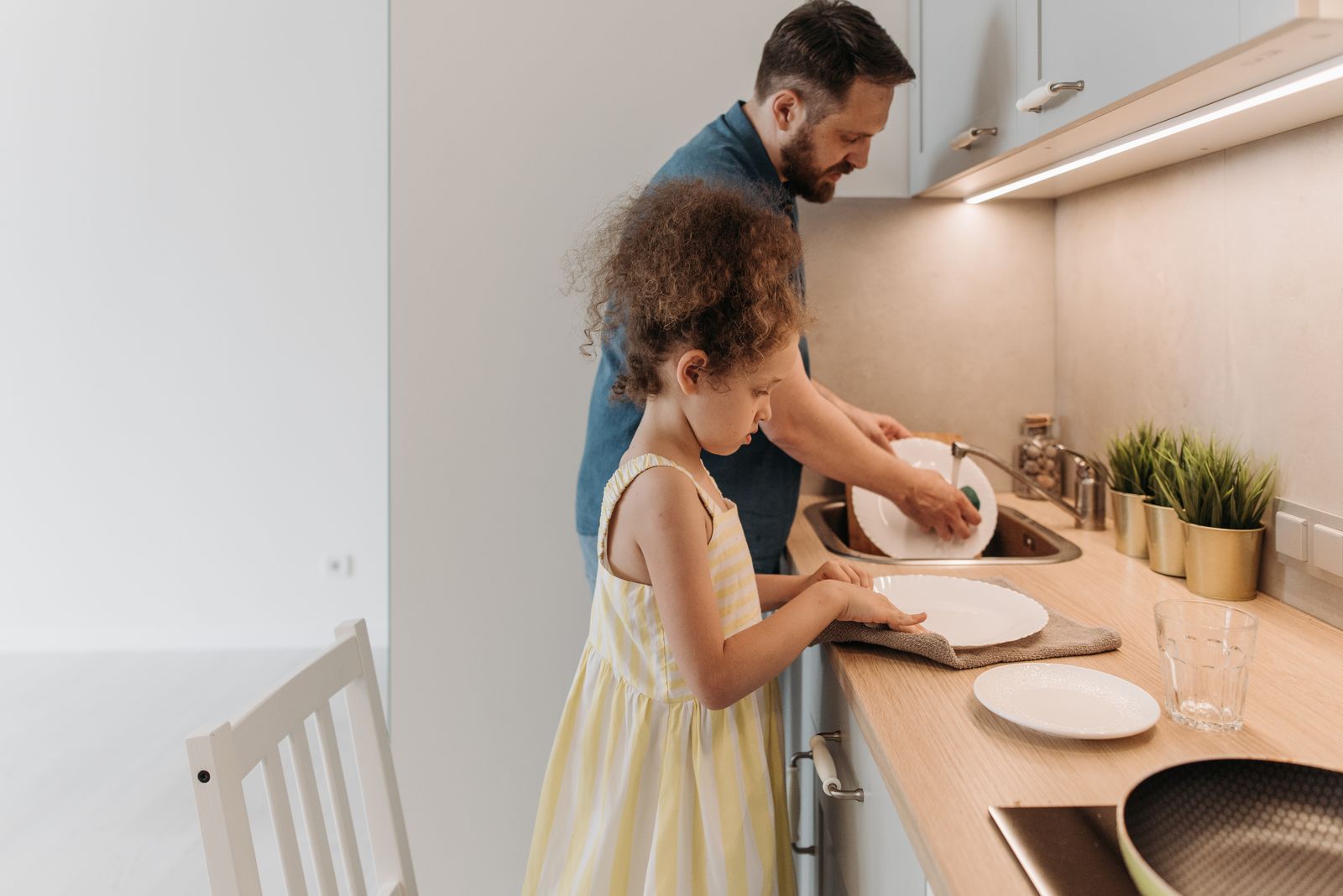
What the research says about chores. A 2022 study from La Trobe University in Melbourne, published in the Australian Occupational Therapy Journal, looked at 207 children aged 5 to 13. Deanna Tepper and colleagues asked parents and carers how often their children did household chores and assessed the children’s executive functions, the mental skills involved in planning, self-control and holding information in mind.
Children who did more chores, particularly caring for themselves and helping the family, such as preparing meals or putting away their belongings, tended to have better working memory and self-control. Pet-care chores were not linked to these skills. The study was a snapshot rather than an experiment, so it cannot show that chores caused the difference. Children with stronger skills may simply be given more responsibility, and other family factors may play a part. But the researchers suggested that everyday tasks such as cooking or gardening may give children regular practice at exactly the kind of thinking skills that help at school and later in life.
The Obamas’ pairing of firm rules with affection also echoes decades of parenting research. Psychologists have long found that the style often called authoritative parenting, which combines warmth with clear expectations, tends to be linked with better outcomes for children than either very strict or very permissive approaches.
Mila Kunis and Ashton Kutcher: no presents at Christmas
In a 2017 interview with Entertainment Tonight, actor Mila Kunis said that she and her husband, Ashton Kutcher, had decided not to give their two young children Christmas presents. She explained that their daughter had received far too many gifts the previous year. The couple asked grandparents to give a single present or make a donation to charity instead, while building their own family traditions around the holiday.
What the research says about gifts. A 2015 study in the Journal of Consumer Research by Marsha Richins of the University of Missouri and Lan Nguyen Chaplin of the University of Illinois at Chicago surveyed 701 adults about how they had been raised. Those who recalled receiving many material rewards as children, such as gifts for good grades or presents as a way of showing affection, were more likely as adults to define themselves by their possessions and to admire people with expensive things. Previous research has linked this kind of materialism to lower wellbeing and more financial and relationship problems.
The researchers stressed that the parents in these situations were often warm and loving, and that gifts in moderation are fine. The concern is when material things become the main way of expressing love or rewarding success. They suggested parents place more emphasis on gratitude, time together and shared experiences.
What these rules have in common
Most families will not adopt any of these rules exactly, and nobody needs a celebrity’s approval to parent well. But the rules share a few themes that the research supports: protecting time together from distraction, giving children real responsibilities, and avoiding the habit of using things as a substitute for attention.
Perhaps the most useful lesson is the one Barack Obama described. Rules on screens, chores or gifts seem to work best not as ends in themselves, but as part of a home where children feel loved and know what is expected of them.
Photo by Pavel Danilyuk on Pexels