
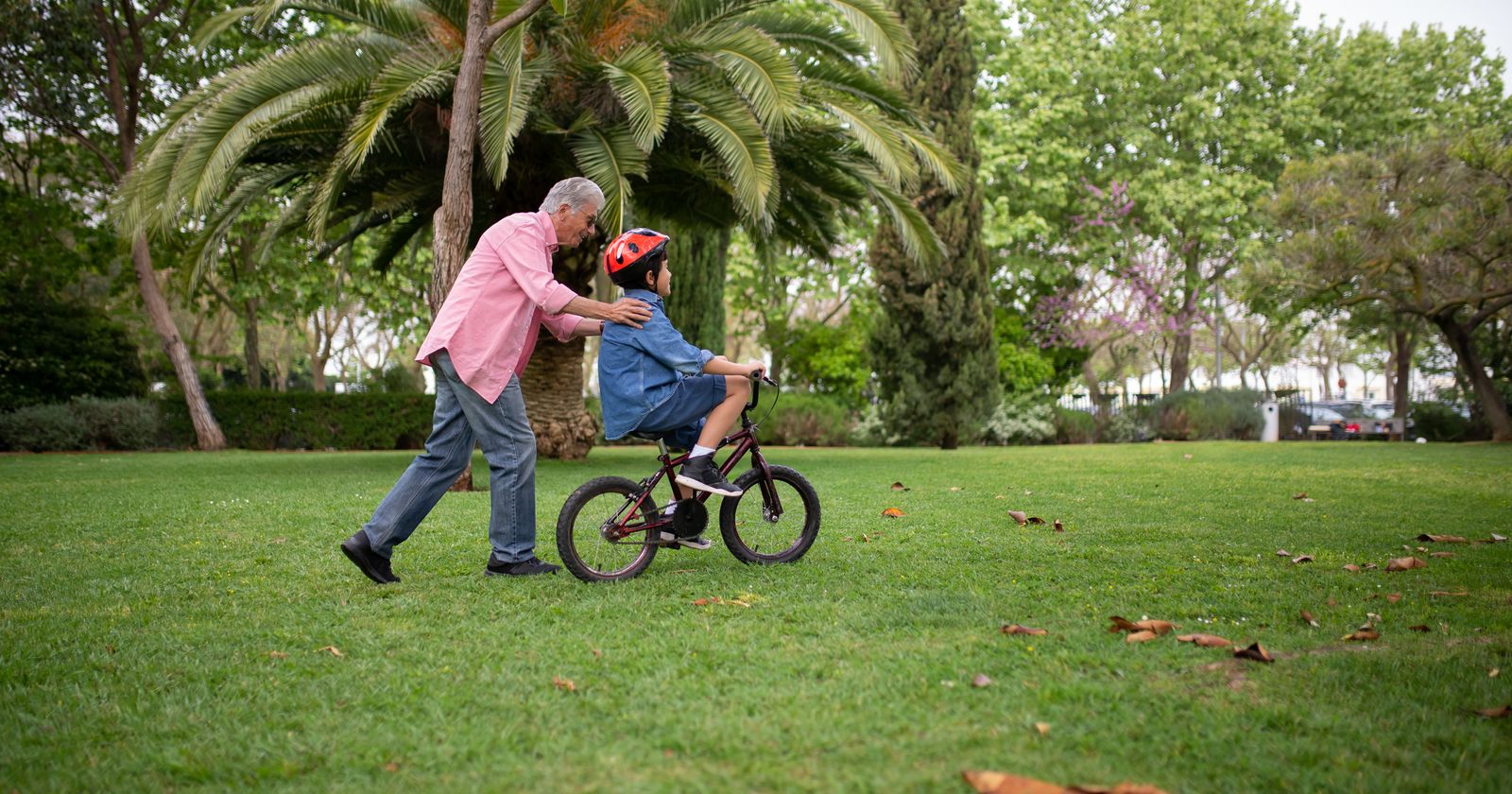
Your nine-year-old grandson finds the sneakers he wants, taps twice, and they’re in the cart. “Mom says she’ll order them tonight.”
You think of the red bicycle in the hardware store window, the summer you were ten. It took you most of that summer, mowing lawns at a quarter a yard, to pay for it. You still remember the day you rode it home.
If you grew up in the 1950s and 60s, a lot of your lessons came the same way: slowly, by necessity, and sometimes the hard way. Not everything about those years was better. Plenty was harder for reasons nobody misses, and not every family had the same experience. But some of those lessons are worth keeping. Many were taught by circumstance, and circumstances have changed, so today they usually have to be taught on purpose. Here are eight, with simple ways to pass them on.
The Artful Parent
Family-life ideas and sharp reads, in your inbox.
1. If you want something, you save for it
Back to the red bicycle. Many families had little room for buying things they couldn’t pay for yet, so you waited, saved, and sometimes put something on layaway at the department store and paid it off a little each week.
Waiting taught patience. It also taught you how much you really wanted something. Some things you stopped wanting halfway through saving, and that was a lesson too.
Try this: give a child a clear jar for something they want. Let them watch the coins add up, and resist the urge to top it off so they get there faster.
2. Things are meant to last
Socks got darned. Jeans got patches on the knees. Your older cousin’s winter coat became yours, then your little sister’s.
Many people who grew up this way had parents who’d lived through the Depression or the war, when throwing something out was a last resort. It could be embarrassing to wear the patched pants to school. But it taught you to look after what you had.
Try this: the next time a stuffed animal splits a seam or a shirt loses a button, fix it together instead of replacing it. Let your grandchild pick the thread color.
3. Nothing on the table goes to waste
Sunday’s roast became Monday’s sandwiches and Tuesday’s soup. Stale bread turned into bread pudding. Bacon grease went in a can by the stove.
Food waste is still a big problem. The USDA estimates that 30 to 40 percent of the US food supply goes to waste.
Try this: once a week, have a leftovers night and let the kids help decide what to make. “What can we do with half a chicken and some rice?” can turn into a pretty good game.
4. You share, and you work it out
One television, with three channels. One phone, in the hallway, with a cord that only reached so far. One bathroom for five people on a school morning.
There was no way around it. You took turns, made deals with your brother over which show to watch, and learned to knock. Sometimes the negotiations got loud. Mostly, you got better at them.
Try this: pick one shared thing at home, like choosing the Saturday movie, and let the kids work out whose turn it is before an adult steps in.
5. Money comes from work
Paper routes, babysitting, mowing lawns, bagging groceries. For many kids, the first money that was truly theirs came from a job.
Teen jobs are less common than they were. In most summers from 1948 through 2000, more than half of 16- to 19-year-olds in the US worked for pay, according to a Pew Research Center analysis of federal data. In summer 2026, averaging June and July, it was 35.5%. (Earlier summer figures also include August.) Economists have pointed to several possible reasons, Pew notes, including fewer entry-level jobs, school years that run later into June, and more teens taking summer classes.
Try this: offer a grandchild a real paid job, like washing the car or weeding the garden, with a fair price agreed up front. Pay them when the job is done, not before.
6. When you break it, you go to the door
The baseball went through Mrs. Kowalski’s front window. Nobody called her for you. You walked over, knocked, and said it yourself. Then you paid for the glass out of your allowance for the next two months.
That long walk to the door was hard. But facing someone directly taught you that mistakes can be fixed, and that the fixing is your job.
Try this: when a child breaks something that belongs to someone else, go with them and let them say the part that’s theirs: “I’m sorry I broke your window.” Then you can add the grown-up part: “I’ll talk with you about getting it fixed.”
7. You don’t always win
You tried out for the team and didn’t make it. You lost at checkers to your grandfather, again, because he never let you win.
Losing stung. But it also meant that when you finally did win, you knew you’d earned it. Many families today work hard to protect kids from disappointment, which comes from love. A little losing, in safe places, can still be good practice.
Try this: play board games with your grandkids without letting them win every time. If they lose, keep it light: “Good game. Want a rematch?”
8. You know your neighbors
You knew whose porch light meant you could knock, who had the best Halloween candy, and which neighbor would call your mother if you were somewhere you shouldn’t be.
Fewer people know their neighbors well today. In a 2025 survey, Pew Research Center found that 26% of US adults said they knew all or most of their neighbors, down from 31% in 2018.
Try this: take your grandchild with you to drop off something small, like a few cookies or a tomato from the garden, to a neighbor. Let them ring the bell.
Passing it on
You don’t need to recreate the 1950s, and you wouldn’t want to. But a few of these lessons fit easily into a modern childhood.
Back to your grandson. The sneakers may be exactly what he needs. Kids outgrow shoes. But the next time he mentions something he’d simply like to have, like a bike bell or a new set of markers, you might try: “Tell you what. Wash my car this Saturday, and I’ll pay you for it. Then we can start a jar for the bell.” It won’t take a whole summer. But it might be the first thing he remembers saving for, the way you still remember that red bicycle.