
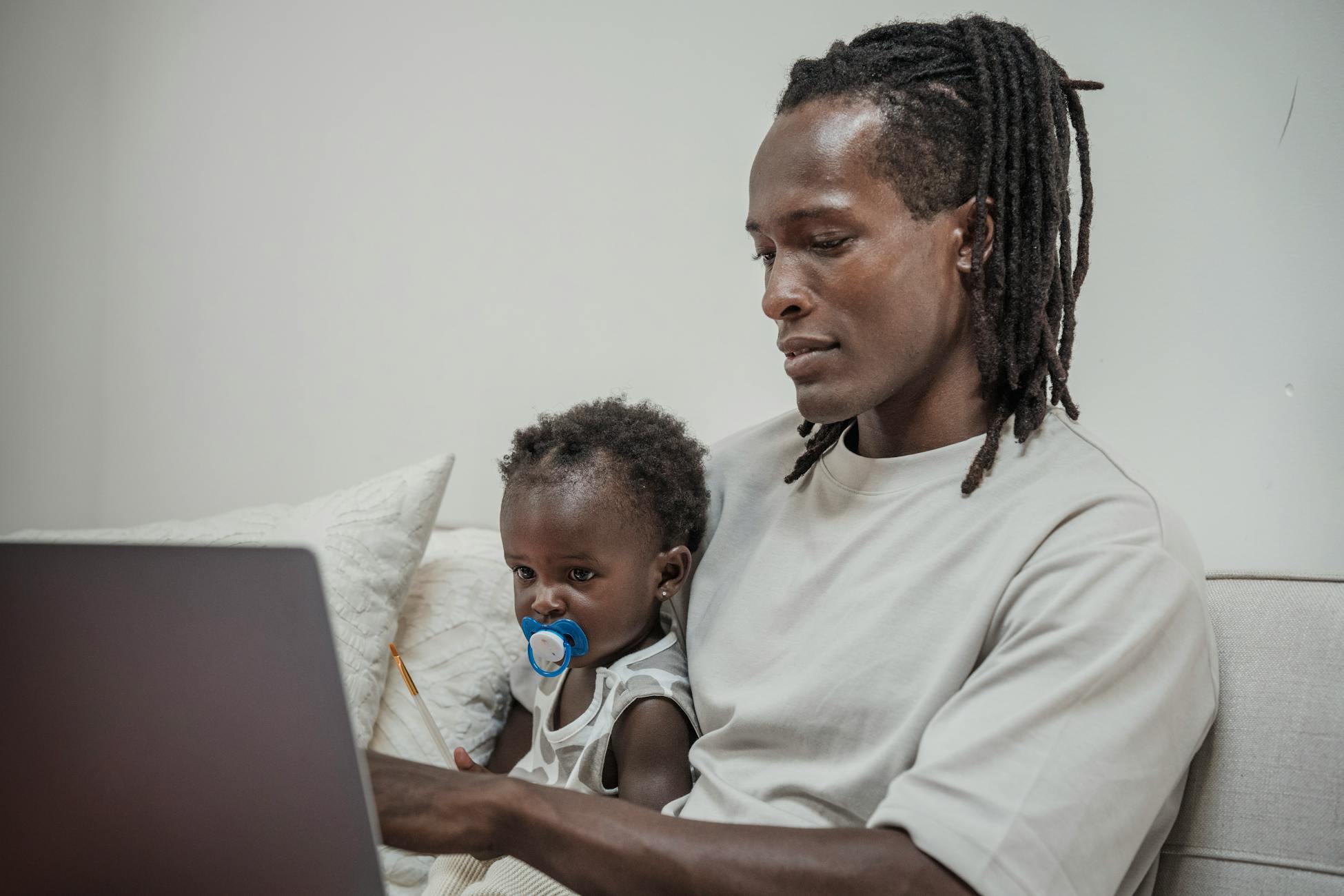
Last Sunday morning I stood at the stove with a whisk in one hand and my phone in the other, scrolling through a friend’s Instagram post about taking his kids backcountry camping. His six-year-old was perched on a boulder overlooking a valley, headlamp still on from the sunrise hike. The caption said something about “building memories that last.” Meanwhile, Julien was in his high chair smearing banana into his eyebrows, and Elise was asking me — for the fourth time — if the pancakes were ready yet.
Box mix. The kind with the cartoon on the front. Add water, stir, pour.
I remember looking at that Instagram photo and feeling the familiar tug. The one that says: You’re not doing enough. Your kids deserve more. A good father would make this more interesting.
And then Elise dragged her stool over to the counter, climbed up, and said, “Daddy, can I do the stirring part?” She does this every Sunday. She knows the order — she knows I’ll hand her the whisk after I pour the water in. She knows I’ll let her stir even though she splashes batter on the counter every time. She knows the whole thing.
That’s when it hit me. She doesn’t know it’s supposed to be boring. To her, this is the ritual. This is the thing.
The Myth of the Extraordinary Father
Somewhere along the way I absorbed this idea that involved fatherhood meant doing big, impressive, shareable things with my kids. Building treehouses. Coaching teams. Planning surprise trips. I don’t even know where it came from — some blend of my own dad’s absence, social media highlight reels, and that quiet guilt that hums underneath most days.
I started chasing it. I researched elaborate weekend projects. I bookmarked national park itineraries. I once spent two hours building an obstacle course in the backyard that Elise used for approximately nine minutes before going inside to line up her stuffed animals on the couch.
None of it was bad. But the energy behind it was wrong. I wasn’t doing it because my kids needed extraordinary. I was doing it because I thought ordinary wasn’t enough.
What the Research Actually Says About Rituals
Here’s what I’ve learned, both from reading and from paying attention to my own house: kids don’t need spectacle. They need predictability.
A 2015 meta-analysis published in the Journal of Marriage and Family reviewed fifty years of research on family routines and rituals and found that predictable family rituals were consistently linked to better child health outcomes, stronger parent-child relationships, and improved emotional regulation. Not elaborate rituals. Not expensive ones. Just predictable ones. The kind your kids can count on.
That study kept running through my head. Fifty years of data, and the through line wasn’t novelty or excitement. It was repetition. It was showing up the same way, again and again, until the ritual became part of the family’s identity.
Related Stories from The Artful Parent
- There is a specific kind of exhaustion that belongs to children who learned to read their mother’s face before entering a room, adjusting their energy, their news, and their volume to whatever frequency would keep her stable. They’ve been doing it so long most don’t realize it’s not a personality trait. It’s a survival skill.
- The hardest question a childless person faces isn’t ‘why didn’t you have kids.’ It’s the one they ask themselves at 3am: who will advocate for me when I can’t advocate for myself, and the silence that follows that question is unlike any other silence in human experience.
- I raised my children, hosted Christmas for twenty-seven years, and kept the whole family connected. Last week I ate dinner alone for the sixth night in a row and realized that being needed and being wanted were never the same thing.
Box mix pancakes every Sunday morning. That qualifies.
The Pancake Ritual, Unpacked
I want to describe what this actually looks like, because I think the magic is in the mundane details that would never make Instagram.
Julien wakes up first, usually around 6:15. I bring him downstairs, put him in the high chair with some banana slices, and start coffee. Elise wanders down somewhere around 6:40, blanket trailing behind her like a cape. She asks, “Is it pancake day?” even though she already knows.
I pull the box out of the cabinet. She gets her stool. I pour the mix, add water. She stirs. Batter splashes. I wipe the counter. She tells me something — about a dream she had, or what she wants to do that day, or a question about why dogs can’t talk. It’s never the same conversation, but the container around it is always identical.
While the first pancakes cook, she sets two plates on the table. She puts a fork on each one. She’s started doing this without being asked. Julien bangs on his tray and says something that might be “more” or might be “dog.” Camille comes down eventually, and by then there’s a stack on the table and Elise is already eating.
Nothing about this is extraordinary. Everything about this is ours.
- I worked full-time while raising a one-year-old and maintaining a marriage and by month ten I was overwhelmed in the supermarket aisle because I realized I had optimized my entire life for efficiency but forgotten to leave space for joy - Global English Editing
- I’m 38 and I just realized my Boomer parents don’t call me for advice — they call me to hear their own thoughts repeated back in a younger voice because somewhere in the last 5 years they stopped trusting their own judgment and my job isn’t to have answers anymore, it’s to make their answers sound valid, and I don’t know when that shift happened but I know exactly what it cost them to need it - Global English Editing
- 9 signs you’ve quietly become the most self-aware person in your social circle — and why it sometimes feels lonelier, not better - Global English Editing
Why “Enough” Is Hard for Fathers to Believe
I think fathers — particularly fathers of my generation — carry a specific kind of performance anxiety around parenting. We were told to be more involved than our fathers were. Good. We should be. But the messaging often came loaded with an implicit standard: involvement means visible, measurable, impressive effort.
Research from the American Psychological Association has shown that father involvement is most beneficial when it’s characterized by warmth and consistency rather than the specific activities performed. In other words, what you do matters far less than whether you keep doing it and whether you’re emotionally present while you do.
I think about that a lot when the guilt creeps in. The camping trips, the woodworking projects, the elaborate birthday scavenger hunts — those aren’t bad. But they aren’t what makes a kid feel secure. Secure attachment comes from the boring, repeatable stuff. The stuff that tells a kid, this is how our family works, and you can count on it.
The parents I admire most — the ones whose kids seem genuinely at ease — aren’t necessarily the ones with the most creative weekends. They’re the ones whose priorities center on emotional steadiness over achievement. They’re boring in the best possible way.
The Invisible Architecture of Predictability
Donald Winnicott, the British pediatrician and psychoanalyst, gave us the concept of the “good enough” parent — the idea that children don’t need perfection, they need a reliably responsive caregiver who creates a stable environment while also allowing small, manageable frustrations. What’s often missed about Winnicott’s work is how much of “good enough” depends on repetition. The good-enough parent isn’t the one who occasionally shows up with brilliance. It’s the one who shows up with adequacy, reliably, over and over.
Pancakes from a box mix. Every Sunday. Whether I’m tired, whether it’s raining, whether I’d rather sleep in.
That consistency is doing something in my daughter’s brain. She’s building a model of what safety feels like, and it’s made of batter splashes and the sound of a fork clinking on a plate she set herself.
What Elise Actually Remembers
A few weeks ago Camille’s parents visited. Elise’s Grandmère asked her what she likes to do on weekends. I expected her to say the park, or painting, or something from the elaborate craft box we bought in a moment of parental ambition.
She said, “Pancake day with Daddy.”
She didn’t mention the time I built the pillow fort that took up the entire living room. She didn’t mention the zoo trip. She mentioned the thing that happens every week without fail, the thing that isn’t designed to impress anyone, the thing that exists only because one morning two years ago I made pancakes and she liked them and so I did it again.
There’s something in the way grandparents give presence rather than things that mirrors this same principle. The gift isn’t what you do. It’s that you keep showing up to do it.
Permission to Be Ordinary
I’m writing this partly for myself, because I need to hear it regularly. But I’m also writing it for every father who scrolled past a picture this weekend of someone else’s dad doing something incredible with his kids and felt that quiet deflation in his chest.
Your kids don’t need incredible. They need you, doing the same small thing, in the same small way, with enough warmth and attention that they learn to expect it.
A 2019 study in Infant and Child Development found that predictable parent-child routines in early childhood were associated with stronger self-regulation and fewer behavioral problems later on. The mechanism isn’t complicated: when kids can predict what’s coming, their nervous systems relax. They spend less energy scanning for uncertainty and more energy growing.
That’s what Sunday pancakes do. They’re not about nutrition. They’re not about culinary skill. They’re about telling a four-year-old, in a language she understands before she has words for it: I’m here. I’ll be here next week too.
The Thing I Almost Missed
Last Sunday, after I cleaned up the kitchen, Elise was sitting on the floor with Julien, showing him how to stack her plastic cups. She wasn’t teaching him the way I would — she was patient in a way that looked almost practiced. She’d stack one, he’d knock it over, and she’d laugh and say “again” in the exact tone I use when she drops batter on the floor.
She was imitating the ritual. Not the pancakes — the patience inside the ritual. The repetition. The gentleness of doing the same thing again because someone you love needs you to.
That’s when I understood that the pancakes were never really about pancakes. They were about what it looks like when someone shows up for you reliably, without fanfare, without needing it to be special. And Elise was already passing it along.
I think about the kind of father I want to be when my kids are grown — the kind whose adult children want to visit, not out of obligation, but because home felt safe. And I think the foundation for that isn’t being built on camping trips or elaborate surprises. It’s being built on a $3 box of pancake mix, a four-year-old’s stool pushed up to the counter, and the same question every Sunday morning: “Is it pancake day with Daddy?”
Yeah. It’s pancake day.
It was always enough.