
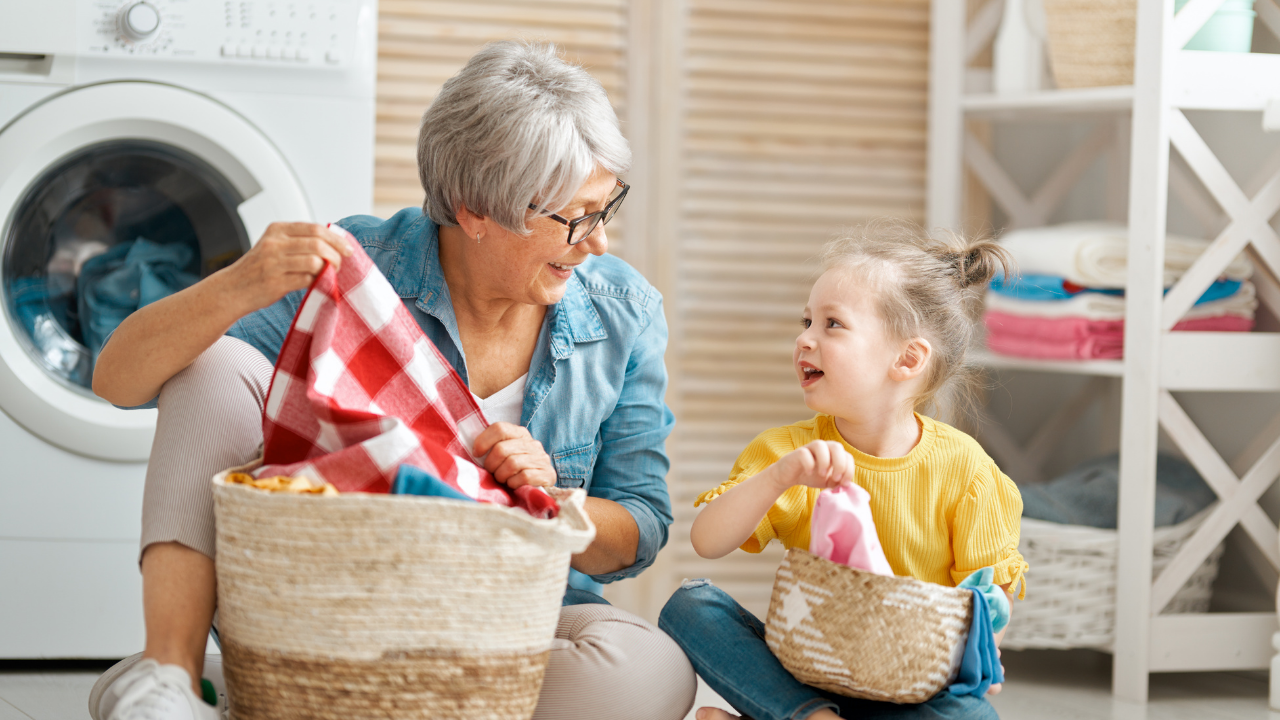

The other day, I watched a grandmother stop herself halfway through a sentence.
Her daughter was trying to settle a tired child who had reached that stage of the afternoon when nothing—not the snack, the toy or the carefully negotiated choice of shoes—was going to be quite right.
The grandmother could clearly see another way of handling it. You could almost hear the advice forming.
The Artful Parent
Family-life ideas and sharp reads, in your inbox.
“Have you thought about…?”
But she stopped.
Instead, she waited until her daughter looked up and said, “Do you want me to take over for a few minutes, or would you rather I just stay nearby?”
It was such a small moment, but it stayed with me.
She had not withdrawn. She had not pretended not to notice. She had simply offered support without assuming control.
And I found myself thinking that this may be one of the hardest and most generous things a grandmother can learn to do.
Advice can carry a message we never intended
Most grandmothers do not offer advice because they think their adult children are incapable.
They offer it because they care.
They have lived through sleepless nights, tantrums, school worries, friendship dramas and the mysterious ability of a child to need the toilet precisely three minutes after leaving home.
Experience has taught them things.
But communication is rarely shaped only by what we intend. It is also shaped by what the other person hears.
A grandmother may mean:
“I want to make this easier for you.”
Her daughter or son may hear:
“You are doing this incorrectly.”
She may mean:
“I remember how difficult this stage can be.”
They may hear:
“I managed it better than you are managing it.”
This does not make either person unreasonable. It simply shows how emotionally charged parenting can be.
Modern parents are surrounded by advice. Books, podcasts, parenting accounts and online experts offer firm opinions on sleep, food, behaviour, attachment, education and screens. Even the family group chat can begin to resemble an unpaid advisory panel.
Confidence grows when people are trusted to make decisions
Psychologists often use the term self-efficacy to describe a person’s belief in their capacity to manage situations and take effective action.
Parental self-efficacy is not the belief that a parent will always know what to do. No parent does. It is the growing sense that, when difficulties arise, they can observe, learn, make decisions and adjust.
That confidence develops through experience.
People become more capable partly by being allowed to try things, make imperfect decisions, notice what happens and respond. If someone more experienced repeatedly steps in, even with loving intentions, it can quietly interrupt that process.
Research based on self-determination theory has long explored the importance of autonomy, competence and connection. Autonomy does not mean being abandoned to cope alone. It means experiencing yourself as someone who has a meaningful say in your own choices. Competence grows through having opportunities to act, learn and improve.
Although much of this research examines parents supporting children’s autonomy, I think the principle can also illuminate the relationship between grandparents and their adult children.
Adults still need room to experience themselves as capable.
When a grandmother pauses before intervening, she may be communicating something far more powerful than advice:
“I trust you to know your child.”
“You are allowed to do this differently from me.”
“You do not need my approval to become a good parent.”
That kind of trust is not passive. It can be a deeply generous form of support.
Our children are parenting in a different world
It is tempting to look at a situation and think, We never made this so complicated.
In some ways, that may be true.
There were fewer apps to consult, fewer parenting philosophies to compare and fewer online debates about whether a lunchbox contains the correct emotional balance of protein and sliced cucumber.
But parents today are raising children in circumstances we did not face.
Technology has changed family life. Many parents are combining work with intensive caregiving. Families may live far from extended support networks. Information is available constantly, and much of it is contradictory.
There is also greater awareness of children’s emotional worlds, learning differences and individual needs. That awareness can be valuable, but it can also leave parents feeling that every decision carries enormous consequences.
Saying, “We never worried about that,” may be factually accurate.
It may not be particularly helpful.
Every generation parents within its own culture, knowledge and pressures. Our adult children will inevitably make different choices from ours—not necessarily because they reject what we did, but because they are responding to a different world.
Their difference is not a verdict on us.
That may be one of the harder truths of grandparenting.
Stepping back can feel like losing part of ourselves
For many years, being needed was built into the structure of our lives.
We organised meals, solved problems, remembered appointments and noticed when something was not quite right. We knew which child needed encouragement, which one needed space and where everyone had left their shoes.
Then those children grew up.
They created homes, relationships and families of their own. Suddenly, the experience that once made us essential does not always give us authority.
That transition can feel surprisingly unsettling.
We may tell ourselves we are only trying to help, while another quieter part of us is trying to hold on to a familiar identity: the person who knows what to do.
I do not think we need to judge ourselves for this. Roles do not disappear neatly simply because our children reach adulthood.
But perhaps we can become curious about the impulse.
When I feel an urgent need to advise, I can ask myself:
Is this genuinely necessary?
Has my opinion been requested?
Am I offering support—or trying to relieve my own discomfort at watching someone do things differently?
That last question is not always pleasant.
It is, however, useful.
Support and interference are not the same thing
None of this means grandparents should become silent, distant or afraid of saying the wrong thing.
Good relationships need honesty. Families sometimes need difficult conversations. If a child’s safety or wellbeing is genuinely at risk, stepping back is not automatically the wisest response.
There are also times when adult children desperately want practical help.
The distinction often lies in whether support respects the parents’ authority.
Research into families where grandparents provide significant childcare shows that intergenerational care can be enormously valuable, while differences over roles and parenting practices can also create tension. The quality of the relationship between parents and grandparents appears to matter greatly in how those differences affect the wider family.
A simple question can change the tone:
“Would you like me to listen, or would it help to talk through some ideas?”
That question gives the parent a choice.
Sometimes they want advice. Sometimes they want reassurance. Sometimes they want someone to take the children to the park so they can sit in a quiet room and remember their own name.
Practical support can be wonderfully loving when it lightens the load rather than taking over the steering wheel.
Children benefit when the adults around them trust one another
Grandchildren notice more than we think.
They notice when a grandparent rolls her eyes at a parent’s rule. They notice when one adult quietly overturns another adult’s decision. They learn very quickly which person to approach when the first answer was no.
This can be mildly amusing when it concerns another biscuit.
It becomes less amusing when it creates a pattern in which a child experiences the adults as competing authorities.
Children do not need every adult in the family to agree on everything. That would be unrealistic and possibly rather dull.
But they do benefit from a sense that the important adults in their lives respect one another.
A grandmother can have a different perspective without making the parent wrong. She can follow a household rule she would not have chosen. She can speak privately rather than contradicting a parent in front of a child.
In doing so, she offers her grandchildren something larger than a particular parenting technique.
She shows them what respect looks like when people disagree.
The rarer gift
It is easy to recognise love when it arrives as action. It is harder to recognise love when it arrives as restraint.
But perhaps that is one of the gifts this stage of life asks us to learn.
To pause before correcting.
To remain available without hovering.
To share experience without insisting it becomes instruction.
To let our adult children develop confidence through living their own family lives.
But when a grandmother resists the urge to fix every problem, she is not withdrawing her love.
She may be expressing it in a more mature form.
She is saying: “I am here. I will help when you need me. I may occasionally have to sit on my hands. But I trust you.”
And perhaps that faith—quiet, steady and without conditions—is one of the most reassuring things an adult child can receive from a parent.