
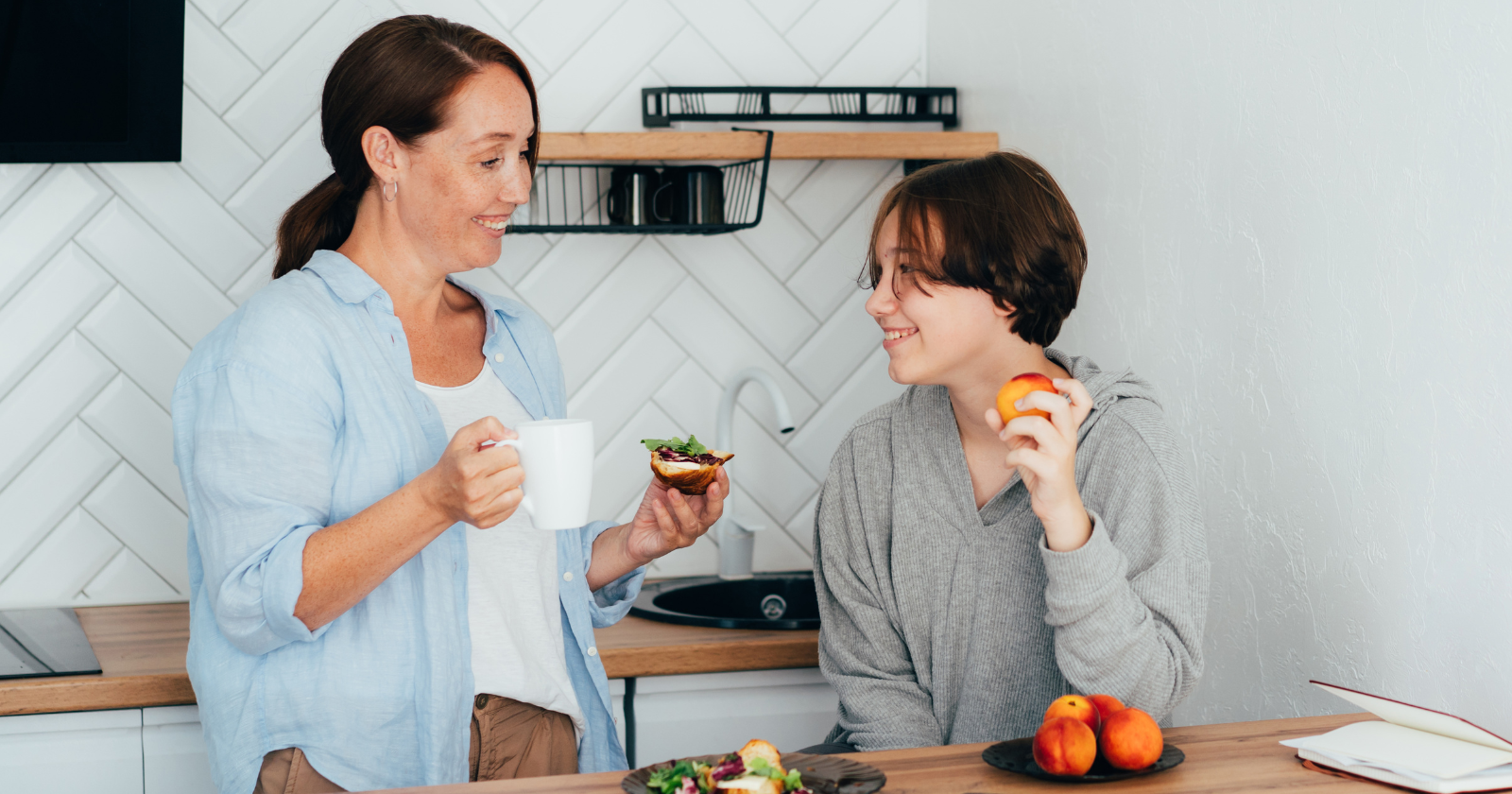

A few weeks ago, Megan came and sat down next to me while I was having my morning coffee. Just sat — no phone, not doing anything in particular. She looked comfortable with it in a way that surprised me a little. I watched her and thought: she got that from somewhere. The quiet doesn’t come naturally to most teenagers. It hasn’t always come naturally to me. I’ve worked for years to be okay with stillness — my own mother was always in motion, always onto the next thing — and somewhere along the way, without any conversation about it, Megan had absorbed it. Not because I told her that rest was valuable. Because she’d seen me sitting quietly, morning after morning, before the house woke up.
Most of the teaching we do as parents happens in moments neither of us registers as teaching.
We put a lot of thought into what to say to our children about looking after themselves — about not running themselves ragged, about recognizing when they need a break, about being kind to their own bodies. The conversations matter. But there’s a ceiling on how far they go, because children do not primarily learn by being told. Albert Bandura, the social psychologist whose foundational work on social learning theory showed that children acquire behaviors and attitudes primarily through observation, makes the mechanism explicit: they watch what the people they love actually do, and they treat that as the template. The gap between what a parent says and what a parent does isn’t invisible to them. It registers before they have words for it.
The Artful Parent
Family-life ideas and sharp reads, in your inbox.
None of what follows is clinical guidance — I’m a writer and a mother, not a psychologist. But after years of paying attention to what I absorbed from my own upbringing, and watching what my children seem to be absorbing from mine, I’m persuaded that these five behaviors matter more than most of us realize.
1) Whether you eat a meal — or just explain why you can’t
This one is quieter than it sounds. There’s a version of daily life where lunch is a standing-at-the-counter situation, where meals are organized around everyone else’s hunger but yours, where you narrate your eating as a small confession: “I’ve been terrible today,” “I really shouldn’t,” “I haven’t had time.” None of it is delivered as a lesson. But your child is watching what nourishment looks like in practice, and what they see is that the adult in this house treats her own hunger as the last item on the list.
What a child whose parent actually eats — sits down and eats — absorbs is something different: that hunger is real and worth attending to. That their own needs are not an imposition on the schedule. This is one of the first and most repeated things they’ll watch you do, which means it’s one of the first and most repeated things they’ll learn about the relationship between their needs and the world.
2) How you talk about your body when you think no one is really listening
The casual comments feel harmless in the moment. “I look terrible in this.” “I’ve been so lazy.” “I really need to do something about…” They tend to happen in passing — while getting dressed, glancing in a mirror, looking at a photograph. Which is exactly the problem: children are present for them, without any signal that something significant is being said.
Research published in Frontiers in Psychology found that a mother’s attitudes toward her own body are consistently associated with her daughter’s body dissatisfaction and eating behaviors — a relationship documented across multiple studies. Fathers carry influence here too, but the maternal modeling link is particularly well-established in the literature. The mechanism isn’t complicated: children observe the people they love most, take note of how those people think about their own bodies, and treat it as information about what bodies are for and how to think about their own.
The offhand comment you’d forgotten you made often lands more durably than the conversation you’d carefully prepared.
3) Whether you ever let yourself stop before everything is done
I absorbed my mother’s busyness without knowing it. She was always onto the next task — efficient, never idle, the kind of person whose stillness felt like a pause before more motion. I took that in as normal, then as personality, then finally — slowly — as inheritance. The realization didn’t arrive in a single moment. It was a gradual accumulation of noticing the same pattern in myself that I’d watched in her.
The question it eventually forced on me: what are my children watching me model about the relationship between rest and worth? If they see me work through every window and treat my own stopping as something to justify — as falling behind, as laziness — what does that teach them about what their own rest will be worth someday?
A 2022 meta-analytic review of 53 studies led by Melanie Zimmer-Gembeck at Griffith University found that “parents with better emotion regulation skill or fewer difficulties are higher in positive parenting behaviors and have children with better emotion regulation.” The ability to regulate yourself — to actually stop, recognize a limit, and treat it as legitimate — turns out to be one of the most transmissible things a parent possesses.
4) How you handle feeling overwhelmed
There are two versions of this they might see. In the first, a parent is visibly fraying — the pace picks up, the responses get shorter, something is building — and then it passes without ever being named or addressed. The lesson, absorbed without being spoken: when you’re overwhelmed, push through and hope it doesn’t show. In the second version, you say: “I’m feeling overwhelmed right now. I need ten minutes.” And then you take them.
The second version is harder. Naming something feels like admitting it, and admitting it can feel like losing ground. But for a child watching, it does two things at once: it tells them that emotional states are real and worth paying attention to, and it shows them that the person experiencing the feeling gets to decide what to do about it. Watching a parent do it — even imperfectly — is a significant thing to absorb.
5) Whether your self-care looks like something you earned, or something you’re simply allowed
Looking after yourself can send very different messages depending on how it’s framed. The announced version — preceded by a careful accounting of how much you’ve been managing — teaches children that self-care is compensation: a reward you clock enough exhaustion to justify. “After this week, I finally deserve an hour to myself.”
The quieter version looks different to a child watching. The cup of tea made without explaining it. The book picked up because you feel like reading. The walk that isn’t punishment for anything, or productivity toward anything, just air. When children observe a parent moving through a day treating their own small needs as unremarkable — as simply part of being a person — they receive a different message: what I need is allowed. I don’t have to earn access to my own care.
These five things are not revolutionary. None of them requires a transformation of personality or a restructured week. They’re the texture of an ordinary day. Which is exactly why they carry the weight they do: children watch the ordinary, not the exceptional, and they build their understanding of what life is supposed to look like from what they see happen again and again without fanfare.
What they watch you do with your own life is the first draft of what they’ll believe about the value of theirs.
If any of this is hitting closer to home than it is to interesting — if your own patterns feel harder to shift than expected — talking to a therapist is worth more than any article, and there’s no reason to try to untangle it alone.