
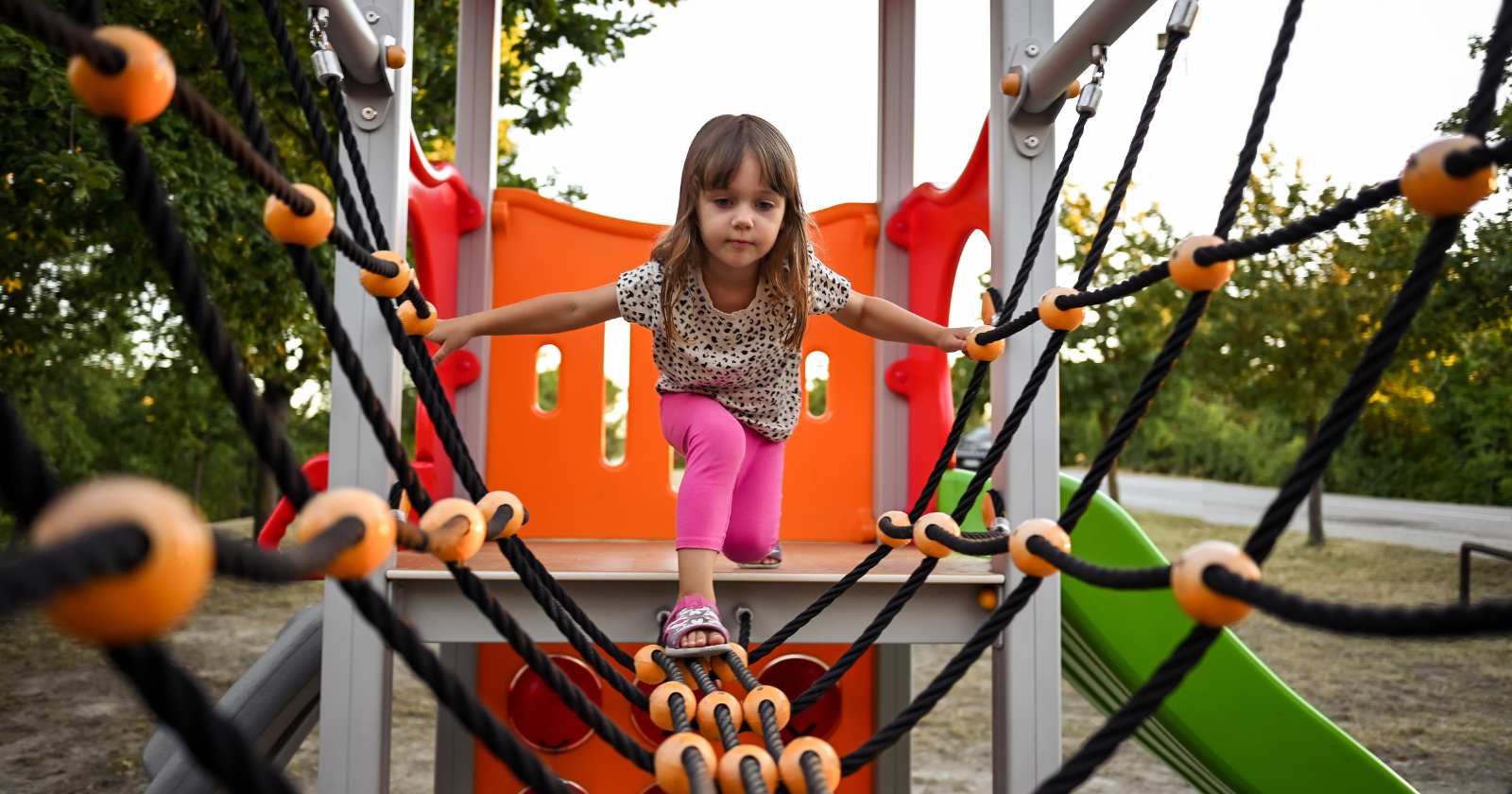

The instinct is almost involuntary. A child climbs to the top of the jungle gym, or runs full speed toward a fence, or picks up something that looks like it could hurt them, and the words are out before you’ve decided to say them: be careful. It is reflex, not reasoning. For most parents, it has become the background sound of childhood — said so often the kids probably stopped hearing it years ago.
But research into how children develop emotional resilience suggests that reflex, however well-intentioned, may be costing something. Not the scraped knee — families tend to recover from those. Something harder to name once it’s been removed.
The world we built around them
Over the past several decades, the physical and social landscape of childhood has been steadily cleared of hazards. Playgrounds were redesigned with softer surfaces and lower equipment. Independent outdoor time — once ordinary for young children — became rare enough to attract concern from neighbors and, in some cases, attention from authorities. Peter Gray, a research professor at Boston College and author of Free to Learn, cites a UK survey of more than a thousand parents in which a large proportion believed children under 14 should not be allowed outside unsupervised — many putting the threshold at 16 or older.
The Artful Parent
Family-life ideas and sharp reads, in your inbox.
None of this happened because parents became careless. It happened because the visible risks were easier to address than the invisible ones. A child falling from a tree is a crisis that can be photographed and treated. The slow development of a child who was never allowed to test their own limits is much harder to see, and much slower to show up.
What happens in the falling
Risky play researcher Ellen Sandseter, at Queen Maud University College in Trondheim, Norway, identified six categories of risk that children seek out independently, regardless of where they grow up: great heights, rapid speeds, dangerous tools, dangerous natural elements, rough-and-tumble physical contact, and the experience of venturing far enough from adults to feel genuinely on their own.
The consistency of those six categories, appearing in children across different countries and very different childhoods, is not random. As Gray describes it: “Children love to play in risky ways — ways that combine the joy of freedom with just the right measure of fear to produce the exhilarating blend known as thrill.”
The research on why points to what’s known as the emotion regulation theory of play. Neuroscientist Jaak Panksepp found that rat pups deprived of play during a critical developmental phase grew up emotionally impaired — prone to freezing in unfamiliar environments and oscillating between fear and aggression in social situations. They had the emotional range but none of the control. Similar patterns emerged in early primate research. The leading interpretation is that risky, fear-inducing play is how young mammals learn, in small and survivable doses, to manage the emotions that would otherwise overwhelm them.
Gray puts it plainly: “Children are designed by nature to teach themselves emotional resilience by playing in risky, emotion-inducing ways.”
I’m not a psychologist, and none of this is medical guidance. But as a parent who let my own children figure out a lot on their own, that framing landed differently than I expected it to.
The childhood we grew up in
Gray’s own childhood in 1950s Minnesota included unsupervised bike rides across the countryside at age five, carrying a jackknife from age six, all-day skating and skiing trips across a five-mile lake with friends and a box of matches, and operating a large industrial printing press at age ten — regularly missing school on Fridays to help print the town’s weekly newspaper. He notes that the teachers and principal never complained.
His point is not nostalgia for a simpler era. His point is that none of this was considered unusual. The things that would now prompt a call to child services were, not long ago, just childhood — what happened when children were trusted to operate in the world before adults decided the world was too dangerous for them.
The contrast with the present is not just cultural. It shows up in the data.
What disappeared when the playgrounds got safer
Over roughly the same sixty years that children’s freedom to play independently has declined, something else has moved in the opposite direction. Gray has reviewed and synthesized research — most notably psychologist Jean Twenge’s analysis of decades of standardized MMPI data, given to normative groups of children and young adults in unchanged form — that found “five to eight times as many young people today suffer from clinically significant levels of anxiety and depression, by today’s standards, than was true in the 1950s.”
The caveat matters: this is correlational, not causal. The decline in free play is one factor among several, and drawing a clean line from fewer tree-climbs to more anxiety is harder than it looks. But the two trends move in parallel across the same sixty years, and that alignment is at minimum worth thinking about.
As Gray quotes from Sandseter’s 2011 paper in Evolutionary Psychology: “We may observe an increased neuroticism or psychopathology in society if children are hindered from partaking in age-adequate risky play.”
Gray’s own framing of the arc is pointed: “We deprive children of free, risky play, ostensibly to protect them from danger, but in the process, we set them up for mental breakdowns.” That’s a strong claim — the data is correlational and this is one researcher’s interpretation — but it captures the directional concern that the research raises.
The difference between danger and difficulty
None of this is an argument for removing adult judgment from the picture, or treating every hazard as a lesson worth preserving. The research is also careful on this: forced or adult-directed risk does not produce the same benefits as self-chosen risk. What matters is that children are in charge of their own play — choosing how high, how fast, how far. Children are, it turns out, quite good at reading their own capacity when no one else is managing the decision for them.
Gray also notes that the children most likely to be injured are not those in unsupervised free play. They are the ones in adult-organized competitive sports, where adult encouragement and competitive pressure push kids past the limits they would have set for themselves. The risk we removed from the backyard did not actually remove risk. It moved it somewhere adults were more comfortable watching.
I was a fairly relaxed parent in this department — not out of any philosophy, just disposition. I didn’t engineer challenges for my children, but I also didn’t clear the path ahead of them at every turn. I let them climb things, fall off things, and work out on their own how high was too high. I said be careful less than most parents I knew, mostly because it didn’t occur to me to say it unless something actually seemed dangerous.
What the research offers is not a mandate to stop caring about your children’s safety. It is an invitation to look more carefully at which protective instincts are serving them, and which might be quietly taking something away.