
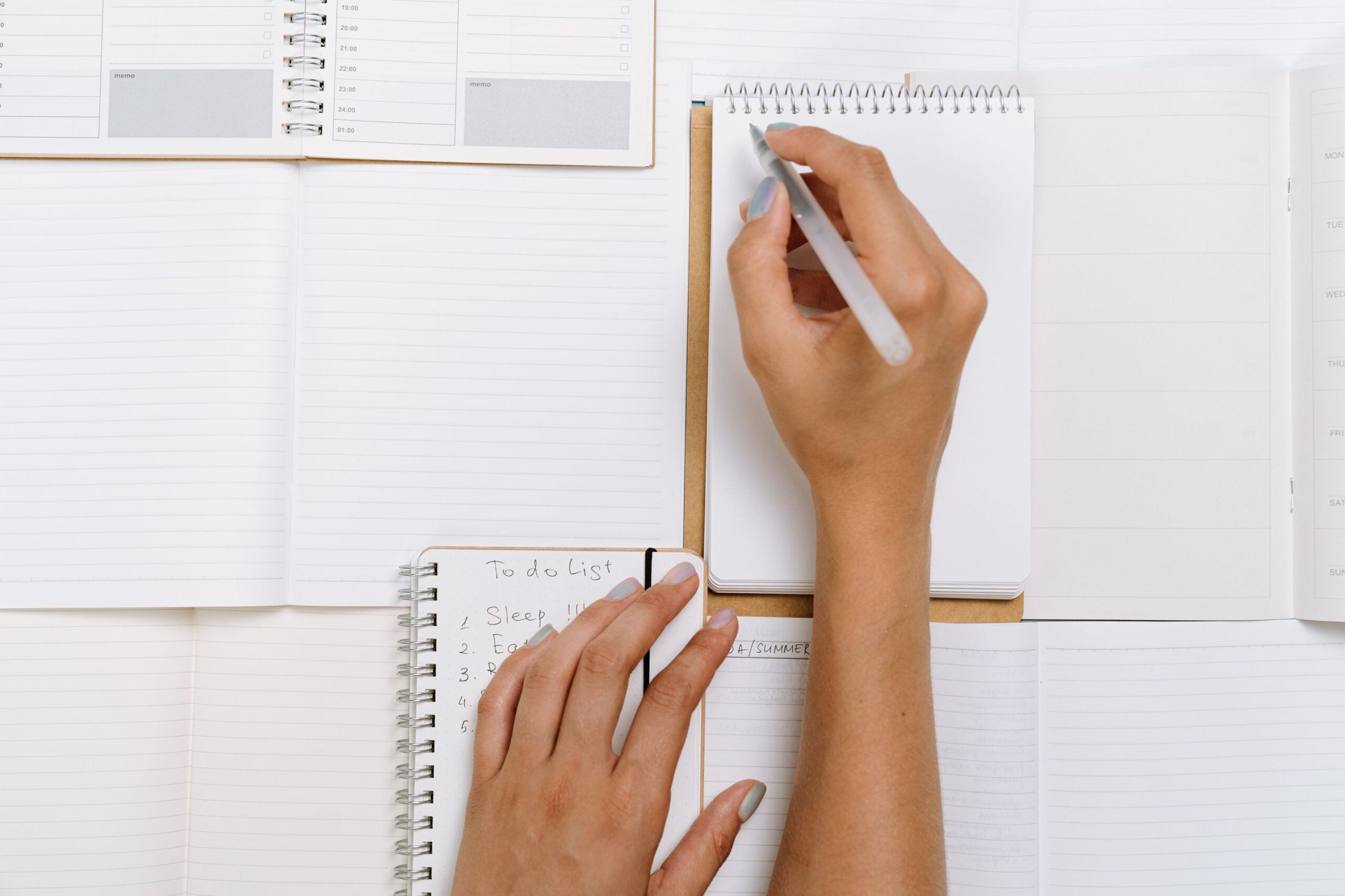

There is a familiar moment at the edge of a busy family day: a scrap of paper appears on the counter and somebody writes down library books, washing powder, permission slip, birthday present. The phone could hold all of it. The paper still feels easier.
Psychology has not identified a nine-trait personality shared by people who make handwritten lists. No study can look at a notepad and reliably tell us who is disciplined, creative or organised. What research can explain is why paper suits certain ways of managing attention, memory and unfinished plans.
The traits below are careful behavioural inferences, not a personality test. They describe what a repeated preference may be doing for someone, without turning an ordinary stationery choice into a verdict about character.
What the research can and cannot say
Most comparisons of handwriting and typing concern lecture notes, word learning or laboratory memory tasks. They do not study parents writing “return library books” while packing lunch. Research on reminders also shows that digital tools can be extremely useful. A phone can deliver a cue at the right time and place, share a list across a household and preserve information that a loose page cannot.
A handwritten to-do list combines three simpler things: an external memory, a brief planning session and a physical object placed in the environment. Those functions give us a more grounded way to read the habit.
They move intentions out of their heads
1. They believe memory deserves support
Psychologists Evan Risko and Sam Gilbert use the term cognitive offloading for actions that change a task so the mind has less information to carry. Setting an alert, turning a bottle upside down as a reminder and writing a list all belong to this broad family.
The handwritten-list maker is not necessarily admitting to poor memory. They may simply have no interest in using memory as a test of responsibility. Once “buy glue sticks” is on the page, it no longer needs to be rehearsed through breakfast, school drop-off and work.
2. They prefer specific plans to vague intentions
E. J. Masicampo and Roy Baumeister studied the mental effects of unfinished goals across several experiments. Unfinished tasks could intrude while participants worked on something unrelated. When participants formed a specific plan for completing a goal, that interference was reduced.
The study did not compare paper with phones, and it did not establish that list writers worry less. It supports the planning move itself. “Sort the school things” is a cloud. “Sign the excursion form and put it by the front door” is an action with an end.
3. They want reminders where life happens
A page on the fridge, beside the kettle or tucked under the car keys stays in the physical setting where it will be useful. It does not need to be unlocked or summoned.
Sam Gilbert’s experiments on strategic reminder-setting found that using reminders improved performance on delayed intentions. People’s reminder choices were related to both their actual ability and their confidence in memory. A regular paper-list habit can reflect that same practical self-knowledge: knowing what your future attention is likely to miss and leaving it a cue.
They use the page as part of the thinking
4. They notice place and position
Paper has edges. An urgent item can sit at the top, a grocery note can occupy the left corner, and an arrow can pull tomorrow’s job out of today’s column. The layout becomes part of how the information is recognised later.
Keita Umejima and colleagues explored something related with 48 university students. Participants entered fictional appointments in a paper calendar, tablet or smartphone, then answered questions about the schedule. The paper group recorded the appointments faster and was more accurate on straightforward retrieval questions. The researchers argued that the physical and spatial information available on paper may have provided richer cues.
This is one study, not settled consensus, and a calendar-memory experiment is not a to-do-list personality study. Its relevance is modest: a person may prefer paper partly because the location of a mark helps the item feel findable.
5. They are willing to slow down and select
Handwriting is usually slower than typing. That is inconvenient when the aim is to capture every word, but useful when the job is to decide what matters enough to write.
A 2024 meta-analysis covering 24 college note-taking studies found that students who took and reviewed handwritten notes had a small achievement advantage, while typing produced a much larger volume of notes. That evidence belongs to lectures and college learning, not household planning. It should not be turned into “handwriting makes you smarter”.
For a to-do list, the useful parallel is selection. A small page resists the fantasy that twenty-seven tasks all belong to today. The writer must shorten, group or leave something for later.
6. They protect one small task from interruption
Picking up a phone to write one line also means picking up the place where messages, news, photographs and work alerts arrive. The distraction is not inevitable, but the doorway is there.
Cary Stothart, Ainsley Mitchum and Courtney Yehnert found that phone notifications disrupted performance on an attention-demanding task even when participants did not interact with the device. A handwritten list removes one opportunity for a five-second planning job to turn into ten minutes elsewhere.
This preference need not mean someone dislikes technology. It may mean they recognise which tasks are easier when technology is not invited into them.
They want the tool to stay simple
7. They tolerate a system that shows its mess
A paper list keeps its revisions visible. Crossed-out words, arrows, cramped additions and rewritten priorities remain on the page. There is no pressure to maintain an immaculate dashboard before the system can be used.
This is observation rather than a measured psychological result. Still, people who happily return to paper often seem comfortable with a planning tool that changes as the day changes. The list is allowed to look used.
8. They value a small transition ritual
Family days contain many open loops, including the ones nobody else can see. Sitting down with a pen can mark the shift from carrying all of them at once to deciding what happens next.
The value may lie less in the handwriting than in the pause. Naming the tasks, putting them in an order and choosing which three belong to today creates a clean edge around the planning moment. A notes app can support the same ritual, but for some people the phone carries too many other associations to feel like a pause.
9. They choose familiarity over extra features
Paper cannot sync with another parent, sound an alert or restore a lost list. It also has no password, update, subscription or menu. It begins working the instant a pen touches it.
Someone who keeps choosing that simplicity may care more about immediate fit than maximum capability. This can look traditional from the outside. In practice, it is often a very current kind of tool judgement: use the smallest thing that reliably does the job.
Paper is a preference, not a virtue
A shared digital list is usually better when several people need live updates. Timed alerts are better for appointments and tasks that must happen away from the kitchen counter. Searchable lists help when plans are long, repeated or connected to documents and addresses.
Many people use both: paper for deciding and a phone for reminding. Nothing in the research supports ranking one group as more thoughtful, organised or creative than the other. The result depends on the task, the person and what happens after the list is made.
The handwritten list does not reveal a superior kind of mind. It shows that somebody has found continuing value in a tool that is visible, finite and quiet, which is often exactly what a crowded day needs.