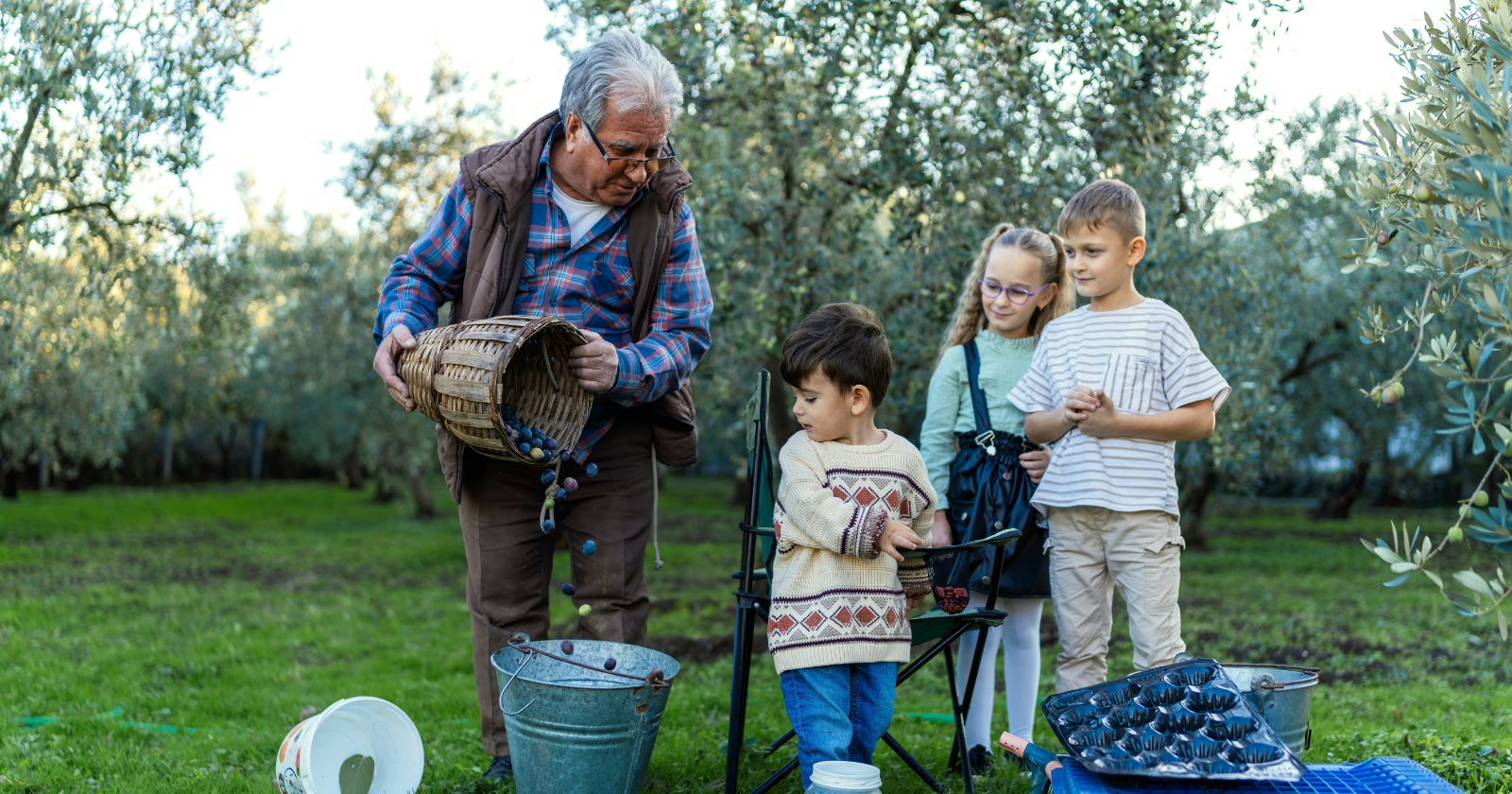
You know that moment when you watch your mom with your kids and suddenly see everything differently? Last week, I was folding laundry while my mother played with Ellie and Milo in the living room.
She wasn’t doing anything special, just sitting cross-legged on the floor, letting them show her their latest treasures from the backyard. But what struck me was how she responded to every single rock, leaf, and mysteriously sticky pinecone with genuine curiosity. “Tell me more about this one,” she’d say, turning each item over in her hands like it was precious.
My parents were initially skeptical of what they called my “hippie parenting,” but watching my mom that day, I realized she’d stumbled onto something profound that psychology has been trying to tell us about grandparent-grandchild relationships. The secret isn’t in grand gestures or expensive gifts. It’s simpler and more challenging than that.
The one rule that changes everything
Grandparents who practice radical presence create the deepest, most lasting bonds with their grandchildren. Not presence as in just being physically there, but presence as in being fully engaged, undistracted, and genuinely interested in whatever world the child is inhabiting at that moment.
Think about it. When was the last time someone gave you their complete, undivided attention? No phone buzzing, no mental grocery lists, no half-listening while planning dinner. It’s rare, right? And when it happens, you feel it in your bones. Children, with their finely tuned authenticity detectors, feel it even more intensely.
The research is fascinating. Studies from developmental psychology show that children who experience this kind of focused attention develop stronger emotional regulation skills, higher self-esteem, and better social connections throughout their lives. But beyond the data, there’s something almost magical about what happens when an older generation truly sees and hears the youngest.
Why grandparents are uniquely positioned for this
Here’s the thing about grandparents that took me years to understand: they’re playing a completely different game than parents. When I’m with my kids, I’m juggling seventeen things. There’s dinner to make, baths to give, tomorrow’s schedule to figure out, and that constant low-grade anxiety about whether I’m doing any of this right. My mother? She shows up with nothing but time.
She doesn’t care if lunch is nutritionally balanced or if bedtime gets pushed back. She’s not worried about developmental milestones or kindergarten readiness. She’s just there, fully available to enter whatever imaginative universe my five-year-old is creating with her leaf collection.
This freedom from the daily grind of parenting creates space for something precious: pure relationship. No agenda, no teaching moments forced in, no behavior to correct. Just connection.
I remember teaching kindergarten before having my daughter, watching how differently children behaved with classroom volunteers who were often grandparent age. These kids would open up, share stories, show sides of themselves that we teachers rarely saw. Why? Because these adults brought presence without pressure.
The challenge of true presence in our distracted world
But let’s be honest about how hard this actually is. We live in a world designed to fracture our attention. Even my mother, champion of floor-sitting and pinecone examination, sometimes reaches for her phone when the kids are playing. It’s almost involuntary, this twitch toward distraction.
Related Stories from The Artful Parent
- I’m 65 and I stopped arguing politics with my daughter three years ago — not because I gave up on her, but because I finally understood that protecting our relationship mattered more than being right about things neither of us can control
- Psychology says the hardest part of watching your parents age isn’t the physical decline – it’s the moment you realize they’ve started performing competence the same way you performed adulthood when you first moved out, and you’re both pretending not to notice the act
- Psychology says people others describe as ‘easy to talk to’ aren’t being casual — they’re performing one of the hardest social skills that exists
The grandparents who create those deep bonds? They’re the ones who treat their grandchild time like a meditation practice. Phone in another room, TV off, full engagement with whatever bizarre game involving couch cushions is happening. They ask questions not to teach but to understand. “Tell me more” becomes their mantra, just like it’s become mine in trying to teach my kids emotional regulation.
What fascinates me is how this mirrors what we know about secure attachment. John Bowlby’s attachment theory isn’t just about parents. These secondary attachment figures, especially grandparents, create additional layers of security for children. When grandparents practice this radical presence, they become what psychologists call a “protective factor” in a child’s life.
The ripple effects through generations
There’s something else that happens when grandparents follow this rule of presence, something that goes beyond the individual relationship. They model for us parents what slowing down looks like. Every time my mother sits on that floor, ignoring the dishes in the sink and the toys scattered everywhere, she’s quietly teaching me that relationship trumps tasks.
I watch my two-year-old climb into her lap, his little body relaxing completely, and I’m reminded that this is what we’re actually after. Not the perfect routine or the organized toy bins, but these moments of complete connection.
Children who have close bonds with grandparents carry those relationship patterns forward. They become adults who know how to be present for others, who understand that attention is love made visible.
Sometimes I wonder if this is why so many of us have such vivid, specific memories of our grandparents. Not because they took us to Disney World or bought us the biggest presents, but because they were the adults who sat still long enough to really see us. My own grandmother would let me talk for hours about my elaborate plans to live in a tree house. She never once suggested it might be impractical. She just listened, asked where I’d put the kitchen, wondered about the ladder situation.
Conclusion: The gift of undivided attention
What strikes me most about this one rule is its beautiful simplicity. No special training required, no equipment to buy, no philosophy to master. Just presence. Full, undivided, agenda-free presence.
Yet in our culture that prizes productivity and multitasking, this might be the most countercultural thing grandparents can do. To sit on the floor and examine leaves as if they matter. To listen to rambling stories about imaginary friends without checking the time. To be genuinely curious about which couch cushion makes the best fort wall.
My parents are slowly coming around to my “hippie parenting,” but what they don’t realize is that they’re teaching me something far more valuable than any parenting book could. They’re showing me that the deepest bonds aren’t built through doing but through being. Being present, being curious, being willing to enter a child’s world completely.
The next time you see a grandparent fully absorbed in a child’s play, know that you’re witnessing something profound. It’s not just cute or sweet. It’s the creation of a bond that will echo through generations, teaching each child that they are worth someone’s complete attention, that their thoughts and feelings matter, that they are deeply, fully seen.
And isn’t that what we all want, at any age? Someone who will sit with us, phone tucked away, eyes engaged, saying with their whole being: “Tell me more. I’m listening.”