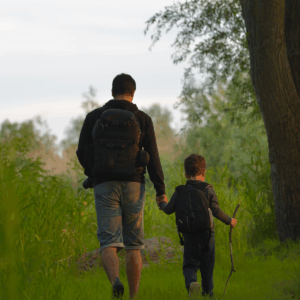

Time moves differently when you’re my age. Just last weekend, I was pushing my youngest grandchild on the swing when she asked me, “Grandpa, will you always be here?” The question stopped me cold. At three, she doesn’t understand mortality, but I do. And it got me thinking about all the things I want my grandchildren to know while I still have the chance to tell them.
I’ve been taking my local grandkids to the park most weekends for years now. It’s become the highlight of my week, watching them grow, listening to their stories, being part of their world in a way work never allowed when my own sons were young. But that innocent question reminded me that my time with them isn’t infinite.
If you’re a regular reader, you may remember I’ve written about the importance of being present with our grandchildren. Today, I want to share something more specific: the exact phrases they need to hear from us. Not someday, not when they’re older, but now, while we’re still here to say them.
1. “I’m proud of who you are, not just what you do”
Last month, my eleven-year-old grandchild didn’t make the school basketball team. When I picked him up for our usual one-on-one time (something I do with each grandchild because they’re completely different people when they’re not competing for attention), he was devastated.
“Grandpa, I’m not good at anything,” he said.
That’s when I told him something I wish someone had told me at his age: “I’m proud of who you are, not just what you do.” I explained how I noticed his kindness when he helped his younger cousin tie her shoes last week. How he always asks the new kid at the playground to join in. Those things matter more than making any team.
Our grandchildren are growing up in a world obsessed with achievement. They need to hear from us that their worth isn’t tied to their accomplishments. When we tell them we’re proud of their character, their effort, their kindness, we give them something that transcends any trophy or grade.
2. “You don’t have to be perfect to be loved”
Have you noticed how hard kids are on themselves these days? My eight-year-old granddaughter cried for an hour because she got a B on her spelling test. A B! When I was her age, I was thrilled if I remembered to bring my homework to school.
During our walk after the spelling test incident, I shared something with her: “You know, I made tons of mistakes when I was your dad’s age. Still do, actually. But you know what? People still love me. And I’ll always love you, no matter what grades you get or mistakes you make.”
The relief on her face was immediate. Kids today face pressure we can barely imagine. They need to know that our love isn’t conditional on their performance. When we tell them they don’t have to be perfect, we give them permission to be human.
3. “Your feelings matter to me”
My five-year-old grandson is what some might call “sensitive.” He feels things deeply, cries easily, gets overwhelmed in crowds. His older brother sometimes teases him for it. But when we have our special time together, I make sure to tell him, “Your feelings matter to me. All of them.”
Related Stories from The Artful Parent
- Psychology says what predicts whether adult children maintain close relationships with aging parents isn’t how well the parents provided—it’s whether the children ever felt like an inconvenience, and that feeling gets established in thousands of tiny moments, not in the big parenting decisions
- Children who grew up watching a parent handle frustration without rage, disappointment without withdrawal, and stress without collapse develop these 7 emotional regulation skills that therapy can rarely teach
- My mother cleaned. I schedule, analyze, and prepare. Anxiety still found the family resemblance.
Growing up, many of us heard phrases like “big boys don’t cry” or “stop being so sensitive.” We know better now. When we validate our grandchildren’s emotions, we teach them emotional intelligence. We show them that feelings aren’t weaknesses to hide but experiences to understand.
I’ve started asking him to name his feelings when he’s upset. “That sounds frustrating” or “You seem worried about that.” Simple acknowledgment, but it makes all the difference. He knows Grandpa gets it, even when the world doesn’t.
4. “I believe in you”
There’s something powerful about having someone in your corner who truly believes in you. Not in a fake, participation-trophy way, but genuine faith in your ability to figure things out.
My granddaughter wants to be an artist. She’s seven. Her drawings are, well, what you’d expect from a seven-year-old. But when she shows me her latest creation, I don’t just say “that’s nice.” I say, “I believe in you. I believe you can do whatever you set your mind to.”
Does that mean she’ll become the next Picasso? Who knows? But she’ll grow up knowing that someone believed in her dreams when they were just scribbles on paper. That kind of faith can carry a person through a lot of doubt.
5. “I’m sorry”
This might surprise you, but our grandchildren need to hear us apologize. Not for everything, but when we mess up, when we’re wrong, when we lose our patience.
- I’m 73 and I have a VHS tape of my children’s first Christmas and I can’t play it because I don’t own a machine that reads it anymore — and that tape contains the only moving footage of my husband holding our daughter when she was three months old, and the technology that preserved that moment has become obsolete faster than the grief, and somewhere in my attic is a recording of the happiest day of my life that I can no longer access in a format the modern world recognizes - Global English Editing
- I’m 73 and last Thursday my doctor asked who was driving me home and I said “I drove myself” and the look on his face told me that answer had an expiration date and the 40-minute drive home was the first time in my life I was afraid of something I’ve done ten thousand times because he didn’t take my keys but he took my certainty and that’s almost worse - Global English Editing
- I’m 65 and I found a box of photographs in the attic last month and I sat on the floor for three hours — not because I was looking at them but because I was looking at a world that doesn’t exist anymore, where my parents are young and my children are small and the kitchen table in the background is the center of a life that felt permanent and turned out to be temporary - Global English Editing
Last week, I snapped at my grandson for tracking mud through my house. I was tired, my back hurt, and I overreacted. Later, I found him and said, “I’m sorry I yelled. That wasn’t fair to you. I was frustrated, but I shouldn’t have taken it out on you.”
You know what he said? “It’s okay, Grandpa. Everyone gets grumpy sometimes.”
When we apologize to our grandchildren, we teach them that everyone makes mistakes, that relationships require repair, and that they deserve respect regardless of their age. We model accountability and humility.
6. “Tell me more about that”
Kids today are into things I don’t understand. Video games with complicated plots, YouTube channels about who knows what, music that sounds like noise to my old ears. It would be easy to dismiss it all.
Instead, I’ve learned to say, “Tell me more about that.” And then I actually listen.
My eleven-year-old spent thirty minutes explaining his favorite game to me last week. Did I understand half of it? Nope. Did it matter? Not one bit. What mattered was that Grandpa cared enough to ask, to listen, to try to understand his world.
When we show genuine interest in what matters to them, we build bridges across generational gaps. We tell them their interests are valid, their passions worth sharing, their world worth understanding.
7. “You are enough, just as you are”
This might be the most important phrase of all. In a world constantly telling our grandchildren to be more, do more, achieve more, they need to hear from us that they are already enough.
Not “you’ll be enough when you’re older” or “you’re enough if you try harder.” Just simply, “You are enough, just as you are, right now, today.”
I tell each of my grandchildren this regularly. Sometimes when they’re celebrating a success, sometimes when they’re dealing with failure, sometimes for no reason at all. Because being enough isn’t about what they do. It’s about who they are.
Closing thoughts
That question my granddaughter asked at the swing set still echoes in my mind. “Will you always be here?” The honest answer is no, I won’t. None of us will. That’s not morbid; it’s motivating. It reminds me that every weekend at the park, every one-on-one conversation, every “I love you” matters.
These seven phrases aren’t just words. They’re gifts we give our grandchildren, tools they’ll carry long after we’re gone. They’re the voices in their heads when they face challenges, make mistakes, or doubt themselves.
So here’s my question for you: Which of these phrases will you share with your grandchildren this week? Because someday it really will be too late, and the only thing worse than running out of time is wasting the time we have.