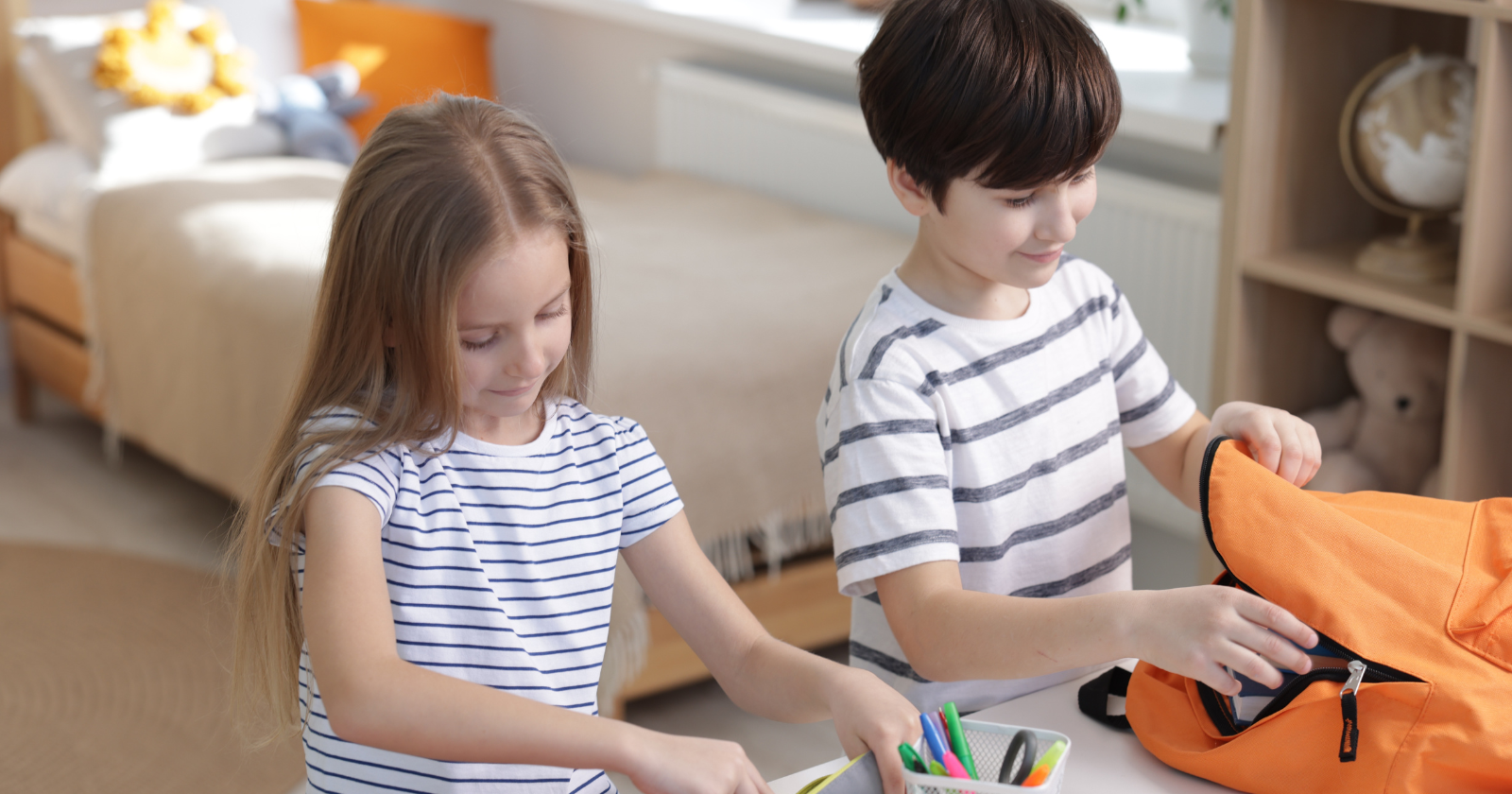
When we think about getting kids ready for school, our minds often jump to letters, numbers, and sitting still at a desk.
But the children who truly thrive in those early classroom years? They’ve been building something far more foundational long before the first day arrives.
School readiness shows up in surprising ways—in how a child handles disappointment, whether they can wait their turn during a board game, or how they navigate a disagreement with a sibling.
These are the skills that help kids feel confident, connected, and capable when they step into a classroom full of new faces and expectations. The beautiful thing is that most of these signs develop naturally through the kind of play, conversation, and daily rhythms that already fill your home.
Here are ten readiness signs to watch for in the months leading up to school.
1) They can follow two or three step directions
This one sneaks up on you. One day you’re repeating yourself endlessly, and the next your child is putting on their shoes, grabbing their jacket, and heading to the door—all from a single request. The ability to hold multiple steps in mind and execute them in order is a huge indicator of cognitive readiness.
This skill develops through everyday moments. Cooking together, tidying up toys, or getting ready for an outing all offer natural practice. “Can you put the blocks in the bin, then bring me your water bottle?” These small asks build working memory and help children feel competent.
If your child still needs reminders, that’s completely normal. Keep instructions clear and concrete. Visual cues help too—a simple picture chart for morning routines can work wonders without adding pressure.
2) They show curiosity and ask questions
A child who peppers you with “why” and “how come” and “what happens if” is doing important work. Curiosity is the engine of learning, and kids who arrive at school eager to explore tend to engage more deeply with whatever comes their way.
As noted by the National Association for the Education of Young Children, curiosity-driven learning in early childhood lays the groundwork for literacy, problem-solving, and social development. When children feel safe to wonder aloud, they’re practicing the very skills that will help them thrive in a classroom setting.
You don’t need to have all the answers. Sometimes the best response is, “I don’t know—let’s find out together.” That models lifelong learning and shows your child that questions are valuable, not inconvenient.
3) They can manage basic self-care tasks
Zipping a coat, washing hands, using the bathroom independently, opening a lunch container—these practical skills matter more than we sometimes realize. Teachers appreciate children who can manage basic self-care, and kids feel more confident when they’re not relying on adults for every small need.
This doesn’t mean perfection. A five-year-old who still needs help with tricky buttons is completely typical. But if your child can handle most of their bathroom routine, put on their own shoes, and manage their snack, they’re in good shape.
Practice at home by building in extra time for your child to do things themselves. It’s tempting to rush through getting dressed or packing a bag, but those few extra minutes of independence pay off. Milo, at two, already insists on putting on his own socks—even if they end up inside out. That determination is exactly what we want to nurture.
4) They can separate from you without major distress
Some tears at drop-off are normal and expected, especially in the beginning. But a child who has practiced separating from caregivers—at a playdate, with grandparents, during a short class—tends to adjust more smoothly to the school routine.
Attachment research consistently shows that children with secure bonds to their caregivers actually separate more easily over time. They’ve internalized the knowledge that you’ll return, which frees them to explore.
If your child struggles with separation, gentle practice helps. Start small—a short visit to a trusted friend’s house, a morning at a nature program.
Talk about what to expect in concrete terms. “I’ll drop you off, you’ll play and have snack, and then I’ll be back to pick you up.” Predictability builds security. And when you do leave, keep goodbyes warm but brief. Lingering often makes it harder.
5) They can express their needs with words
“I’m hungry.” “I need help.” “That made me sad.” A child who can name what they’re feeling or needing is better equipped to navigate the social and emotional landscape of school. Teachers can’t always read minds, and classrooms move quickly.
This doesn’t mean your child needs a sophisticated vocabulary. Simple, clear communication is the goal. If they can tell an adult when they need to use the bathroom, when something hurts, or when they’re feeling overwhelmed, they have what they need.
At home, help your child build this skill by naming emotions together. “You seem frustrated that the tower fell down. That’s disappointing.” Over time, they’ll start using those words themselves.
Ellie has gotten so good at this—she’ll announce, “I need some quiet time,” and take herself to her room with a book. It took years of practice to get there, but it started with us simply naming what we noticed.
6) They can play with other children
Cooperative play is one of the strongest predictors of school success. Can your child share materials, take turns, and work toward a common goal with a peer? These skills form the foundation of classroom collaboration.
According to the Center on the Developing Child at Harvard University, the executive function skills built through play—like impulse control, flexible thinking, and working memory—are essential for academic learning. Play isn’t just fun; it’s preparation.
If your child tends toward parallel play or prefers adults to peers, that’s okay. Create low-pressure opportunities for interaction. A playdate with one familiar child, a simple game with clear rules, or collaborative art projects can all help. The goal isn’t constant social engagement—it’s comfort with give-and-take.
7) They can handle small frustrations without falling apart
School is full of minor disappointments. The red crayon is broken. Someone else got called on first. The puzzle piece won’t fit. Children who can tolerate these small frustrations without a complete meltdown are better able to stay engaged and keep learning.
This is about emotional regulation, and it develops slowly over the early years. Your child doesn’t need to be stoic—big feelings are normal and healthy. But if they can recover from a setback with some support, take a deep breath, or try again after a short break, they’re building resilience.
At home, resist the urge to fix every frustration immediately. Sit with your child in the hard moment. “That’s really frustrating. I’m here with you.” Sometimes just being witnessed helps them move through it. Other times, you can gently offer a strategy: “Would it help to try a different piece first?”
8) They show interest in books and stories
A child who enjoys being read to, who asks for favorite stories again and again, who notices words on signs or pretends to read to their stuffed animals—these are all wonderful signs of emerging literacy. They don’t need to be reading yet. They need to love books.
This love grows through cozy read-aloud sessions, trips to the library, and seeing adults in their lives enjoy reading too. Talk about stories together. Ask what they think will happen next. Let them “read” the pictures to you.
If your child isn’t naturally drawn to books, try different formats. Audiobooks, graphic novels, nonfiction about their favorite topics—there’s no single right way to build a reading life. The goal is connection and curiosity, not performance.
9) They can focus on a single activity for a short stretch
Sustained attention develops gradually, and expectations should match your child’s age. A four or five-year-old who can stay engaged with a puzzle, drawing, or building project for ten to fifteen minutes is right on track.
This kind of focus grows through unstructured play. When children choose their own activities and aren’t constantly interrupted or redirected, they practice sinking into something deeply. Screen time, on the other hand, tends to fragment attention rather than build it.
Notice what captures your child’s interest and protect that time. If they’re absorbed in digging in the sandbox or arranging small figures in elaborate scenes, let them be. That concentration is exactly what will help them engage with classroom learning later.
10) They’re comfortable with routines and transitions
School runs on routines—circle time, snack, recess, centers, cleanup. Children who are used to predictable rhythms at home tend to adapt more easily to the structure of a classroom. They know what to expect and can move through transitions without too much resistance.
Dr. Laura Markham, clinical psychologist and parenting expert, has noted that routines help children feel safe because they reduce uncertainty. When kids know what comes next, they can relax into the present moment rather than bracing for the unknown.
You don’t need a rigid schedule at home, but some predictability helps. A consistent morning flow, a bedtime routine, regular mealtimes—these create anchors in your child’s day.
When transitions are hard, give warnings. “In five minutes, we’ll clean up and head outside.” That small heads-up makes a big difference.
Closing thoughts
School readiness isn’t a checklist to complete or a set of skills to drill. It emerges naturally through the kind of connected, play-rich childhood you’re probably already providing.
When you read together, cook together, let your child struggle a little and succeed a lot, you’re laying the groundwork for everything that comes next.
If your child isn’t showing all of these signs yet, please don’t worry. Development is uneven and individual. Some kids bloom earlier in one area and later in another.
What matters most is that they feel secure, curious, and loved—that’s the foundation everything else is built on.
Trust the process. Trust your child. And trust yourself. You know them better than anyone, and that connection is the most powerful school-readiness tool there is.