
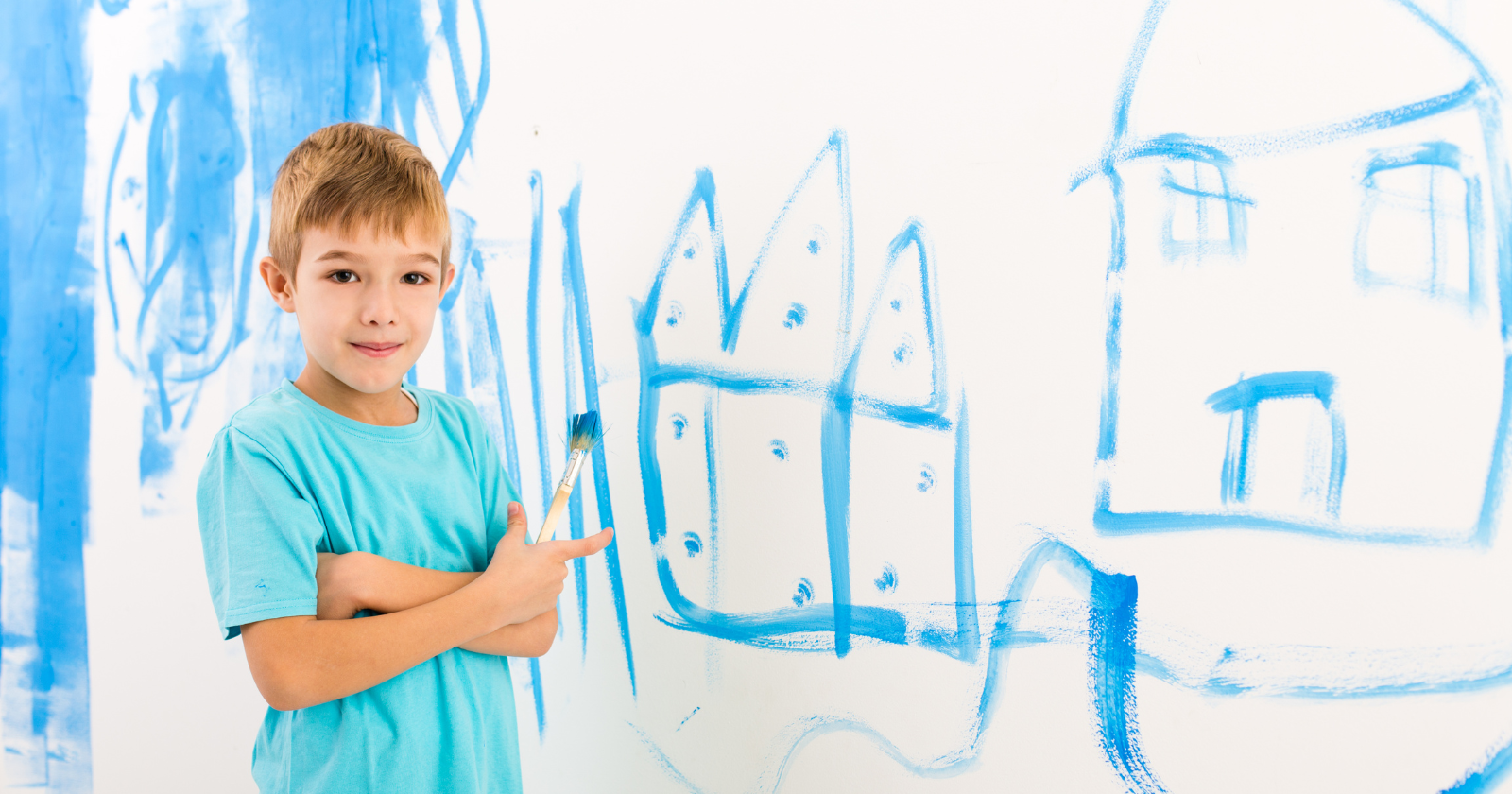
There’s a particular kind of tired that comes from answering your forty-seventh “but why?” of the morning. Or from discovering that your freshly painted hallway now features an elaborate crayon mural. Or from negotiating bedtime for the third time in twenty minutes with a small person who has somehow developed the debate skills of a seasoned attorney.
In those moments, it can feel like you’re doing something wrong. Like maybe you should have more control, more order, more compliance. But here’s what I’ve come to believe after years of parenting through the chaos: these behaviors that test our patience are often the very same qualities that will serve our children beautifully as they grow.
The curiosity, the creativity, the persistence, the willingness to question authority. These aren’t problems to fix. They’re seeds of something remarkable.
The wall artist might be your future innovator
When you walk into a room and find marker streaked across the wall, your first reaction probably isn’t pride. I get it. My own heart has sunk at the sight of permanent marker on surfaces that were definitely not meant to be canvases. But once the initial frustration passes, there’s something worth noticing here.
A child who draws on walls is a child who sees possibility everywhere. They look at a blank surface and think, “This could be something.” They’re not trying to ruin your day or disrespect your home. They’re creating. They’re expressing. They’re following an impulse that says the world is their canvas, and honestly, that’s a beautiful way to move through life.
As Dr. Stuart Brown, founder of the National Institute for Play, has noted, creative play is fundamental to healthy brain development and helps children develop problem-solving abilities that serve them throughout life. That mess on your wall? It’s brain-building in action.
Of course, we redirect. We provide appropriate outlets. We explain why some surfaces are for art and others aren’t. But we can do all of that while still honoring the creative impulse underneath the behavior.
The bedtime negotiator is practicing essential life skills
“Just five more minutes.” “But I’m not even tired.” “Can I have one more story? Just one? A short one?” If you’ve heard these phrases approximately ten thousand times, you’re not alone. Bedtime resistance is one of the most universal parenting experiences, and also one of the most draining.
But consider what your child is actually doing when they argue about bedtime. They’re advocating for themselves. They’re practicing negotiation. They’re testing boundaries to understand where the lines are. They’re using language to try to get their needs met. These are all skills we desperately want them to have as teenagers and adults.
The child who accepts every rule without question might be easier to parent in the moment.
But the child who pushes back, who asks why, who tries to find a compromise? That child is learning to stand up for themselves. They’re developing the confidence to question authority when it matters. They’re figuring out how to advocate for what they want while still operating within a relationship.
Related Stories from The Artful Parent
- 8 signs you’re raising an emotionally secure child even when it doesn’t feel like you know what you’re doing
- 9 things creative kids do that look like misbehavior but are actually signs their mind is working overtime
- The 8 messiest childhood activities are actually the ones building your child’s brain in ways screens never will
Yes, we hold the boundaries. Yes, bedtime still happens. But we can appreciate that the negotiation itself is practice for a lifetime of standing their ground.
A hundred questions means a mind that refuses to accept the surface
Why is the sky blue? Why do dogs bark? Why can’t I eat cookies for breakfast? Why do we have to wear clothes? Why? Why? Why? There are days when the questions feel relentless, when you’ve explained something three different ways and they’re still asking, when you genuinely don’t know the answer and “because that’s just how it is” feels like your only option.
But that constant questioning? It’s one of the most valuable traits a person can have. Curious children become curious adults, and curious adults are the ones who solve problems, create art, build businesses, and make discoveries. They’re the ones who don’t just accept the way things are but wonder how they could be different.
Research from the Harvard Graduate School of Education has shown that curiosity is a key driver of learning and that children who ask more questions develop stronger critical thinking skills. Every “why” is your child’s brain reaching for understanding.
Every question is them refusing to accept the surface level of things. That’s not annoying. That’s incredible. Even when it’s also exhausting.
Strong-willed children become strong-willed adults
There’s a particular kind of child who seems to come into the world knowing exactly what they want and being utterly unwilling to back down. These are the kids who have opinions about everything, from what they wear to how their sandwich is cut to which route you take to the grocery store. Parenting them can feel like a constant power struggle.
- What veteran bloggers who stay happy and passionate years into their career have learned to let go of - The Blog Herald
- A 2005 warning that the blogging world ignored — and is still paying for - The Blog Herald
- The rise and quiet exit of MSN Spaces: what bloggers should still learn from it - The Blog Herald
But strong-willed children often become the adults we most admire. They become leaders who don’t bend to peer pressure. They become advocates who fight for what’s right even when it’s hard. They become innovators who pursue their vision despite obstacles. The very traits that make them challenging to raise are the same traits that will help them change the world.
Our job isn’t to break their will. It’s to help them learn to channel it. To teach them when to stand firm and when to compromise. To show them how to advocate for themselves while still respecting others. The goal isn’t compliance. The goal is raising a person who knows their own mind and has the courage to follow it.
Emotional intensity is a gift wrapped in difficulty
Some children feel everything deeply. The joy is bigger, the sadness is heavier, the frustration is volcanic. These are the kids who have meltdowns that seem disproportionate to the situation, who cry at commercials, who rage when things don’t go their way. Parenting an emotionally intense child requires patience reserves you didn’t know you had.
But emotional intensity, properly supported, becomes emotional depth. These children grow into adults who feel compassion deeply, who connect with others authentically, who experience life in full color rather than muted tones. They become the friends who really listen, the partners who truly empathize, the leaders who understand what their people need.
As noted by Dr. Dan Siegel, clinical professor of psychiatry at UCLA, helping children understand and regulate their emotions builds the neural pathways for emotional intelligence that will serve them throughout their lives. When we help our intense children name their feelings and move through them, we’re not just surviving the moment. We’re building their capacity for rich emotional lives.
The child who won’t follow the crowd is learning to lead
Maybe your child insists on wearing rain boots with their summer dress. Maybe they want to play differently than the other kids at the playground. Maybe they have interests that seem unusual for their age or refuse to participate in activities everyone else enjoys. It can be tempting to push them toward conformity, to help them “fit in.”
But the ability to be different, to follow your own path even when it’s not the popular one, is increasingly rare and valuable. We live in a world that often rewards conformity, yet the people who make the biggest impact are usually those who dared to be different. The inventors, the artists, the changemakers. They were all once children who didn’t quite fit the mold.
When we let our children be themselves, even when that self is quirky or unconventional, we’re telling them that who they are is enough. We’re building the foundation for a lifetime of authenticity. We’re raising someone who won’t lose themselves trying to be what others expect.
Reframing the hard moments
None of this means we don’t set limits or teach appropriate behavior. We absolutely do. The crayon mural still needs to be cleaned up, and we still redirect to paper. Bedtime still happens, even after the negotiation. Questions still get answered, even when we’re tired. Boundaries matter, and so does guidance.
But we can hold those boundaries while also holding a different perspective on what these behaviors mean. We can be firm and still be curious about what’s driving the behavior. We can redirect and still appreciate the underlying trait. We can be exhausted and still recognize that we’re raising someone remarkable.
The next time you’re in the thick of it, when the questions won’t stop or the bedtime battle is raging or you’ve just discovered artwork in an unexpected place, try to take a breath. Try to see past the inconvenience to the child underneath. That persistent, creative, curious, strong-willed little person is going to be someone extraordinary. And you’re the one helping them get there.
Closing thoughts
Parenting is hard, and some children make it harder than others. But often the very traits that exhaust us are the ones that will serve our children best in the long run. The world needs people who question, who create, who persist, who feel deeply, who dare to be different. And those people were all once children who drew on walls and argued about bedtime and asked a hundred questions a day.
So if you’re raising one of these kids, take heart. You’re not doing it wrong. You’re raising exactly the kind of person the world needs. And someday, when they’re out there making their mark, you’ll look back on these exhausting days and know that every redirected crayon, every bedtime negotiation, every answered question was part of building something beautiful.