
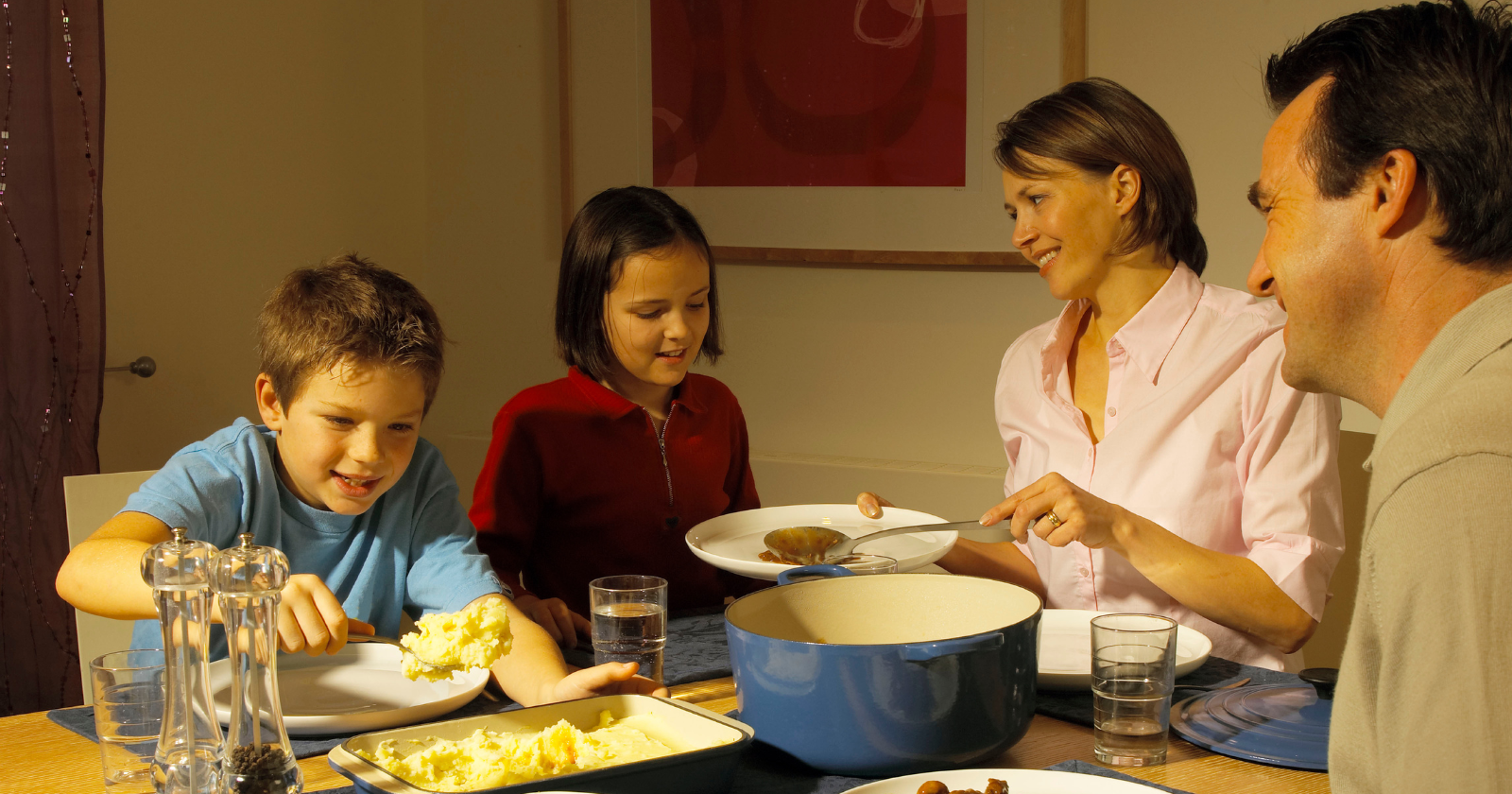
The other night, I caught myself mid-sentence. Milo had pushed his plate away after two bites of the lentil soup I’d spent an hour making, and the words were already forming: “Just try a little more for Mommy.”
I stopped. Where had that even come from? Probably from my own childhood dinner table, decades ago.
Here’s what I’ve been sitting with lately: so much of what we say at mealtimes feels automatic. These phrases roll off our tongues because we heard them growing up, or because we’re tired and just want our kids to eat something green.
But words have weight. And the dinner table, with all its daily repetition, becomes a place where our children quietly absorb beliefs about food, their bodies, and their own hunger signals. Some of those beliefs stick around far longer than we’d expect.
1) “Clean your plate”
This one runs deep in so many families. For generations, finishing everything on your plate was a sign of gratitude, good manners, and not being wasteful. I get it. I really do.
But when we insist kids eat past the point of fullness, we’re essentially teaching them to ignore what their bodies are telling them.
Children are born with a remarkable ability to self-regulate their eating.
As noted by the Ellyn Satter Institute, kids naturally eat when hungry and stop when satisfied, but this internal compass can get disrupted when external pressure takes over. The clean plate rule teaches them that the amount on their plate matters more than the signals from their stomach.
A gentler approach? Serve smaller portions and let them ask for more. Trust that their bodies know things we can’t see from the outside. Some nights Ellie eats like she’s preparing for hibernation. Other nights, three bites and she’s done. Both are okay.
2) “You can have dessert if you finish your vegetables”
I used to think this was a reasonable compromise. Eat the healthy stuff, get the treat. Everybody wins, right? But there’s something sneaky happening here.
When we use dessert as a reward for eating vegetables, we accidentally confirm what kids might already suspect: vegetables are the punishment, and sweets are the prize.
This kind of food hierarchy can follow children into adulthood, where they view healthy eating as something to endure rather than enjoy. It also puts dessert on a pedestal, making it even more desirable and emotionally charged.
What’s worked better in our house is serving dessert as just another part of the meal sometimes, without fanfare or conditions. A small cookie alongside dinner. Fruit with a drizzle of honey. It takes the power away from sweets and helps kids see all food as just… food. Some nourishing, some fun, all neutral.
3) “You’re such a good eater!”
Praise feels harmless, even helpful. But when we tie “good” to how much or what a child eats, we’re layering moral value onto something that should be pretty neutral. Kids start to connect their worth with their eating habits. A good eater is a good kid. A picky eater must be… what? Bad? Difficult?
I’ve watched Ellie beam when she finishes a big meal and gets praised for it. But I’ve also seen her face fall on days when she’s just not that hungry. She shouldn’t feel like she’s letting anyone down by listening to her body.
Instead of praising the eating itself, I try to comment on other things. “I love having dinner together.” “Thanks for trying something new.” Or simply enjoying the meal without commentary at all. Sometimes the best thing we can say is nothing.
4) “No more bread until you eat some protein”
Carbs have become strangely controversial, haven’t they? I catch myself monitoring how many rolls Milo reaches for, wanting to redirect him toward the chicken or beans.
But controlling which foods kids can access during a meal can backfire. It often makes the restricted food even more appealing and can lead to sneaking or overeating when that food is finally available.
Research from Penn State found that restricting certain foods actually increased children’s desire for and intake of those foods when restrictions were lifted. The forbidden fruit effect is real, even when the fruit is sourdough.
A more relaxed approach is to serve a variety of foods family-style and let kids choose what goes on their plates. Yes, some nights that means a plate of mostly bread. But over time, when all foods are available without restriction, kids tend to balance things out on their own.
5) “You don’t like that, remember?”
Kids change constantly. The food they gagged on at two might become a favorite at five. But when we remind them of past rejections, we’re essentially closing a door before they even reach for the handle. We’re defining their preferences for them, based on outdated information.
I’ve done this with Ellie and tomatoes. For years, I’d skip putting them on her plate because “she doesn’t like tomatoes.” Then one day at a friend’s house, she ate half a bowl of cherry tomatoes like it was nothing. She’d been ready to try again. I just hadn’t given her the chance.
Now I try to offer foods without narrating their history. No “I know you didn’t like this before, but…” Just quiet offering, again and again, without pressure or expectation. Kids deserve the space to surprise us and themselves.
6) “That’s too much food for you”
When we comment on portion sizes, whether a child is taking “too much” or “not enough,” we insert ourselves into a process that really belongs to them. It can make kids second-guess their hunger and start relying on external cues rather than internal ones.
I remember being a kid and feeling embarrassed when adults commented on how much I was eating. It made me self-conscious in a way that lingered. I don’t want that for my kids.
If I’m worried about food waste, I’ll suggest starting with a smaller portion and getting more if they’re still hungry. But I try to keep my tone light and avoid making it about their appetite being “wrong.” Their hunger is their own. My job is to provide the food, not police how much of it they want.
7) “Eat this, it’ll make you big and strong”
We mean well with this one. We’re trying to motivate healthy choices by connecting food to positive outcomes.
But tying eating to body size or physical appearance can plant early seeds of body image concerns. It suggests that the goal of eating is to look or be a certain way, rather than to feel good, have energy, or simply enjoy a meal.
As pediatric dietitian Jennifer Anderson of Kids Eat in Color has pointed out, focusing on what food does for our bodies internally, like giving us energy to play, can be more helpful than emphasizing external outcomes like size or strength.
With my kids, I’ve shifted toward talking about how food makes us feel. “This gives us energy for the park.” “Drinking water helps our bodies work well.” It keeps the focus on function and feeling rather than appearance.
8) “Stop playing with your food”
I’ll be honest, this one still slips out when Milo is building mashed potato mountains instead of eating.
But here’s the thing: for young children especially, playing with food is part of how they learn about it. The textures, temperatures, smells, and sounds all matter. Sensory exploration is a stepping stone to actually eating new foods.
When we shut down food play too quickly, we might be interrupting a process that leads to acceptance. That squishy avocado they’re smooshing today might end up in their mouth next week, if we give them space to get comfortable with it first.
I’m learning to take a breath and let some mess happen. Not every meal needs to be efficient. Sometimes the slow, messy, curious approach is exactly what a child needs to build a healthy relationship with food over time.
Closing thoughts
None of us are going to get this perfect. I still catch old phrases bubbling up, especially on hard days when I just want everyone to eat something and stop negotiating. But awareness is the first step. When we notice the scripts we’re running on autopilot, we get to choose whether to keep them or write new ones.
The dinner table is such a small space, but so much happens there. Connection, conflict, nourishment, and yes, a whole lot of learning. Our kids are absorbing more than calories. They’re absorbing our attitudes, our anxieties, and our relationship with food itself.
What if we made the table a place of less pressure and more presence? A place where food is offered with love and eaten, or not, without drama? That’s the table I’m trying to set. Most nights, I’m still figuring it out. But I think that’s okay. We’re all learning together.
