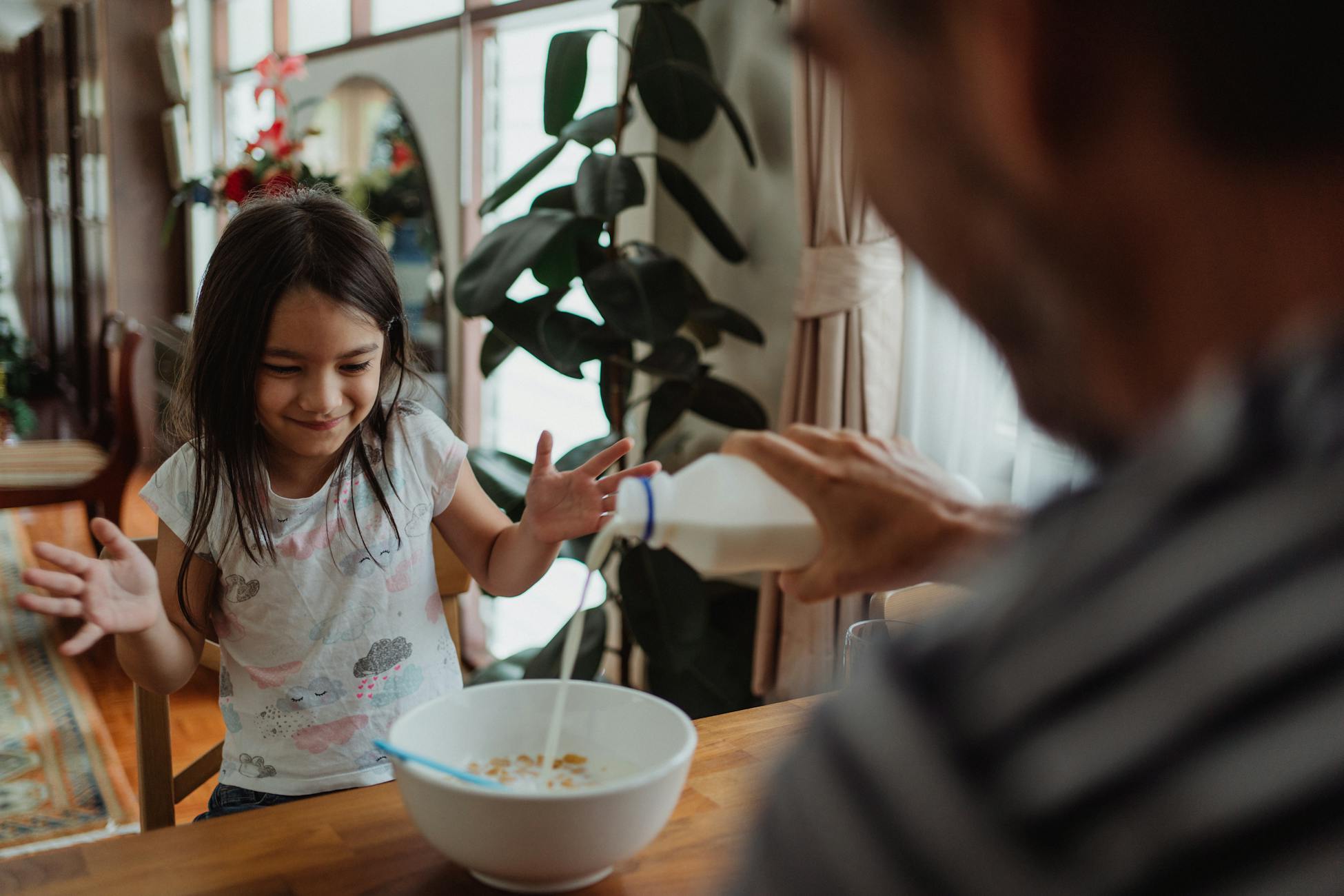
Last Saturday morning I was at my older son’s house. I’d come over early to help with a leaking tap under the kitchen sink, though if I’m honest I mainly came because the grandchildren were there and I’ll take any excuse. Breakfast was the usual chaos — cereal boxes open, toast burning, the three-year-old painting the high chair tray with yoghurt. My son was trying to get everyone fed before swimming lessons, and his seven-year-old asked for a different cup. Not rudely. Just asked. And he snapped at her. Sharp voice, tight jaw, the words came out clipped: Just use the one you’ve got.
I came across a video recently from The Artful Parent called “Millennial Parents Were Set Up to Fail” that digs into exactly this generational shift—why my son’s generation apologizes and mine didn’t, and what that cost us.
It wasn’t terrible. It wasn’t cruel. It was the kind of thing that happens in every kitchen on every Saturday morning when the toast is burning and you’re running late and you’ve already said the same thing three times. I know because I did it a thousand times when my boys were small. Probably worse.
But here’s what happened next. About five minutes later, the rush died down a bit. My son walked over to his daughter, crouched to her level, and said: Hey. I’m sorry I snapped at you about the cup. That wasn’t fair. You were just asking, and I was stressed. That’s not your fault.
She looked at him for a moment, nodded, said That’s okay, Daddy, and went back to her cereal. And that was it. The whole thing lasted maybe fifteen seconds.
I stood at the sink pretending to examine the U-bend, and I felt something shift in my chest. Not quite shame. Not quite pride. Something in between that I still don’t have the right word for.
We Didn’t Apologize. We Just Carried On.
In my generation — and I’m sixty-three, so I’m talking about the seventies and eighties — parents didn’t apologize to children. It wasn’t discussed. It wasn’t considered. The hierarchy was clear: adults were in charge, children did as they were told, and if you raised your voice or were unfair, you moved on and hoped the moment would pass like weather. You might be gentler for the rest of the evening. You might let them stay up ten minutes later or give them an extra biscuit. But you didn’t name what happened. You certainly didn’t say I was wrong.
I know this because I lived it from both sides. My father never once apologized to me for anything, and I don’t remember thinking he should. That was simply how things worked. Growing up in the fifties and sixties taught us all sorts of things without anyone saying a word — resilience, self-reliance, how to read the mood of a room. But it also taught us that admitting fault was weakness, that authority required infallibility, and that children’s feelings were background noise in the business of running a household.
And when I became a father, I carried all of that forward without examining it. Not because I was unkind. Because I didn’t know there was another way.
What Children Actually Remember
Here’s what I’ve come to understand, partly through my own sons telling me and partly through reading I’ve done since retirement: children don’t forget the sharp moments. They don’t forget the mornings when your voice changed and they didn’t understand why. They file it away. And if no repair comes — no acknowledgment, no reconnection — they start building a story about what it means. Usually that story is: I did something wrong. I am too much. My feelings don’t matter enough for anyone to notice.
Research supports this in ways I wish I’d understood forty years ago. Edward Tronick’s work on the “still face” paradigm showed that what matters most for children isn’t whether ruptures happen — they always will — but whether those ruptures get repaired. The repair is the thing. A parent who snaps and then comes back with honesty teaches the child that relationships can break and heal. A parent who snaps and pretends it didn’t happen teaches the child that their reality isn’t real.
I think about that a lot now. Not with self-punishment — my therapist has helped me with that — but with a kind of clear-eyed sadness. Because the boomers who raised us weren’t trying to be cold — they were parenting with the tools of people who were never truly parented themselves. And then we did the same thing, one generation later, with marginally better tools and the same blind spots.
What I Got Wrong With My Own Boys
I was a decent father. I want to say that, not as a defense but because it’s true and I’ve spent enough time in the last few years being hard on myself. I showed up. I worked. I coached football on Saturdays when my knees still allowed it. I read to them most nights until they were old enough to read to themselves.
But I didn’t apologize when I was wrong. I didn’t name my frustration as mine. If I was short with them because of a bad day at work — and after thirty years in HR at a manufacturing company, there were plenty of bad days — I’d just be quieter for a while and then act normal again. I assumed children were like the weather: they’d cycle through moods and come out the other side without intervention.
My older son told me, about three years ago, that the thing he remembered most from being thirteen wasn’t the time I shouted about his school report. It was the silence afterward. The way I never came back to it. He said he spent the rest of that week convinced I was disappointed in him as a person, not just his grades. He carried that for twenty years.
Twenty years. Because I didn’t walk into his room and say five simple words: I’m sorry. I was wrong.
A 2019 study in the Journal of Family Psychology found that parental hostility — even at low levels, even the everyday kind — predicted emotional insecurity in children, and that the effect was significantly buffered when parents engaged in repair behaviors. The science is saying what my son already told me over a cup of tea: it’s not the snap that does the damage. It’s the absence of what comes after.
Watching My Son Do It Differently
So there I was on Saturday, watching my son do the thing I never learned to do. And doing it naturally, the way you’d pick up a dropped spoon. No drama. No lengthy speech. Just a quick, honest acknowledgment that he’d been unfair, delivered at his daughter’s eye level.
I don’t know exactly where he learned it. Maybe from his wife, who is better at emotional language than anyone in our family. Maybe from books or podcasts — he’s always been a reader. Maybe from the gaps in his own childhood that he decided, consciously or not, to fill differently.
Research by Marissa Drell and Amrisha Vaish has shown that children as young as four can meaningfully process apologies, and that genuine apologies from adults help children develop their own capacity for empathy and forgiveness. When my son apologizes to his seven-year-old, he’s not just fixing a moment. He’s teaching her that people she loves can make mistakes and own them. He’s showing her that she’s worth the discomfort of honesty.
That’s something I never showed my children. Not because I didn’t love them — I loved them with everything I had — but because the toolkit I inherited didn’t include that particular wrench.
The Quiet Work of Breaking Patterns
I started therapy two years ago, at Linda’s suggestion. I was resistant at first. Men of my generation didn’t do that. But I went, and one of the first things my therapist asked was: When was the last time someone in your family apologized to you as a child?
I couldn’t think of a single instance.
She wasn’t surprised. She said many of her clients from my generation carry what she called “unrepaired ruptures” — small cracks in the foundation that were never addressed and eventually became part of the architecture. You build your whole emotional house around them without realizing the floor is uneven.
I think that’s why so many of us became people-pleasers or conflict-avoiders as adults. When you grow up in a house where no one names what went wrong, you learn to smooth things over. You learn to read the room instead of speaking in it. You develop antennae for other people’s moods because no one ever taught you to trust your own.
I see it in myself even now. At sixty-three, I still feel a small flinch of surprise when someone says sorry to me and means it. It’s like hearing a word in a language I understand but never learned to speak.
What I’m Trying to Do Now
I can’t go back and apologize to my sons for every sharp morning and every unexplained silence. I’ve apologized for some of them — specific ones, named ones — and both boys have been more gracious about it than I probably deserve. My older son, the one who’s now a teacher and who thinks carefully about how words land on small people, told me it meant more than I knew. My younger son, who’s never been one for big conversations, just nodded and said Thanks, Dad. Which from him is a cathedral of feeling.
What I can do is practice with my grandchildren. Last Sunday at the park, I was impatient with my youngest grandson — he wanted to go back to the swings for the fourth time and I was tired and my back was aching and I said something dismissive. Nothing awful. But I heard it leave my mouth and I heard the echo of my own father in it.
So I stopped. I crouched down the way I’d watched my son do. And I said: I’m sorry, mate. That was grumpy of me. Let’s go back to the swings.
He grinned and grabbed my hand and that was the end of it for him. But it wasn’t the end of it for me. Because every time I say those words — I’m sorry, I was wrong — I feel something loosening. Some old, inherited tightness in my chest that I’ve carried since I was seven years old and learned that adults don’t bend.
They didn’t forget. My sons didn’t forget. I didn’t forget. The children in our lives right now won’t forget either. But what they remember doesn’t have to be the snap. It can be what came after — the moment someone they loved got down to their level, looked them in the eye, and said the bravest thing a person can say to someone small: I got that wrong, and you deserved better.
It’s not complicated. It’s just hard. And it’s never too late to start.