

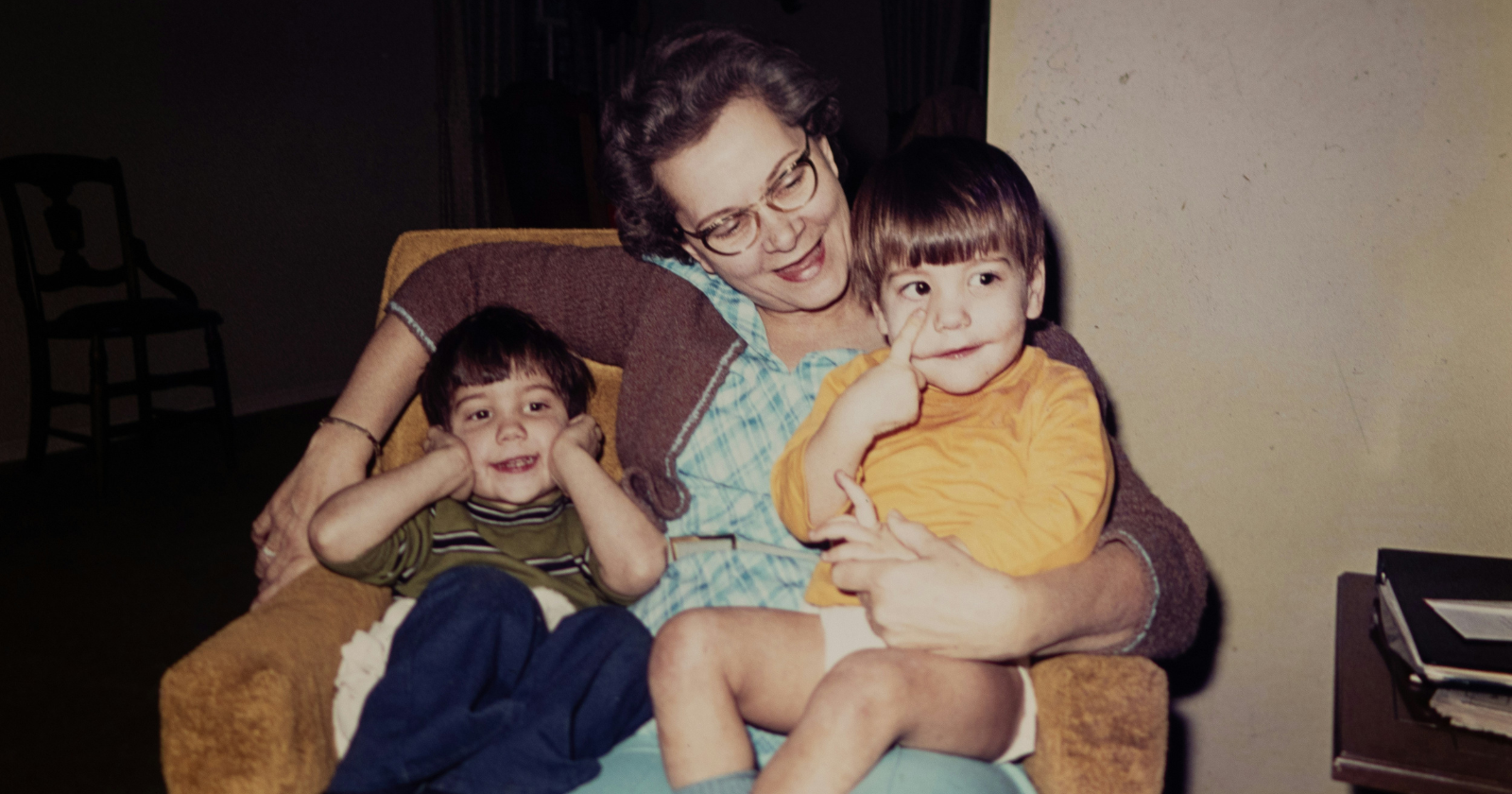
My mom grew up in a small Midwest town in the 1960s. Her summers were spent barefoot in the yard, riding bikes down roads nobody worried about, and not coming home until the porch light flickered on. Nobody tracked her. Nobody scheduled her afternoons. She made everything from scratch — not because it was trendy, but because that’s just how things worked.
My daughter Ellie is five. She’s curious and chatty and happiest with dirt under her nails. In a lot of ways, her childhood looks like a gentler echo of my mom’s — we spend mornings outside, she digs in the garden, she sorts leaves into elaborate piles only she understands. But the world around her is radically different. There’s more structure, more supervision, more noise. And I sometimes wonder what’s been quietly lost in the gap between those two childhoods.
Turns out, psychologists have been wondering the same thing.
A growing body of research suggests that children who grew up in the 1960s and 1970s absorbed certain life lessons through sheer lived experience — lessons that today’s kids rarely encounter the same way. Not because today’s parents are failing, but because the conditions that organically produced those lessons have largely disappeared. Here are nine that keep coming up in the research, and in my own kitchen-table reflections on what I want to carry forward for my kids.
1) Boredom is a launchpad, not a problem to solve
When my mom talks about her childhood, boredom comes up a lot — but never as a complaint. It’s always the beginning of a story. We were bored, so we built a raft. We were bored, so we put on a play in the garage.
Kids in the 1960s and ’70s had vast stretches of unstructured time with no one entertaining them. And what happened in that emptiness wasn’t nothing — it was everything. Imagination kicked in. Projects materialized. The brain, left without input, started generating its own.
I’ve noticed this with Milo, who’s two and already a master of turning couch cushions into elaborate forts. He doesn’t need a toy designed for that purpose. He needs the boredom that makes a cushion look like a building material. When I resist the urge to fill every quiet moment, something almost always sparks.
2) You can survive discomfort, and it won’t break you
This one is hard for me, because every instinct says to smooth the path. But psychologist Albert Bandura’s research on self-efficacy shows that the most powerful source of genuine confidence isn’t praise or encouragement — it’s what he called “mastery experiences.” Moments where you face something difficult and come out the other side having handled it yourself.
Children of the ’60s and ’70s had mastery experiences constantly. They walked to school alone. They settled their own arguments. They scraped their knees and kept going. None of it was designed to “build character” — it just happened, because nobody was hovering close enough to prevent it.
I think about this when Ellie struggles with something and looks at me to fix it. Sometimes I do. But more and more, I’m trying to sit with her in the struggle instead of removing it. The discomfort isn’t the enemy. It’s the teacher.
3) Not every conflict needs a referee
One thing that kept coming up as I read about this era is how children managed their own social lives. If two kids got into an argument during a neighborhood game, there was no adult stepping in to mediate. They either worked it out or the game ended. Both outcomes taught something.
Related Stories from The Artful Parent
- My father fixed everything in the house but never fixed anything between us — and psychology explains that’s not a contradiction, it’s a pattern common in men who were raised to express love through utility because no one ever modeled what it looks like to express it through words
- Research suggests the people who make you lower your guard when you first meet them aren’t more likable than everyone else — they’ve simply never confused being interesting with being interested, and the ones who figured out that distinction early have been the most magnetic people in every room they’ve ever walked into
- Psychologists claim a predictable life doesn’t damage the mind the way trauma does — it starves it, quietly and without drama, in the way that a body fed the same meal every day eventually stops being nourished by it no matter how nutritious the meal
Psychologist Peter Gray, who has spent decades studying children’s free play, put it this way in an interview with NPR: “If you’re always protected from bullies by some adult, you’re not learning how to deal with that yourself.” His research, published in The Journal of Pediatrics, argues that the continuous decline in children’s independent activity since the 1960s is a major contributor to rising rates of anxiety and depression in young people.
That doesn’t mean we abandon kids to figure everything out alone. But it does mean that stepping back sometimes — letting siblings negotiate, letting playground disputes unfold — gives children practice with the social skills no adult can teach through instruction alone.
4) Waiting is a skill, not a punishment
Want to watch your favorite show in 1972? Better be home when it aired. Want that toy? Save your allowance for three months. Want to know the answer to a question? Walk to the library.
Children who grew up in the ’60s and ’70s practiced delayed gratification as a default condition of daily life. There was no streaming, no same-day delivery, no instant answer to every curiosity. And that constant, low-level practice of wanting something and not immediately getting it built a kind of patience and emotional endurance that’s genuinely hard to replicate in a world designed around convenience.
I try to build small pockets of this into our days. We bake bread from scratch — and yes, waiting for dough to rise takes forever when you’re five. We walk to the farmers’ market instead of driving. We don’t skip ahead in stories at bedtime, even when Ellie begs to know what happens. These feel like tiny things. But I think they’re quietly teaching her that good things don’t always come instantly, and that’s okay.
5) Nature is the original classroom
This one’s personal for me because it’s the heartbeat of how we live. We’re outside every morning — in the garden, at the park, walking trails, roaming. Ellie learns more from an hour with a magnifying glass and a patch of dirt than she does from most structured activities.
- Research suggests the reason some people can live the same day on repeat for years without distress while others feel like they’re suffocating isn’t personality. It’s whether the routine was chosen deliberately or inherited by default, because the brain processes voluntary repetition as ritual and involuntary repetition as captivity. - Global English Editing
- Life isn’t a series of random events but a chess game where every move matters - Global English Editing
- Nobody tells you that the real threat to a long relationship isn’t the dramatic betrayal. It’s the Wednesday afternoon coffee where someone at work asks how you’re really doing and you actually answer honestly for the first time in months. - Global English Editing
Kids in the ’60s and ’70s didn’t have “outdoor time” penciled into a schedule. The outdoors was simply where childhood happened. And the research keeps confirming what those kids absorbed instinctively: that unstructured time in nature builds problem-solving, emotional regulation, and a sense of calm that no indoor activity fully replicates.
As a summary of Gray’s research on ScienceDaily notes, adults’ well-intentioned drive to protect and guide children has inadvertently “deprived them of the independence they need for mental health.” The outdoors was never just recreation. It was where resilience got built, one unsupervised afternoon at a time.
6) Community is built by showing up, not by scheduling
My mom knew every neighbor on her street. Not because there were organized block parties, but because people were simply outside at the same time. Kids ran between yards. Adults borrowed sugar. Doors were unlocked.
That kind of organic, proximity-based community has largely evaporated. But I see echoes of it at our Saturday farmers’ market, where we know the vendors by name, and at the community garden where Ellie and Milo have their own little plot. These connections aren’t efficient or optimized. They’re slow and sometimes inconvenient. And that’s exactly what makes them real.
Children in the ’60s and ’70s learned that belonging wasn’t something you signed up for. It was something that happened when you were present, available, and willing to share what you had. I want my kids to carry that understanding — that community isn’t a product you consume but a practice you show up for.
7) Failure is information, not identity
Have you ever noticed how afraid kids are to get things wrong now?
I see it in Ellie sometimes — the hesitation before trying something new, the quick look to see if I’m watching, the desire to get it right on the first try. And I don’t think that comes from her. I think it comes from a culture that’s made failure feel like a much bigger deal than it needs to be.
Children growing up decades ago failed all the time, in small and manageable ways, without anyone making a fuss. The bike wobbled and you fell. The recipe didn’t work. The fort collapsed. And then you just… tried again. There was no participation trophy. There was no long debrief. There was just the quiet knowledge that failing at something didn’t mean you were a failure.
I practice repair quickly when I lose patience with my kids, and part of that is modeling what it looks like to mess up and keep going without making it a crisis. Progress, not perfection — that’s the line I keep coming back to. And I think it’s one of the most important things I can teach them.
8) You don’t need to be watched to be worthy of trust
This might be the biggest shift between then and now. In the 1960s and ’70s, children moved through the world with an astonishing degree of unsupervised freedom. They walked to school, rode buses alone, explored neighborhoods without a GPS-equipped phone in their pocket.
Australian parenting educator Maggie Dent writes about how children who have a safe base and are given opportunities to stretch and grow “in their own time, in their own way, get better at risk assessment, resilience and courage.” The key is that the safety comes from the relationship, not from constant surveillance.
That reframe has changed how I think about independence with my own kids. Ellie doesn’t need me watching her every second in the backyard to know I’m there for her. Milo doesn’t need me hovering over his block tower to feel safe. What they need is the confidence that comes from being trusted — trusted to explore, to try, to fail, and to come back when they need me.
9) Resourcefulness beats abundance every time
My mom’s family didn’t have much money. But they had a garden, homemade meals, and the ingrained understanding that you worked with what you had. Toys were improvised. Clothes were handed down. Nothing was wasted, and creativity filled the gaps that money didn’t.
That resourcefulness wasn’t a hardship lesson. It was a life skill. And it’s one I find myself deliberately cultivating in our family — not out of scarcity, but out of a belief that children who learn to make something from nothing carry a kind of confidence that no amount of store-bought enrichment can provide.
We rotate toys instead of buying new ones. We craft with recycled jars and fabric scraps. Ellie’s favorite game right now involves a cardboard box, a blanket, and her imagination. Milo turns a wooden spoon into a sword, a drumstick, a magic wand — sometimes all within the same five minutes. That inventiveness isn’t something I had to teach them. I just had to stop replacing it with something shinier.
What we carry forward
I don’t want to romanticize the past. Plenty about childhood in the 1960s and ’70s was imperfect, even harmful. Seatbelt laws didn’t exist. Emotional conversations were rare. My mom’s family ate together every night but never really talked about how they felt. I’m trying to build something different for Ellie and Milo — something that takes the best of what that era accidentally got right and weaves it into a family life that also makes room for emotional openness, connection, and gentleness.
But I do think we’ve lost something worth reclaiming. The space to be bored. The trust to explore. The understanding that discomfort is not damage, and that children are far more capable than our anxious supervision suggests.
None of this requires going back in time. It just requires being willing, every now and then, to step back a little — and let our kids surprise us with what they already know how to do.
