
Picture this: something goes wrong for your child — really wrong — and you’re not reachable. Maybe it’s a scary situation at school, a falling-out with a close friend, or something that just shakes them up and they need an adult in their corner fast.
Who do they call?
Not you. Not their other parent. An adult outside your immediate family — someone they genuinely trust to show up for them.
Can your child name that person? Can they name three?
That question sounds simple. But it turns out the answer is one of the most meaningful indicators we have of how well a child will cope with life’s harder moments. And when researchers looked into who children tend to name most — it was grandparents, by a wide margin.
What the research is telling us
The idea that children need more than their parents to thrive isn’t new. But the specificity of recent findings has made a lot of parents — me included — stop and think.
A landmark Welsh national survey published in BMC Psychology examined nearly 2,500 adults about their childhood access to trusted adults and how that access connected to their resilience. The findings were striking. Children who had consistent access to a trusted adult outside the home were significantly more likely to develop the kind of emotional resources that help them face adversity — things like problem-solving confidence, a sense of belonging, and the belief that they were capable of handling difficulty. What’s more, the more sources of trusted adult support a child had, the stronger those resilience resources tended to be.
It’s not just one adult who makes the difference. It’s a network.
This backs up decades of developmental research. Emmy Werner, whose landmark 40-year Kauai Longitudinal Study tracked nearly 700 children from birth through adulthood, found that the most resilient children in her cohort — those who overcame real adversity and built genuinely good lives — consistently shared one thing: a close bond with at least one caring, stable adult outside their nuclear family. In many cases, that person was a grandparent.
Why the number matters
One trusted adult is meaningful. But why does having multiple people in that role change things so significantly?
Think about it from a child’s perspective. When you have just one person you feel truly safe with outside your parents, losing access to them — even temporarily — can feel like losing a lifeline. When a child has three or more people they could genuinely turn to, they develop something different: a felt sense that the world has space for them in it. That there are people, beyond the walls of their own home, who would show up.
Related Stories from The Artful Parent
- Psychology suggests people who always clean up after themselves at restaurants don’t do it to be seen doing it — and that distinction, between the behavior performed for an audience and the behavior that happens when no one is watching, is the only one that actually tells you anything true about a person
- My father fixed everything in the house but never fixed anything between us — and psychology explains that’s not a contradiction, it’s a pattern common in men who were raised to express love through utility because no one ever modeled what it looks like to express it through words
- Psychology claims people who grew up in the 1960s and 1970s learned these 9 life lessons that are rarely taught today
That belief — quiet, low-key, often never consciously examined — turns out to be protective in ways that are hard to overstate.
It builds what psychologists call a wider attachment network. The child doesn’t just rely on one or two people for emotional safety. They carry an internal map of their community, populated with faces they trust. And when something hard happens, that map guides them toward help rather than away from it.
I think about Ellie and Milo when I sit with this research. Ellie at five is already someone who connects easily — she knows the names of vendors at our Saturday farmers’ market, she’s developed a real thing for our neighbors, and she asks about people long after we’ve seen them. Milo at two is just beginning to sort out his world beyond our immediate family. And what I want — more than almost anything as their parent — is for both of them to grow up knowing their village, really knowing it, in the way that feels like a floor under their feet.
Why grandparents keep showing up
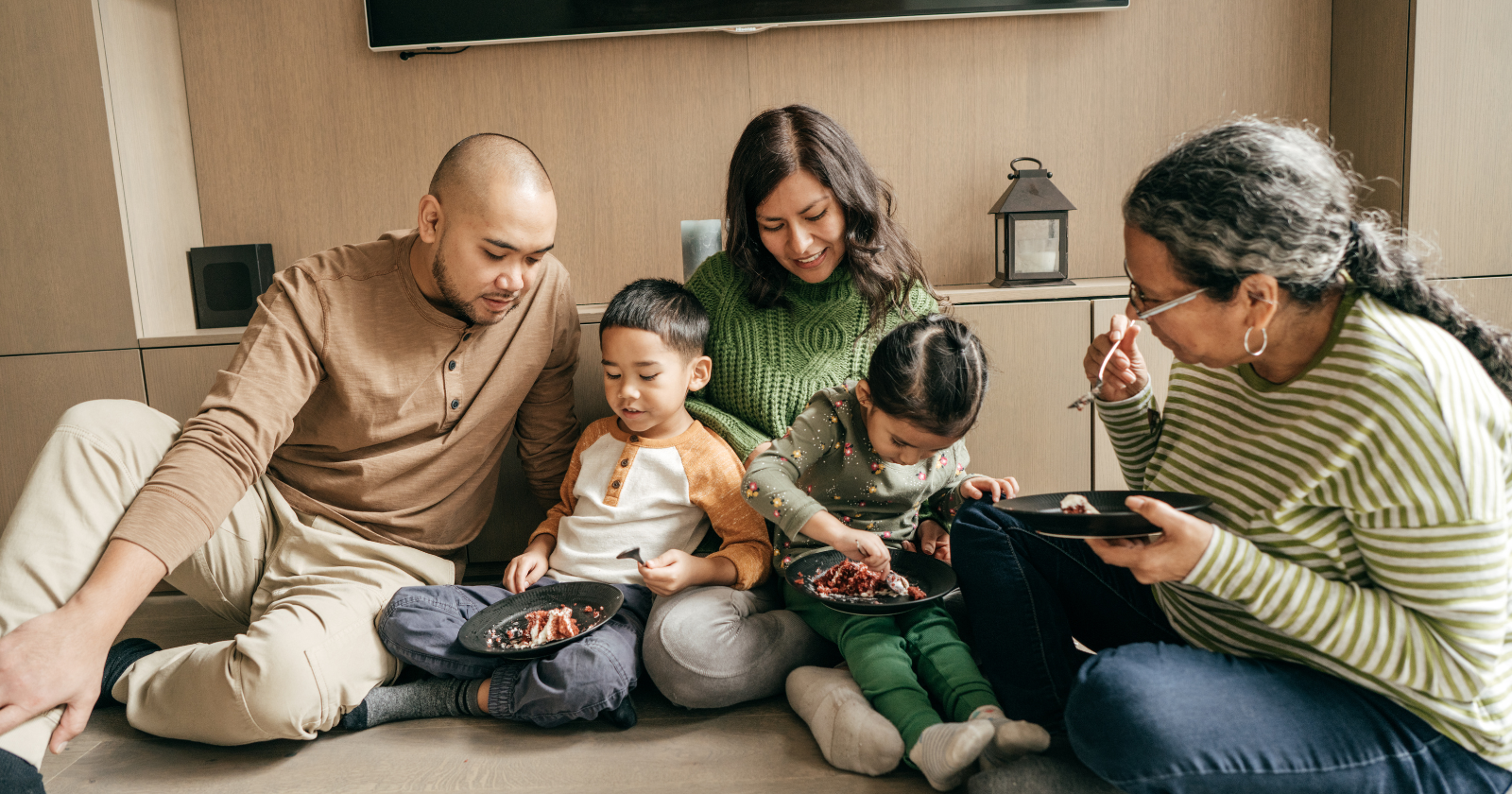
When children across multiple studies are asked to name the trusted adults in their lives, grandparents consistently top the list. There are good reasons for that.
Research published in Frontiers in Psychology found that close relationships with grandparents during early childhood were positively associated with emotional wellbeing, resilience, and lower rates of anxiety and depression well into young adulthood. The researchers noted that grandparents occupy a uniquely valuable emotional role — they tend to focus on the relationship itself, less burdened by the day-to-day management of discipline, schedules, and logistics that can sometimes crowd the parent-child dynamic.
Grandparents love without the weight of the daily to-do list.
- Research suggests the reason some people can live the same day on repeat for years without distress while others feel like they’re suffocating isn’t personality. It’s whether the routine was chosen deliberately or inherited by default, because the brain processes voluntary repetition as ritual and involuntary repetition as captivity. - Global English Editing
- Life isn’t a series of random events but a chess game where every move matters - Global English Editing
- Nobody tells you that the real threat to a long relationship isn’t the dramatic betrayal. It’s the Wednesday afternoon coffee where someone at work asks how you’re really doing and you actually answer honestly for the first time in months. - Global English Editing
That doesn’t mean parents love their children less — obviously they don’t. But children can feel the difference between a relationship that’s woven through with instruction and management, and one that exists mostly just to enjoy them. Grandparents often represent the latter. They’re the ones who will sit for an hour listening to a five-year-old explain a dream. Who have time — or at least feel like they do — in a way that harried parents on a Tuesday evening often can’t manufacture.
There’s also the identity piece. Grandparents carry family stories, traditions, a sense of where a child comes from. That continuity is its own kind of anchor.
When the village is thin
Here’s the part I want to be honest about: a lot of modern families are operating with a thinner village than they realize. We move for work, we lose touch with extended family over distance or disagreement, we live in neighborhoods where nobody knows each other past a polite wave. The informal community structures that once meant a child was surrounded by multiple caring adults — grandparents nearby, aunts and uncles around the corner, neighbors who actually knew each other’s names — have quietly eroded for many families.
And I say this as someone who has felt it. Growing up in a small Midwest town, our family ate dinner together every night, but the conversations rarely went very deep. The adults in my life were present in a physical sense, but not always in the emotionally available way this research points to. I didn’t have a clear sense, as a kid, of three or four people outside my immediate family who would genuinely show up for me in a crisis.
That shaped me. And it shapes the parent I’m trying to be.
I’ve lost some friendships over the years by choosing an alternative parenting path that not everyone understood. But I’ve also built something — a small, intentional community of families who genuinely know us. We’re part of a babysitting co-op with three other families. We volunteer at the community garden, where Ellie and Milo have their own small plot and know the other families by name. I host monthly craft playdates and attend La Leche League meetings not just for the information, but for the people. Slowly, carefully, we’re building the kind of network where I think Ellie could one day name a handful of adults who she knows, really knows, would be there for her.
That doesn’t happen by accident. It takes intention.
What this means for how we parent
If you read this and feel a flicker of concern about whether your own children have enough of these connections — I’d gently say: that’s a useful flicker. Not a reason to panic, but a reason to look up.
The first step is genuinely simple: ask your child. Ask them who, besides you and their other parent, they would go to if something scary happened. Who they trust. Who makes them feel safe. You might be surprised by the answers — a teacher, a neighbor, a family friend, a grandparent they only see a few times a year but have a quiet bond with.
From there, you can start to tend those relationships consciously. Create regular moments of connection with the people your child already gravitates toward. If grandparents are in the picture, make space for them to have one-on-one time with your kids — not just whole-family visits where the adults are all talking and the kids are on the margins, but real, focused time. Let the relationship breathe and deepen.
And if the village is genuinely thin right now? Be kind to yourself about that. Many of us are building community in conditions that make it genuinely hard. What matters is starting. One connection at a time, one relationship made a little more consistent, a little more real.
Building the net wider
There’s something both humbling and hopeful about this research. Humbling because it reminds us that we, as parents, cannot and should not be everything to our children — no matter how much we love them. Hopeful because it means that every relationship we help our kids build, every trusted face we add to their world, is doing quiet and important work.
Your child doesn’t need a flawless parent. They need a full village.
The grandparent who sits with them at the kitchen table and asks how school is going. The neighbor who notices when they seem off. The family friend who has known them since they were born and will still know them when they’re fifteen and difficult. Those people are not peripheral to your child’s resilience — they are part of its foundation.
So if there’s one thing worth doing this week, maybe it’s this: count the adults your child could turn to. And then think about who might deserve a warmer hello.