There is a moment I have seen play out in our backyard dozens of times.
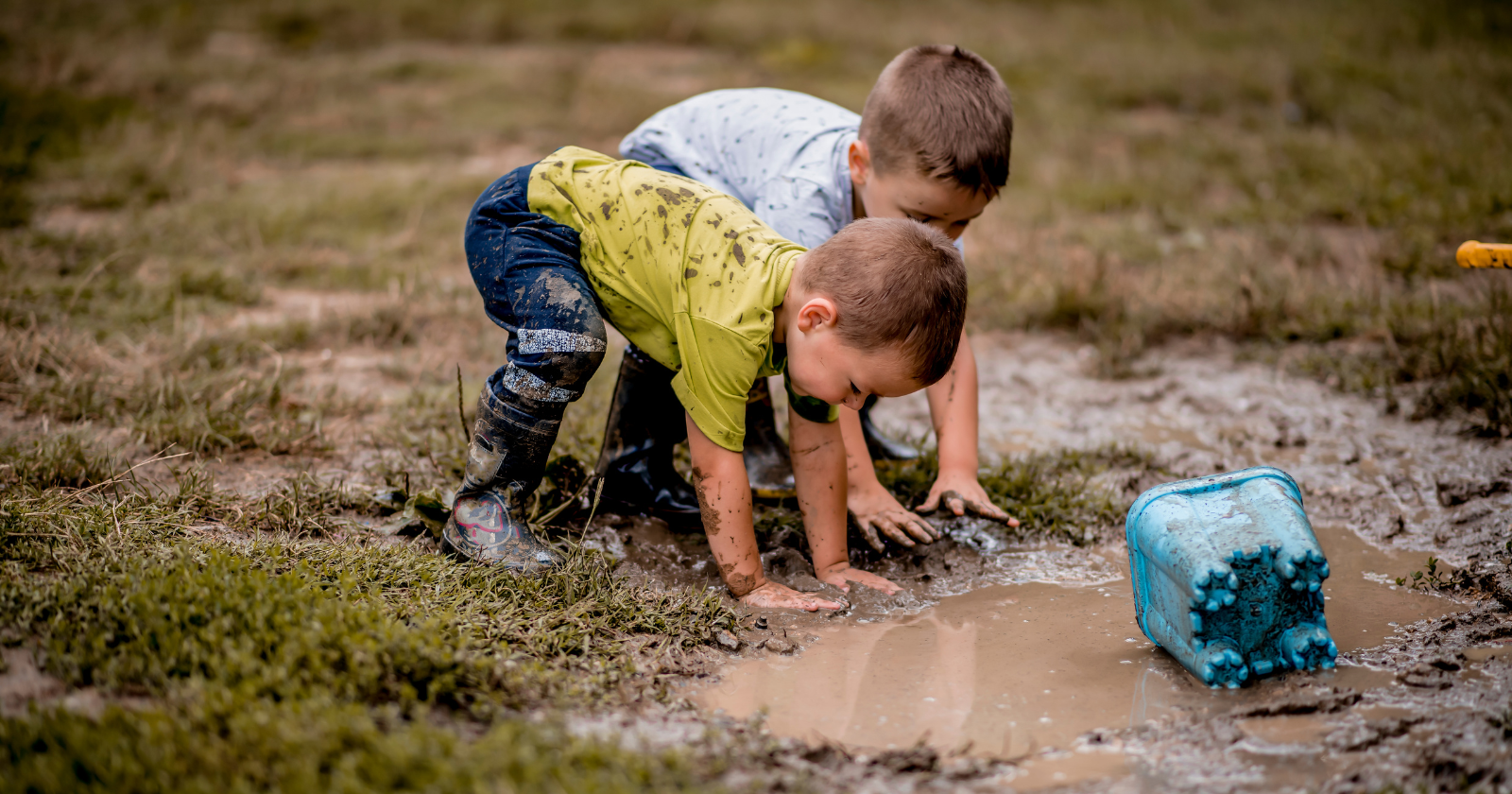
Ellie wanders outside with no particular plan, stands there for a minute looking vaguely dissatisfied, and then, almost like something clicks into place, starts building something out of sticks and mud and whatever scraps she can find from the garden. A few minutes later she is completely absorbed, entirely self-directed, and producing something I never would have thought to suggest.
That moment, the one between “I don’t know what to do” and “watch what I made,” turns out to be one of the most important gaps in a child’s day. And behavioral scientists have been quietly building a compelling case for why we should stop filling it.
The research points to something that feels counterintuitive at first: children who spent long, unstructured hours outdoors in the 1960s and 70s, often doing what looked like nothing much at all, developed problem-solving capacities that appear to be holding up better into older age than those of their grandchildren’s generation.
The variable isn’t intelligence. It isn’t education, or socioeconomic background, or any of the factors we typically reach for when we try to explain developmental outcomes. The variable, researchers keep arriving at, is boredom. Specifically, the experience of being left alone long enough to feel it, sit with it, and eventually do something about it.
The science of doing nothing
“When we’re bored, we’re searching for something to stimulate us that we can’t find in our immediate surroundings,” says Dr. Sandi Mann, a psychologist at the University of Central Lancashire and author of The Upside of Downtime: Why Boredom Is Good. “So we might try to find that stimulation by our minds wandering and going off someplace in our heads. That is what can stimulate creativity, because once you start daydreaming and allow your mind to wander, you start thinking beyond the conscious and into the subconscious. This process allows different connections to take place.”
What Mann is describing is not laziness. It is the brain’s default mode network firing up: the internal system responsible for imagination, reflection, future planning, and the kind of associative thinking that underlies genuine problem-solving. That network only activates meaningfully when the brain is not being fed external stimulation. It needs the gap. And for children who grew up in a generation of long summer days with no organized agenda, that gap was constant.
The contrast with today is stark. A child who wakes up, reaches for a device, moves through a school day filled with structured transitions, attends an after-school activity, comes home to homework, and winds down with a screen has very possibly not had a meaningful stretch of genuine boredom in the entire waking day. Their brain’s problem-solving network has had almost no reason to switch on independently. This, repeated across childhood, across years, leaves a mark.
What unstructured play was actually building
It wasn’t just that the outdoor-playing generations were getting fresh air. It was what they were being forced to do every single time they found themselves with nothing to do and no adult ready to solve that problem for them.
They had to invent something. Figure out how to get from A to B through territory they’d never navigated. Negotiate with other children without a referee. Come up with an idea when every obvious option had already been exhausted. Fail at that idea and try a different one. They were, without anyone framing it this way, running daily training sessions in executive function, flexible thinking, and creative problem-solving.
Jamie Jirout, a researcher at the University of Virginia who studies how curiosity shapes children’s learning, has noted: “When kids have the agency to do what they want to do, they’re going to be motivated to get into activities in a deep way. Kids learn a lot about problem solving and thinking creatively from these types of experiences.” The key word there is agency. Self-directed. Chosen by the child, for the child, because the child’s brain decided it needed something and then had to figure out what that something was.
Related Stories from The Artful Parent
- Psychology says the children most shaped by toxic parenting rarely come from homes that looked broken, they come from homes that looked completely fine, and they spend their adult lives trying to explain a wound that has no obvious source
- There’s a specific kind of exhaustion that comes not from doing too much but from spending decades performing a version of yourself that was designed to make other people comfortable, until one morning you can’t remember what your face does when nobody is watching
- Behavioral scientists found that adults who describe themselves as ‘not creative’ almost always trace it back to a single moment in childhood when someone evaluated what they made instead of asking what it meant
That is a fundamentally different cognitive process than being handed a structured activity, however well-designed. Structured activities can teach specific skills. But the capacity to figure out what to do when there is no obvious next step, to tolerate the discomfort of not knowing and push through it to a solution, that builds through repetition of a different kind of experience entirely.
The generation gap that research is mapping
Growing up in a small Midwest town, I spent most of my summers outside. Not at camps or organized playdates but just outside, with the neighborhood, the field behind our street, the long ordinary hours of a childhood that nobody was curating. My mother was a homemaker who made everything from scratch and kept us busy in the kitchen, but there were also long stretches where we were simply released and expected to return for dinner.
I didn’t think of those hours as developmental. They felt unremarkable. But looking back through the lens of what researchers are now documenting, I can see what was happening. I was practicing. Not at anything specific. At the deeper skill underneath specific skills, the one that asks: what do I do now, when no one is telling me?
That practice, accumulated across years of childhood, appears to produce something durable. Adults who had it seem to be holding onto cognitive flexibility and creative problem-solving in ways that are measurably different from those who grew up in more scheduled, stimulated, structured environments. The researchers studying this aren’t making a nostalgic argument. They’re tracking a specific developmental input and its long-term output, and the data keeps pointing the same direction.
Why filling the gap feels so hard to stop
I want to sit with the harder question for a moment, because I think it’s worth being honest about.
We don’t schedule every moment of our children’s lives because we’re trying to harm them. We do it because we love them, because the culture tells us that enrichment is investment, because an idle child makes us anxious in ways that are hard to name. And because, if we are truly honest, a bored child who is vocalizing that boredom directly at us is deeply uncomfortable to sit with.
Every instinct says: fix it. Suggest something. Hand them a device. Sign them up for the thing.
Dr. Mann addresses this directly in her research. She has found that parents are often more distressed by their children’s boredom than the children are themselves, and that the impulse to immediately resolve it short-circuits exactly the process that makes boredom developmentally valuable. The discomfort is the point. The gap is where the work happens. When we close it too fast, we don’t rescue our children from something unpleasant. We take the cognitive workout away before it can do anything.
What it looks like to leave room for it
I won’t pretend I get this right every time. There are days when I fill the gap because I am tired and the silence of a child with a screen is genuinely easier than what comes before it. I am a work in progress on this, like most parents.
But what has shifted for me, slowly and as a result of sitting with this research, is a tolerance for that initial restless stretch. When Milo wanders the living room looking dissatisfied, I have been learning to wait instead of offering something. When Ellie announces that there is nothing to do, I have been trying to say something like “I wonder what you’ll figure out” and mean it, rather than immediately solving it for her.
The mornings we spend outside with no agenda at all, walking through the market or working in the garden, are the mornings where I most often watch both kids move from boredom into genuine absorption. Something catches Ellie’s eye. Milo finds something to move or pour or carry. Nobody planned it. Nobody taught it. The brain did what brains are designed to do when given the conditions they need: it found the thing.
Peter Gray, developmental psychologist and author of Free to Learn, has spent decades arguing that self-directed play is not a luxury of childhood but its central developmental mechanism. As he has noted, children are biologically designed to educate themselves through play, and the erosion of opportunities for that play has consequences that ripple forward in ways we are still measuring. The generation raised on unstructured outdoor afternoons wasn’t accidentally resilient. They were practicing something, every single boring day, that their grandchildren rarely get the chance to practice at all.
The gap worth protecting
None of this requires a dramatic overhaul of how we raise our children. It doesn’t mean canceling all the activities or throwing out the devices. It means understanding, with some clarity, what we are actually protecting when we protect unstructured time. Not the absence of something. The presence of something. The specific, irreplaceable experience of a child left alone with their own mind long enough to discover what it can do.
A restless afternoon in the backyard. A slow morning with nothing planned. The moment between “I’m bored” and “look what I built.”
That gap is not a problem. It is probably the most important part of the day.