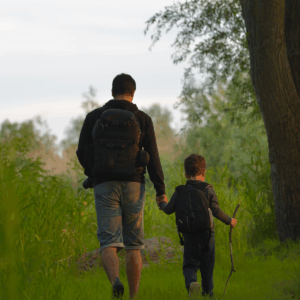

Every parent I know worries about whether their child is creative enough, and almost every one of them is looking in the wrong direction. They buy art supplies. They sign up for music lessons. They praise every scribble on the fridge as if it’s a Picasso. All of that is fine, and none of it matters as much as something far simpler: whether that child has regularly seen an adult they trust struggle with something hard, get frustrated, and keep going anyway.
The conventional wisdom about creativity says talent is innate and encouragement unlocks it. You find the spark, you fan the flame. Parenting magazines have said this for decades. Entire industries exist around early enrichment, creative confidence, gifted identification. The assumption is that if you create the right environment and deliver the right praise, creativity will bloom like a plant given proper sunlight.
What I’ve found, from watching my own sons grow into adults and now watching my four grandchildren navigate the world, is that praise barely registers compared to presence. And a very specific kind of presence at that: the kind where an adult is visibly working through difficulty.
What My Father Taught Without Teaching
My father was a factory worker. He didn’t have hobbies in the way we understand them now. But on weekends he’d fix things around our terraced house in the north of England. Plumbing, shelving, a broken gate latch. I remember standing in the doorway watching him try to fit a pipe under the kitchen sink, his knuckles scraped, muttering to himself, starting over three or four times.
He never once turned to me and said, “Son, this is how you develop grit.” He didn’t know he was modelling anything. He was just a man trying to stop a leak because we couldn’t afford a plumber. But what I absorbed, standing there at seven or eight years old, was a template for how a person responds when something doesn’t work the first time. Or the second time. Or the fifth.
That template lives in me still. I’m 63, and when I sit down to write and the sentences come out wrong, when I tear up a page and start again, I can feel my father under that sink. I didn’t inherit his skill with pipes. I inherited his willingness to stay in the room when things got difficult.
Children learn behaviour through observation and modelling, watching adults and absorbing not just what they do but how they respond emotionally to difficulty. Research into observational learning shows that children are wired to imitate the adults around them, picking up patterns of response that go far deeper than explicit instruction. What a child sees you do when you’re frustrated teaches them more than anything you say when you’re calm.
The Problem With Polished Adults
Most children today see adults in one of two modes: competent or distracted. Mum is efficient at work, efficient in the kitchen, efficient on her phone. Dad is scrolling, driving, answering emails, managing the logistics of family life. Everything looks handled. Smooth. Under control.
What children rarely see is an adult genuinely struggling with something new. Trying to learn guitar and playing the same chord badly for twenty minutes. Attempting a recipe that fails. Painting something that looks nothing like what they intended and laughing about it, or sighing about it, and then picking up the brush again.

I’ve written before about how every creative thing I do now is something I told myself I didn’t have time for during the thirty years I was raising children and proving my worth at a job. That’s true. But the more damaging part is that my sons almost never saw me attempt something I was bad at. They saw me go to work and come home tired. They saw competence and exhaustion. They didn’t see curiosity or fumbling or persistence, because I’d squeezed all of that out of my life to make room for responsibility.
My older son is in his thirties now. He once told me that his favourite memory wasn’t the bike I’d worked overtime to buy him. He remembers the Saturday morning I called in sick and we built a fort in the living room out of sofa cushions and bedsheets. That fort fell down three times. We rebuilt it three times. I remember being irritated by the engineering problem. He remembers the togetherness of failing at something pointless and doing it again.
I didn’t understand why that memory mattered to him more than the bike until years later. The bike said, “I provide for you.” The fort said, “I’m here with you, and I don’t know what I’m doing either, and that’s fine.”
Why Struggle Specifically Feeds Creativity
Creativity requires a particular tolerance for not knowing. You have to sit with a blank page, an empty canvas, a problem that has no obvious solution, and resist the urge to either give up or grab the nearest answer. That tolerance isn’t something you’re born with. You learn it by watching someone else do it.
When a child watches an adult struggle and persist, several things happen at once. The child learns that difficulty is normal, not a sign of failure. They learn that frustration is survivable. They learn that the gap between “I can’t do this” and “I figured it out” is just time and effort, not some mysterious talent that other people have and they don’t.
Studies suggest that creative expression doesn’t just produce art. It builds the cognitive architecture children need to solve problems, handle ambiguity, and take intellectual risks throughout their lives. But what kicks that architecture into gear is exposure to the process, not the product. A child who sees a beautiful painting on a wall learns that beauty exists. A child who watches someone paint badly, adjust, try again, and eventually make something decent learns that beauty is built.
That second child is the one who picks up a brush.
What I Do Differently With My Grandchildren
I take my local grandchildren to the park most weekends. Phone away, no agenda, just whatever they want to do. But I’ve started doing something deliberately that I never would have thought to do as a younger father: I let them watch me be bad at things.
Last month my eleven-year-old grandson wanted to fly a kite. I’d bought one on a whim. I had no idea how to assemble it properly, and the instructions were useless. So there I was, sixty-three years old, standing in a field fumbling with fibreglass rods and tangled string, while my grandson watched.
He didn’t offer to help at first. He just observed. After about ten minutes of me getting nowhere, he said, “Try turning that bit round the other way.” He was right. We got it airborne eventually, though it flew lopsided and crashed twice before we sorted the tail weight.
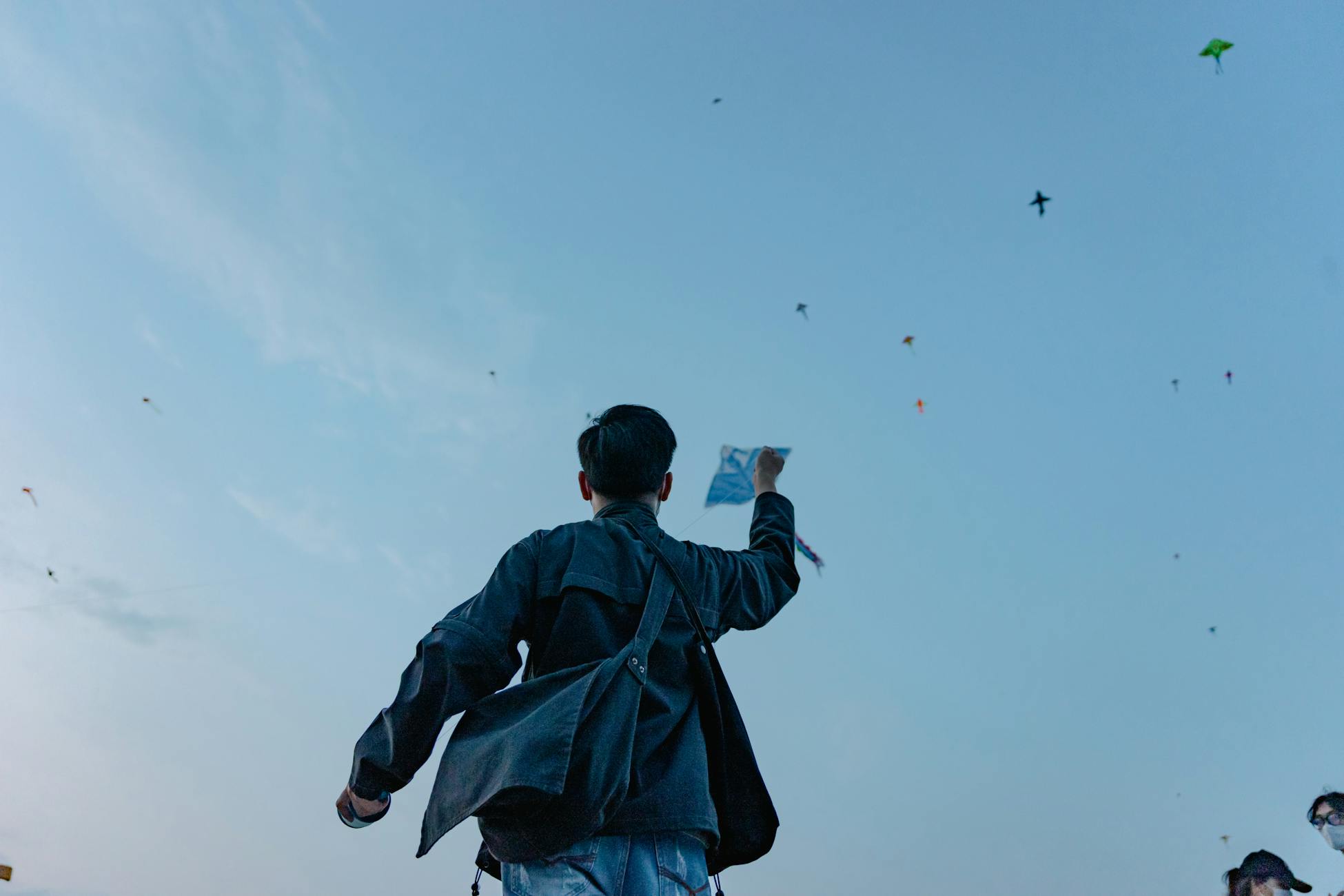
The kite itself was nothing special. What mattered was those ten minutes of visible incompetence. My grandson saw an adult he loves and trusts look confused, make mistakes, adjust, and not give up. He also saw that he could contribute. His idea was better than mine. That combination of watching struggle and being invited to help is, I believe, the engine of creative confidence in children.
My three-year-old granddaughter is too young for kites, but she watches me in the garden. I’ve taken up gardening properly since retirement, and I’m still learning. Seeds fail. Plants die. I put things in the wrong spot and have to move them. She sees all of it. She sees me kneel in the dirt and pull out something that didn’t work and start again. She doesn’t know what she’s absorbing. That’s the point.
The Uncomfortable Parallel
I spent thirty years in human resources, and the pattern I saw over and over was this: the employees who handled difficulty with the most creativity and composure almost always described childhoods where they’d watched a parent or grandparent work through problems. The ones who fell apart at the first setback often described childhoods where everything was managed for them, where adults made life look effortless.
That observation isn’t scientific. I kept no data. But across three decades and hundreds of conversations during restructurings, redundancies, and workplace conflicts, the pattern held. The people who could sit in discomfort had learned it from someone. The people who couldn’t had often been protected from ever seeing it.
There’s an important connection here to how children develop problem-solving abilities through unstructured experience. When I was eight years old I left the house after breakfast and came back for lunch. Nobody knew exactly where I was. That freedom forced me to figure things out on my own, yes. But it also meant I saw adults in my neighbourhood doing real work, visibly. The man two doors down fixing his car engine. The woman across the street repainting her front door, getting it wrong, scraping it off, starting over. Children in the 1960s were surrounded by adults in the middle of difficult, unfinished tasks. We absorbed persistence by osmosis.
Children today are surrounded by adults looking at screens. The work is invisible. The struggle is hidden. And research on how childhood environments shape creativity suggests that what children witness in their formative years profoundly influences their creative development, sometimes in ways that contradict our assumptions about what a “good” environment looks like.
Praise Is Not the Problem, But It’s Not the Answer
I want to be careful here. Encouragement matters. Telling a child their drawing is wonderful matters. I’m not arguing against kindness or support. My mother’s “you’ll be fine” approach worked in the 1960s partly because the world was different and partly because she backed it up with relentless, visible effort. She cooked every meal from scratch on a tight budget. She solved crises by getting on with things. Her encouragement was sparse, but her example was constant.
The problem comes when praise replaces example. When we tell children they’re creative but they never see us create. When we tell them to keep trying but they never see us fail and try again. Children are extraordinarily good at detecting the gap between what adults say and what adults do. They trust behaviour over words every time.
My younger son once told me that my advice felt like constant criticism. That stung. But when I sat with it, I realised he was right. I was telling him what to do without ever showing him what it looked like to not know what to do. I presented myself as the authority with all the answers, and what he needed was a fellow human who sometimes got lost and found his way back.
I’ve been in therapy since my early sixties, and one of the things my therapist helped me understand is that my “easy-going” reputation at work was partly conflict avoidance. I had costs I hadn’t acknowledged. Translating that into parenting terms: my competent, steady presence at home was partly a performance. I hid the mess. My sons saw the edited version of their father, and they grew up thinking adults don’t struggle. When they inevitably struggled themselves, they felt like failures rather than beginners.
That’s on me. I can’t change it. What I can change is what my grandchildren see.
The Smallest Thing That Matters Most
You don’t need to manufacture struggle. You just need to stop hiding it. Let your children or grandchildren see you try a new recipe and burn it. Let them watch you attempt to fix the shelf and get it crooked. Let them hear you say, “Well, that didn’t work. Let me think about this.”
Those seven words might be the most creative thing you ever give a child. Not because they’re wise, but because they model a process: acknowledge the failure, pause, re-engage. That’s the entire creative cycle in one sentence. A child who hears that sentence enough times, from someone they love, will internalise it. They’ll reach for it when they’re sixteen and their essay draft falls apart. They’ll reach for it when they’re thirty and their business plan needs rethinking. They’ll reach for it at sixty-three when they’re sitting in a spare room trying to write something honest and the sentences keep coming out wrong.
My granddaughter once climbed into my lap and told her father that I’m “the patient one.” I’m not, really. I’m just old enough now to let people see me struggle without feeling ashamed of it. Patience, like creativity, is modelled before it’s learned. You can’t teach it with a lecture. You teach it by sitting on the floor with a broken kite and not pretending you know what you’re doing.
The creative children don’t come from homes full of art supplies. They come from homes where someone they love sat with difficulty and didn’t walk away. Everything else is decoration.