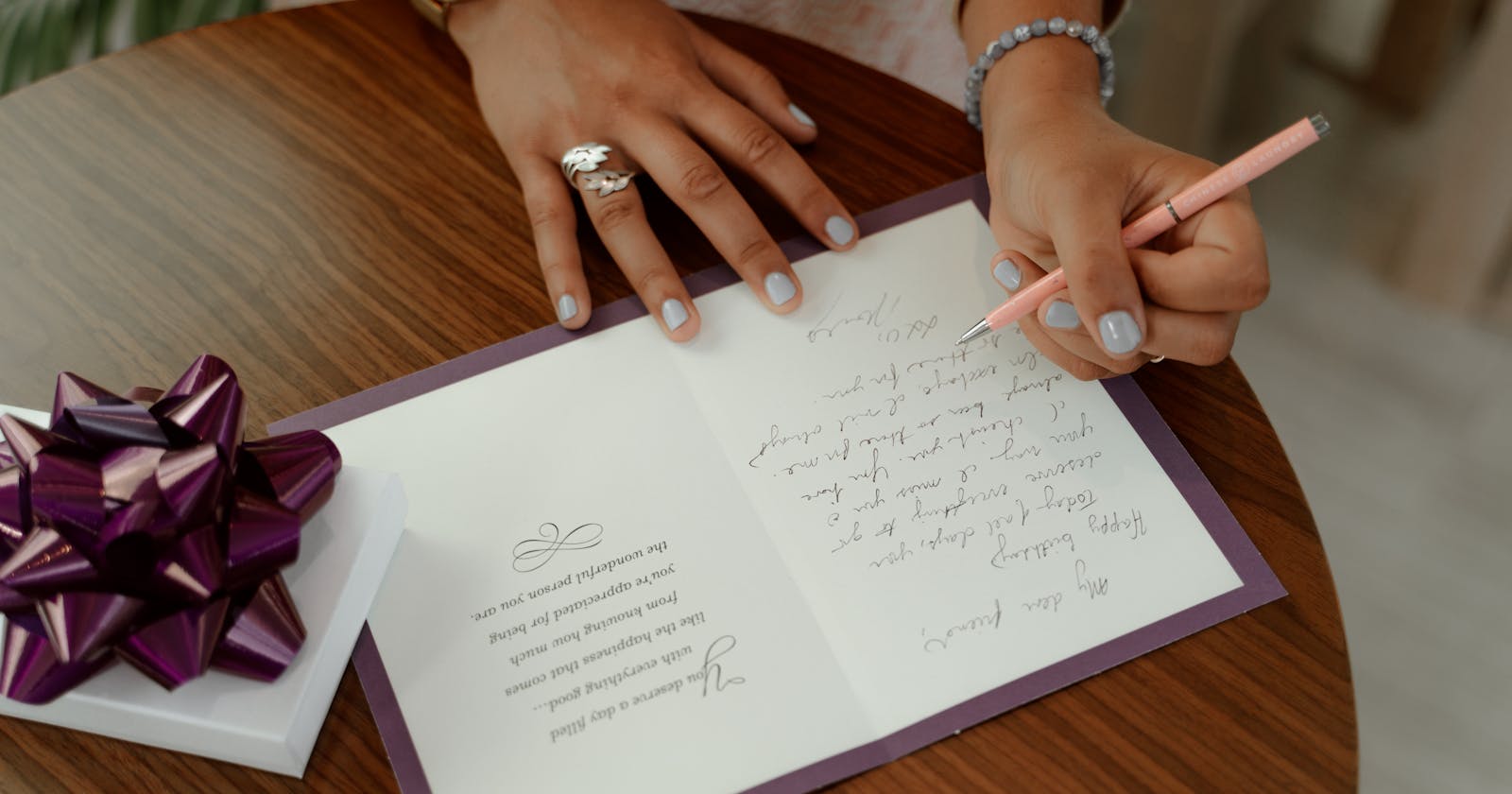
I found it tucked between the pages of a book I was donating last spring. A birthday card from 2019, my mom’s handwriting still steady but not quite the elegant loops I remembered from childhood. I sat on my apartment floor for twenty minutes, just staring at it.
You know that quote about how we’re all just walking each other home? Well, sometimes that walk is measured in birthday cards.
There’s something about watching your parents age through their handwriting that hits different than seeing the gray hair or the reading glasses. It’s intimate. Raw. A timeline you never asked for but can’t look away from.
The golden cursive years
Remember those early birthday cards? The ones where your mom’s handwriting looked like it belonged in a calligraphy textbook?
Mine would write these elaborate messages in perfect cursive, each letter formed with the precision of someone who learned penmanship when it actually mattered. The cards themselves were carefully chosen, never generic. She’d spend fifteen minutes in the card aisle, reading each one to make sure it said exactly what she wanted.
I used to roll my eyes at the length of those messages. Three paragraphs about how proud she was, memories from when I was little, hopes for my future. Now I’d give anything to go back and tell my younger self to pay attention. To trace those letters with my finger. To memorize the way she curved her lowercase g’s.
Those cards from my twenties and early thirties? They’re in a box under my bed. The handwriting is a time capsule of when our parents were invincible. When their hands were steady and their minds sharp and we thought they’d write our names in birthday cards forever.
When the tremor creeps in
The shift happens gradually. So gradually you might miss it if you’re not paying attention.
First, it’s just that the letters aren’t quite as uniform. Maybe the pen pressure varies a bit. The message gets shorter, not because they have less to say, but because writing takes more effort now.
I noticed it on my 40th birthday. Mom’s signature looked tired. The flourish at the end of her name, that confident sweep I’d seen on permission slips and checks my whole life, had become tentative. Uncertain.
That’s when you start saving every card. Not just tucking them in a drawer, but really saving them. Smoothing out the creases. Keeping them in chronological order like evidence of something slipping away.
Related Stories from The Artful Parent
- Research says people who had complicated relationships with their fathers grieve harder, not easier, than the ones who had healthy ones — because uncomplicated love produces uncomplicated grief, and the grief that carries unfinished business has nowhere to deliver it and no one left to receive it
- I finally understand why my father never talked about his accomplishments — it wasn’t because he lacked pride, it was because his generation understood that character doesn’t need an audience
- I’ve been married for thirty-six years and if you asked me whether I’m happy I’d say yes — but if you asked me when I last felt anything other than responsible, I couldn’t tell you
You start noticing other things too. She holds the pen differently now, gripping it tighter. Takes breaks mid-sentence. Sometimes starts a word, crosses it out, tries again.
But she still writes them herself. Still insists on going to the store to pick out just the right one. Still adds that “Love, Mom” at the bottom, even if it takes her three tries to get it right.
The inevitable handoff
Then comes the year someone else signs her name.
Maybe it’s your dad, his handwriting suddenly precious too because you realize his clock is ticking as well. Maybe it’s a sibling who lives closer. Maybe it’s a caregiver whose name you’re still learning.
“Mom wanted to make sure you got a card,” they write, and you know she’s there, probably dictating what to say, probably frustrated that her hands won’t cooperate anymore.
The first time this happened with my grandmother, I cried in my car outside the post office. Not graceful tears, but the ugly kind that fog up your glasses and make your nose run. Because even though she was still alive, something had ended. A direct line of communication, pen to paper, her hand to mine, had been severed.
- People who attract the most devoted blog readers write for one specific person — never for a crowd - The Blog Herald
- 7 types of comments that matter (and why most bloggers ignore them) - The Blog Herald
- The loneliest realization for bloggers isn’t that nobody reads their work — it’s discovering they chose a niche where even excellent content can’t overcome structural problems like low search intent, no monetization pathways, or audiences that don’t form communities - The Blog Herald
What we’re really mourning
It’s not just about handwriting, is it?
It’s about watching the people who signed our permission slips need permission slips of their own. It’s about the reversal that happens so slowly, then all at once. One day they’re teaching you to write your name, and then somehow, impossibly, you’re filling out their medical forms.
I’ve mentioned before how behavioral psychology shows us that we process loss in layers. The handwriting is just the visible part. What we’re really grieving is the inevitability of it all. The brutal mathematics of aging. The fact that love can’t stop time, no matter how hard we wish it could.
Those cards become archaeological artifacts of a relationship in transition. Evidence of a love that adapts to whatever form it needs to take.
The cards we keep forever
I have three cards in my desk drawer that I’ll never throw away.
One from when my mom’s handwriting was perfect, wishing me luck on my first day at a new job. One from a few years ago, shaky but determined, congratulating me on something I can’t even remember now because the message matters less than the effort it took to write it. And one from last year, my dad’s careful printing spelling out what my mom wanted to say.
Sometimes I take them out and lay them side by side, like I’m watching time-lapse photography of a life in motion.
These cards become our inheritance before the actual inheritance. They’re proof that we were loved by someone whose hand once held ours while crossing streets, who wrote our names on lunch bags, who signed us up for Little League and piano lessons and all the things they thought might make us happy.
Wrapping up
If you still have cards with that perfect cursive, take a photo. Frame one. Put one in your wallet. Because one day, you’ll be sitting on your floor, holding a card someone else signed, and you’ll wish you’d paid more attention when the handwriting was strong.
And if you’re already at the shaky stage, or the someone-else-signs stage? Those cards are just as precious. Maybe more so. They’re evidence of a love that persists even when the hand that wants to write it can’t.
We’re all just walking each other home. Sometimes that walk is measured in birthday cards, in the evolution of a signature, in the graceful fade from cursive to shaky to silent.
Keep every single one.