
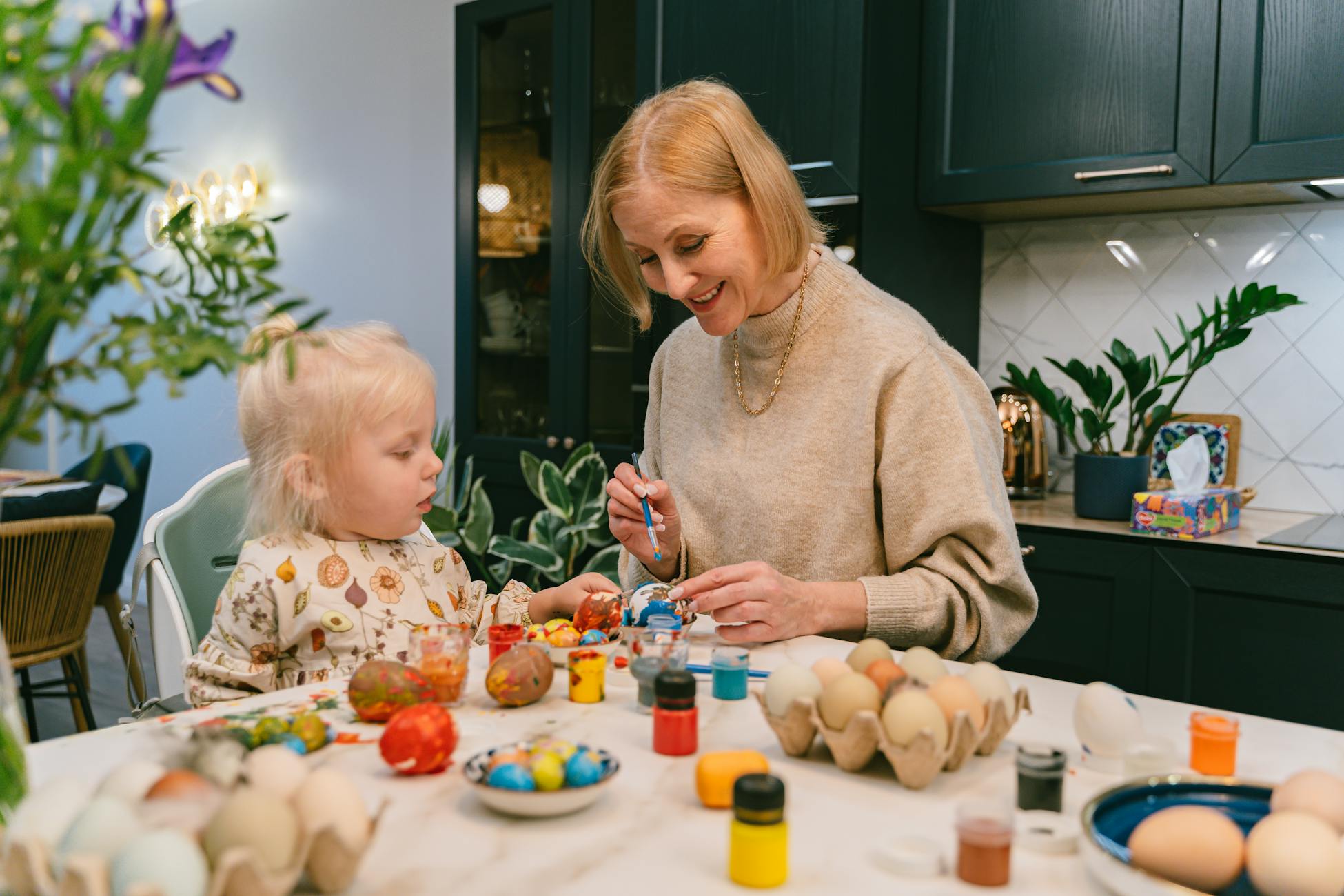
Perfectionism rarely develops in children who spent afternoons elbow-deep in tempera paint. The adults who freeze at the threshold of a new project, who agonize over first drafts and delete emails three times before sending, who would rather produce nothing than produce something mediocre — they tend to share a common absence in their early years. Nobody sat with them while they made something ugly or showed curiosity about their imperfect creations.
The conventional wisdom says creativity is a talent. You either have it or you don’t. Parents enroll children in structured art classes, buy kits with pre-traced lines, or parents often praise the final product with generic enthusiasm before pinning it to the refrigerator. The assumption underneath all of it is that the point of making art is the art itself. That the finished thing matters.
What I’ve found, both as a former kindergarten teacher and as a mother who keeps a collage table permanently set up in the kitchen, is that the finished thing barely registers. The thing that sticks — the thing that rewires how a person handles difficulty twenty years later — is the experience of sitting next to someone who watched you make a terrible decision with the glue stick and said nothing corrective.
The Quiet Curriculum of the Kitchen Table
When Ellie was three, she went through a phase where she would paint an entire sheet of paper one solid color, usually brown. She’d mix every color on the palette together until she arrived at that particular mud-tone, and then she’d cover every square inch of the page with it. My mother, visiting for the weekend, gently suggested I teach Ellie to keep the colors separate.
I didn’t.
Because what Ellie was doing wasn’t wrong. She was experimenting with what happened when things combined. She was learning that blue and yellow make green, that red and green make something darker, that all of it together makes brown, and that brown covers paper just as well as any other color. She was learning that the process has its own logic, even when the result looks like nothing to anyone else.
This is the quiet curriculum of the kitchen table. A parent sits nearby, maybe working on their own project, maybe just drinking coffee and watching. The child makes choices. Some of the choices produce interesting results. Some produce soggy paper and frustration. And the parent’s job, if they understand it, is to stay neutral through both outcomes.
Research suggests that when parents believe they can actively influence their child’s development, measurable changes in outcomes follow. Studies have focused on parental mindset, on whether caregivers see intelligence and skill as fixed or malleable. What struck me reading about this was the implication running underneath: the parents who believed development was malleable were also the ones more likely to sit with the mess. They could tolerate imperfection because they trusted the process hadn’t finished yet.
What Failure Feels Like When Someone Is Watching
Adults who struggle with failure often describe the same physiological experience. Tightness in the chest. A flush of heat behind the ears. The urge to abandon the project and walk away before anyone sees. This response has roots, and those roots usually trace back to the first audiences a child ever had.
If the first audience evaluated whether their drawing looked like a horse or questioned their artistic choices, the child learned that making something visible meant vulnerability to judgment. The rational response to that lesson is to stop making things visible. To keep the draft in the drawer. To choose inaction, which at least can’t be critiqued.
But if the first audience simply witnessed, the lesson was different. Making something visible was just… making something visible. The world continued. Nobody flinched. The brown painting went on the drying rack next to every other painting, and dinner happened afterward, and the child absorbed, without language for it, that imperfection was survivable.

I’ve written before about how many adults who describe themselves as uncreative often trace it to childhood moments of evaluation. The pattern keeps repeating in every conversation I have about this. The memory is always specific: a teacher who held up their drawing as an example of what not to do, a parent who laughed, a sibling who said it was ugly. One moment. That’s all it took to install a lifelong flinch response around making things.
The kitchen table undoes that flinch before it can form. Not because the parent is praising everything — hollow praise creates its own problems — but because the parent is simply present and unbothered.
The Specific Relationship to Failure
Here’s what I’ve noticed in adults who had this experience as children. They still feel the discomfort of imperfection. They still wince when a project doesn’t turn out. But they have a second response layered on top of the first, almost like a counterweight: the impulse to keep going anyway.
They learned, at the kitchen table, that a failed attempt doesn’t require an emotional response from the room. Nobody gasped when they cut the paper crooked. Nobody sighed when the clay figure collapsed. The failure just happened, and then the next moment happened, and the two weren’t connected by shame.
This produces adults who can tolerate rough drafts. Who can send the imperfect email. Who can share the half-formed idea in a meeting without rehearsing it six times first. They carry a kind of emotional scar tissue around failure that makes it less tender. The wound still exists — nobody enjoys falling short — but the tissue around it is thicker, more flexible.
Research has shown that positive relationships with parents and other caring adults during childhood are associated with better mental health outcomes in adulthood, even when the child faced other adversities. Studies have emphasized that the relationship itself functions as a buffer. The mechanism isn’t the absence of hardship. It’s the presence of someone steady through it.
The kitchen table is a microcosm of that. The hardship is small — a painting that goes wrong, a bead that won’t thread, a clay bowl that cracks in the drying. But the steadiness of the parent beside them, unbothered, maybe humming, maybe working on their own imperfect thing, teaches the child that difficulty doesn’t mean danger.
What the Parent Was Actually Modeling
My husband Matt builds things for a living. Carpentry. He makes mistakes constantly — measures wrong, cuts too short, discovers the wood has a hidden knot that splits the board. When Ellie watches him work in the garage, she sees him mutter under his breath, set the ruined piece aside, and pick up a new board. No crisis. No performance of frustration. Just the quiet recalibration of someone who has failed ten thousand times and internalized that failure is a stage, not a destination.
That modeling matters more than any conversation about resilience.
When I sit at the kitchen table with my own sketchbook while Ellie paints and Milo smashes Play-Doh with his palms, I’m not producing good art. I’m producing visible, imperfect attempts. I’m letting my children see me erase something, sigh a little, and try again. I’m letting them see that adults also make things that don’t work, and that the appropriate response is mild irritation followed by continuation. Not catastrophe.

Psychologists who study emotion regulation in children point to the parent’s own regulatory behavior as a primary teaching tool. Children don’t learn to manage frustration from being told to manage frustration. They learn it from watching someone they trust move through frustration without falling apart. The kitchen table, with its small stakes and low pressure, offers hundreds of these micro-lessons over the course of a childhood.
The parent who sits down and makes a lopsided ceramic mug alongside their six-year-old is teaching something no worksheet can deliver. The lesson is: competent adults also produce imperfect things, and the world absorbs those imperfect things without comment, and we all keep going.
The Absence Version
I grew up in a house where making things happened alone, in my bedroom, and the finished product was either praised generically or ignored entirely. My mother was busy. She had three children, an anxious disposition, and a kitchen that served as her domain for meal preparation, not art. I don’t say that with bitterness. She was doing what she knew how to do, and what she knew was that a clean kitchen mattered more than a messy one.
But the absence of that shared creative space left a gap I didn’t identify until I was teaching kindergarten and watching five-year-olds react to their own mistakes. Some kids would crumple the paper and start over, no distress. Others would freeze, eyes going wide, looking to me for a reaction before deciding how to feel. The freeze kids — they were me. They had learned that mistakes required management, that the adults around them needed to be consulted before they could know whether a wrong turn was acceptable.
The gap between those two responses is enormous, and it tracks into adulthood with startling fidelity. Writers on this site have explored how adequate parenting can coexist with a quiet loneliness in the child, how being housed and fed and loved in a general sense still leaves room for something essential to go unnamed and unmet.
The kitchen table fills that room. Not perfectly. Not magically. But consistently, in the way that small repeated experiences build neural pathways that singular dramatic events cannot.
Making Something Imperfect Was Safer Than Making Nothing
This is the specific lesson, and it deserves to be stated plainly. Children who made art with a parent nearby learned that producing something — anything — was the safer choice. Inaction felt worse than imperfection because inaction meant sitting with an empty page while someone you loved was busy making something beside you. The social pull of participation overrode the fear of getting it wrong.
Research has demonstrated that some forms of early challenge can promote resilience to anxiety disorders later in life. The key variable was whether the challenge occurred within a context of support. Challenge plus support builds tolerance. Challenge plus isolation builds avoidance. The kitchen table provides challenge (making something is always a risk) inside a container of support (the parent is right there, calm and present).
As adults, these people become the ones who volunteer for the presentation nobody else wants to give. Who start the business with the imperfect plan. Who write the first draft knowing it will be terrible and submit it anyway. They carry a deep, almost cellular understanding that action, even clumsy action, is preferable to the paralysis of waiting until they’re certain they’ll succeed.
Certainty, they learned at the kitchen table, never arrives. You just pick up the paintbrush and see what happens.
Sometimes what happens is brown. Solid, unremarkable, mud-colored brown covering every inch of the page.
And sometimes brown is exactly the right thing to make, because making it taught you that you could make something else tomorrow, and the day after that, and that the table would be there, and the paint would be there, and nobody in the room would need you to be perfect. They just needed you to sit down and begin.