
Young children can’t talk yet. They can’t walk. They have no idea what their parents do for a living, what they believe about the world, or what kind of people they’re trying to be. They have no framework for evaluating their fathers, no report card to fill in, no basis for comparison.
And somehow they teach us the most important thing about fatherhood: they’re not listening to what we say. They’re watching what we do.
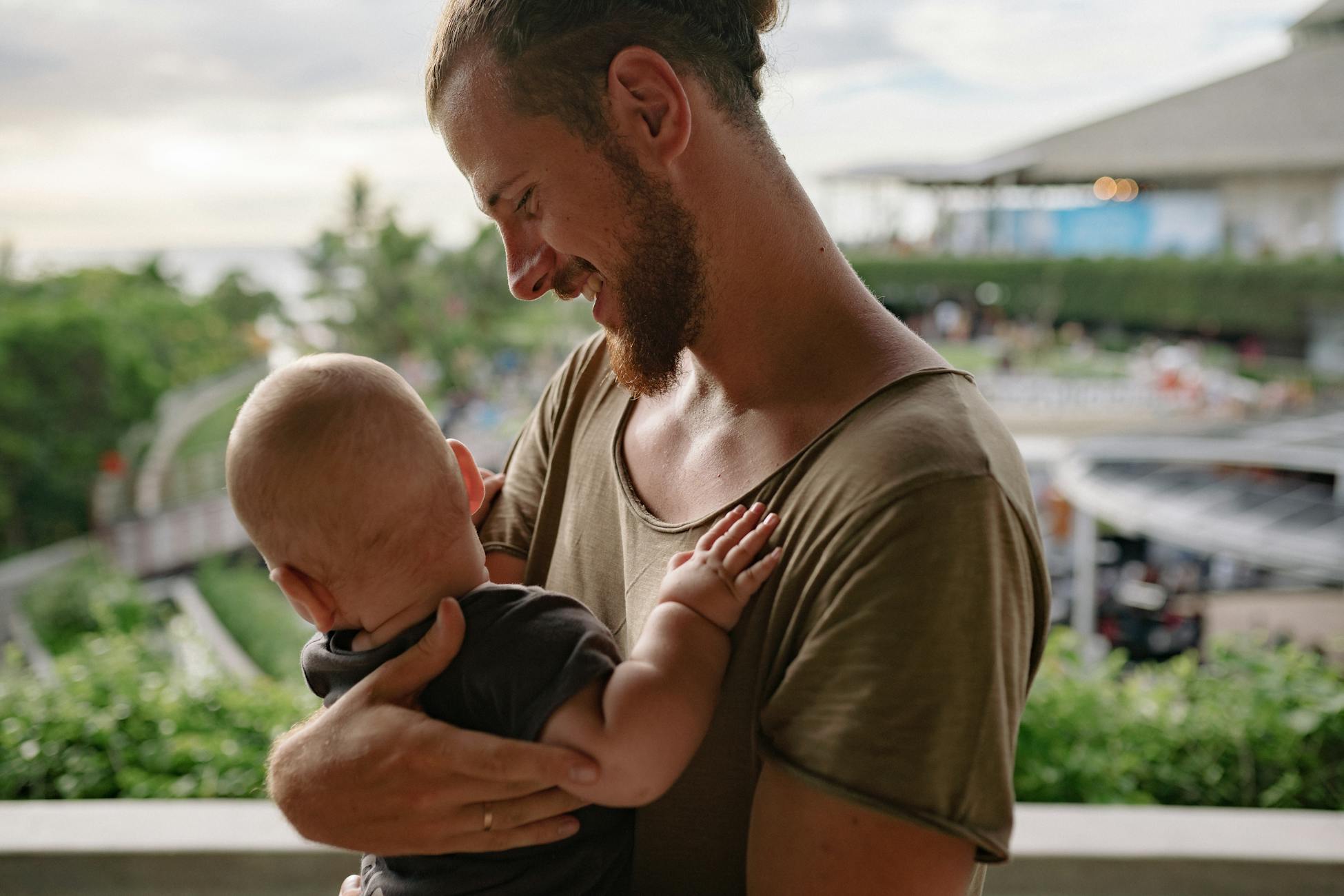
I don’t mean that in a vague, inspirational-poster way. I mean it literally. As a father, I’ve watched my daughter’s eyes track across a room. I’ve noticed what gets her attention. And it’s not words. It’s movement. It’s energy. It’s the way I put down my phone when she reaches for me, or the way I don’t. It’s how I respond when she needs me in the middle of the night – whether I show up with patience or with irritation. It’s the tone I use with my wife when I’m tired, the one I think my daughter is too young to register but probably isn’t.
The Artful Parent
Family-life ideas and sharp reads, in your inbox.
Children absorb everything. Not the lessons we plan to teach them someday. The ones we’re teaching them right now, without knowing it.
The father I thought I’d be
Before my daughter was born, I had a very clear image of the father I wanted to be. Mindful. Present. Patient. The kind of dad who meditates in the morning and carries that calm through the rest of the day. The kind who reads about child development and applies it thoughtfully. The kind who never raises his voice because he’s done enough inner work to regulate his emotions in real time.
I was, in other words, planning to be a concept rather than a person.
The actual experience of fatherhood dismantled that image quickly. The calm I’d cultivated over years of meditation practice evaporated the first time she screamed for forty minutes straight and nothing I did helped. The patience I thought I’d built disappeared after consecutive nights of broken sleep. The mindful presence I’d written about for a living turned out to be significantly harder when the moment you’re being present in involves a diaper situation that defies the laws of physics.
I’m not complaining. I’m trying to be honest about the gap between the father I imagined and the father I actually am. Because that gap is where everything important is happening.
What children are actually learning from us
Here’s what I’ve come to understand, and it’s changed how I think about parenthood entirely. My daughter will not remember whether I read the right books about attachment theory. She will not remember whether our home was tidy or whether I had a five-step morning routine or whether I hit my writing deadlines. She won’t remember any of the things I’m currently stressed about.
What she’ll absorb – what will wire itself into her understanding of how the world works – is the texture of daily life. How her parents treat each other when they disagree. Whether her father can sit still with her without reaching for a screen. Whether he apologizes when he gets something wrong. Whether he laughs easily or carries tension in his shoulders. Whether he’s kind to strangers. Whether he eats his meals slowly or inhales them standing at the kitchen counter.
None of that is teachable in the traditional sense. You can’t sit a child down and say “this is how you become a good person.” You can only be one in front of them, day after day, in the thousand small moments that feel insignificant but are actually the entire curriculum.
Buddhism has a concept for this – it’s called “right action,” part of the Eightfold Path. It doesn’t mean perfect action. It means action that’s aligned with your values, practiced consistently, without needing an audience or a reward. For most of my adult life, I understood right action as a personal discipline. Something I practiced for my own benefit. Fatherhood has reframed it entirely. Right action now has a witness. A small witness who is recording everything.
The phone problem
I want to talk about something specific because I think it’s the defining parenting challenge of our generation and nobody’s being honest enough about it.
The phone is the single biggest obstacle to being the father most of us want to be.
Not because we’re scrolling social media while our kids play. Most of us aren’t that obvious about it. It’s subtler than that. It’s the reflex to check a notification when it buzzes. It’s the way our eyes drift to the screen when it lights up on the table. It’s the micro-abandonment – a few seconds at a time, dozens of times a day – where our attention leaves our children and goes somewhere else. Somewhere that doesn’t need us. Somewhere that isn’t even important.
Children notice. Research on “still face” experiments and infant attention consistently shows that even very young babies are acutely sensitive to the quality of attention directed at them. Full attention feels different from divided attention. When a parent is genuinely present, there’s a warmth in the connection that’s almost tangible. When a parent is half-present, children work harder for attention. They make more noise. They reach for your face. They do what every human does when they sense the other person isn’t fully there – they escalate.
I don’t want my daughter’s earliest understanding of connection to be competing with a screen for her father’s eyes. That’s not the lesson I want wired into her. So I’ve started putting the phone in another room when I’m with her. Not always. Not perfectly. But more often than I used to. And the difference in the quality of our time together is something I feel in my chest.
What my father taught me without trying
I’ve been thinking a lot about my own dad lately. He’s a good man. Worked hard his whole life. Provided for the family. Was present in the sense that he was physically there. But like a lot of Australian men of his generation, he wasn’t taught to connect emotionally with his kids. He showed love through action – through working, through stability, through fixing things that were broken. The words and the warmth came less naturally.
I don’t blame him for that. I understand it now in a way I couldn’t in my twenties. He fathered the way he was fathered, and his father did the same. It’s a chain of men doing their best with the tools they were given, which were almost always practical and almost never emotional.
But here’s what I inherited from watching him, and I only see it clearly now that I have my own child. I inherited the belief that providing is the same as connecting. That being in the room is the same as being present. That working hard for your family is a sufficient expression of love. And none of that is true. It’s close to true, which makes it harder to see. But close isn’t enough.
My daughter doesn’t need me to provide. Not yet, anyway. She needs me to be there. Not in the room – in the moment. And the distance between those two things is the distance between the father my dad was and the father I’m trying to become.
The practice, not the performance
I’ve stopped trying to be a perfect father. That project lasted about a week and produced nothing but anxiety. What I’m trying instead is to be an honest one. A father who messes up and says so. Who gets frustrated and takes a breath instead of pretending frustration doesn’t exist. Who puts down the phone not because he’s performing mindfulness but because the person in front of him deserves his full attention.
Some days I do this well. Some days I don’t. The days I don’t are the ones that teach me the most, because they show me exactly where the gap is between my values and my behavior. And that gap – not the articles I write or the philosophy I study or the meditation I practice – is where fatherhood actually lives.
My daughter will grow up and form her own understanding of the world. She’ll develop her own values, her own beliefs, her own way of being. I have less control over that than I’d like to think. But what I can control is the environment she grows up in. The emotional weather of our home. The way her father treats her mother. The way he treats himself. The way he handles failure, boredom, frustration, joy.
That’s the curriculum. Not the words. The actions. The small, unscripted, unrehearsed moments when nobody’s performing and everybody’s just living. That’s what she’s watching. That’s what she’ll remember. And that’s what I’m trying, imperfectly and daily, to get right.