
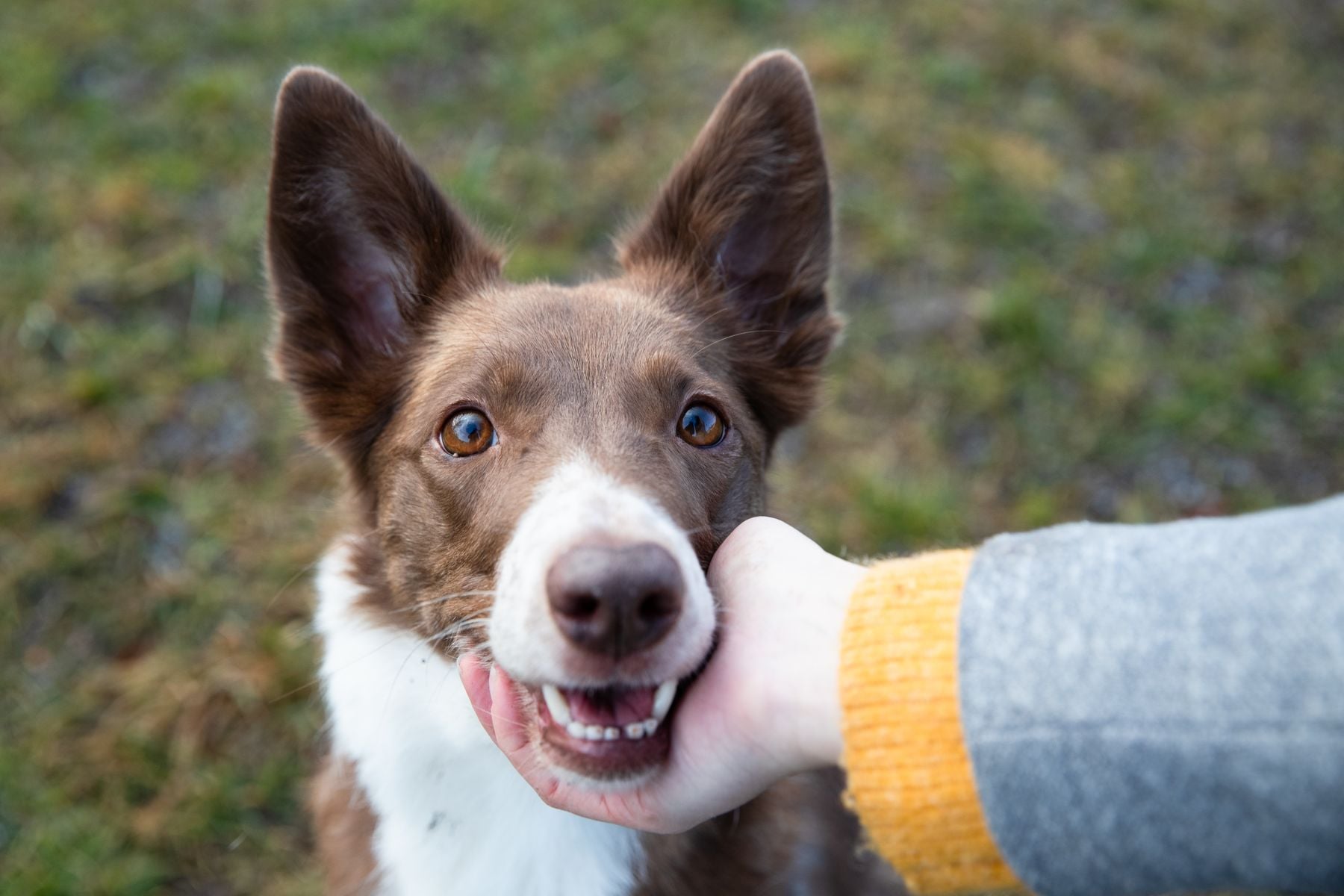

Anyone who’s lived with a dog has a sense that something real is happening behind those eyes, real learning, real listening, real attachment. Two studies that measured this directly, one testing the outer limits of a dog’s vocabulary, one measuring an actual hormone shared between dog and owner, suggest that sense isn’t just projection. Dogs learn and bond in ways backed by hard, measurable data.
The clearest evidence on learning comes from a 2011 study by John Pilley and Alliston Reid, published in Behavioural Processes, describing a border collie named Chaser. Over three years of daily training, Chaser learned and retained the individual proper names of 1,022 distinct objects, drawn from a working set of 1,038 toys, each name verified through a strict test requiring eight correct identifications in a row, a result so unlikely by chance that the odds worked out to roughly one in 16.8 million per word. In monthly blind tests, with the trainer out of sight and 100 randomly selected objects tested each round across 145 test sessions over three years, Chaser never scored below 18 out of 20 correct, ruling out any possibility she was picking up on unconscious cues from a nearby human. In a live, double-blind demonstration in front of roughly 100 psychology students, Chaser correctly retrieved 46 of 50 randomly chosen objects, a 92 percent accuracy rate. The researchers also found she could learn new words by a process of elimination, reasoning normally associated with how young children first acquire language.
A second study helps show that the bond behind all that listening runs on something biological. In a 2015 study by Miho Nagasawa and colleagues, published in Science, 30 dog-owner pairs interacted through talking, petting, and gazing for 30 minutes. Dogs that made longer eye contact with their owners produced a significant rise in their owner’s urinary oxytocin, the hormone closely tied to human parent-infant bonding, and the dogs’ own oxytocin rose in tandem with their owner’s. To test whether this was unique to dogs or just a feature of any close human-animal relationship, the researchers ran the identical experiment with hand-raised wolves and their human caregivers. The wolves showed no comparable oxytocin rise from gazing, suggesting this particular bonding loop is something dogs developed specifically through domestication. A follow-up experiment found that giving female dogs oxytocin nasally increased how much they gazed at their owners, which then drove a further rise in the owner’s oxytocin, showing the loop runs in both directions.
Together, these two studies point to something worth taking seriously about the relationship between dogs and the people who care for them. Pilley and Reid’s research shows that a dog’s capacity to learn and listen can run far deeper than basic obedience commands, extending into genuine word comprehension and category reasoning. Nagasawa and colleagues’ research shows that the bond underneath all that communication is measurable at the level of actual hormones, and that it’s something dogs evolved specifically for connecting with humans, not a general trait shared by their closest wild relatives. Between the two, learning and bonding in dogs look less like separate behaviors and more like two expressions of the same underlying relationship.
It’s worth being honest about what these two studies don’t establish. Pilley and Reid’s research documents an exceptional individual dog trained with extraordinary consistency, several hours daily for three years, so Chaser’s specific vocabulary size isn’t representative of what an average dog will pick up through typical training. Nagasawa and colleagues’ study involved a relatively small sample of 30 dog-owner pairs, and while the gaze-oxytocin loop has since drawn wide interest, the exact size of the effect could vary across different breeds, individual dogs, and types of relationships.
Within those honest limits, the research offers a genuinely grounded picture of what’s actually happening in a dog’s mind and body during everyday moments with an owner. The listening is real, capable of far more sophistication than a handful of trained commands suggests. The bond is real too, running through the same biological wiring involved in some of the closest relationships humans have with each other.