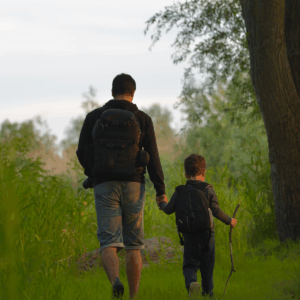

Last Thursday afternoon, I sat in my living room looking at old photo albums with my wife. There we were—thirty years younger, surrounded by finger paintings, soccer trophies, and two small boys who thought we hung the moon.
Now those boys are in their thirties with families of their own, and somewhere between then and now, I’ve come to understand something that nobody warns you about when your kids grow up. The hardest part isn’t the empty nest or missing their daily presence. It’s confronting what you lost along the way and wondering if those pieces of yourself still exist somewhere, waiting to be reclaimed.
After three decades in human resources helping people navigate workplace problems, I thought I understood sacrifice and compromise. But nothing prepares you for the quiet reckoning that comes when you realize just how much of yourself you tucked away in service of being the parent your children needed.
1. You realize you can’t remember who you were before they came along
Try this exercise: describe yourself without mentioning your children or your role as a parent. Harder than you’d think, isn’t it?
I spent so many years being “dad” that when my sons moved out, I stood in my own home feeling like a stranger. Who was I before bedtime stories and Saturday morning cartoons? What did I care about before report cards and college applications?
The truth is, we pour so much of ourselves into our children that we forget we existed before them. Those old interests, dreams, and pieces of our identity get buried under decades of school plays and parent-teacher conferences. And when they leave, you’re left wondering if that person you used to be is gone forever or just dormant, waiting for permission to reemerge.
2. Your relationships became secondary characters in your family story
Remember date nights? Real ones, not the rushed dinners between school events where you talked about the kids the entire time?
My wife and I recently tried to have a conversation that didn’t involve our sons or grandchildren. We sat there, two people who’d been married for decades, struggling to find topics that belonged just to us. When did we become supporting actors in our own marriage?
It’s not that we regret prioritizing our children—that’s what parents do. But there’s a peculiar grief in realizing that while you were busy raising good humans, you let other relationships atrophy. Friends you used to see regularly became birthday card acquaintances. Your partnership became a co-parenting arrangement. And now you’re trying to remember how to be a couple again, not just mom and dad.
3. The dreams you put “on hold” have expiration dates you never noticed
“When the kids are older” became my favorite phrase for about twenty years. When the kids are older, I’ll take that woodworking class. When the kids are older, we’ll travel to Europe. When the kids are older, I’ll get back in shape.
Well, they’re older now, and some of those dreams have passed their sell-by date. My knees don’t cooperate with the hiking trips I postponed. The small business idea I shelved feels outdated now. Some opportunities don’t wait for you to be ready.
Related Stories from The Artful Parent
- Psychology says the reason good parents often feel like failures isn’t because they did anything wrong — it’s because parenting is the only job where success looks like the person you devoted everything to no longer needing you
- 8 things children of the 1960s and 70s got from their grandparents that today’s children are growing up without — and what it’s quietly costing them
- Psychology says people who were raised by emotionally distant parents don’t struggle with love — they struggle with believing they’re worth staying for, and these 9 behavioral patterns reveal how deeply that belief runs
The sting isn’t just in what you can’t do anymore—it’s in recognizing that you chose, again and again, to delay your own desires. And while you’d probably make the same choices, that doesn’t make the loss any less real.
4. Your identity became so intertwined with theirs that their successes feel like yours
When my younger son got promoted last year, I caught myself telling everyone about it like I’d earned it myself. That’s when it hit me—I’d been living vicariously through my children for so long that I couldn’t distinguish their achievements from my own sense of accomplishment.
Don’t get me wrong, pride in your children is natural. But when their wins become your primary source of validation, you’ve crossed into territory that’s unhealthy for everyone involved. They need the freedom to succeed or fail without carrying your emotional well-being on their shoulders. And you need achievements that belong to you alone.
5. The habits you built around their needs are hard to break
I still wake up at 6 AM on Saturdays. There’s no soccer practice to drive to, no breakfast to make for hungry teenagers, but my body doesn’t know that. I buy too much milk at the grocery store. I check my phone expecting texts that don’t come as frequently anymore.
These habits are more than just routines—they’re the architecture of a life built around other people’s schedules and needs. Dismantling them feels like demolishing part of yourself, even when those structures no longer serve a purpose.
6. You gave away your spontaneity and forgot how to be impulsive
Last month, my wife suggested we drive to the coast on a random Wednesday. My first thought? “We can’t just leave.” But we could. There was nothing stopping us except two decades of conditioning that taught us every decision required planning around someone else’s needs.
- If you start cleaning the house the moment you feel overwhelmed, it’s not a quirk — it’s your brain searching for one small corner of the world you can actually control when everything else feels impossible - Global English Editing
- I was the man who never said the wrong thing at dinner parties, never wore the wrong tie, never disagreed too loudly – and it took a heart scare at fifty-eight to realize I’d spent my whole life auditioning for people who weren’t even watching - Global English Editing
- I’m over 60 and my wife asked me last week if I was happy — I said yes automatically, and the real answer is I don’t think I’ve been happy since my mid-forties and I’ve just gotten very good at performing it - Global English Editing
Parenting requires predictability and routine. But somewhere in all that structure, you lose the part of yourself that once made impulsive decisions, took risks, or did things just because they sounded fun. Reclaiming that spontaneity feels foreign, almost irresponsible, even when there’s no one left to be responsible for.
7. The silence you once craved now feels too loud
For years, all I wanted was a quiet house. No arguing, no blaring music, no doors slamming. Now I have it, and the silence is deafening.
It’s not just missing the noise—it’s confronting what the silence represents. The end of one chapter and the uncertain beginning of another. The space where chaos used to live now needs to be filled with something else, and you’re not quite sure what that something should be.
8. You wonder if the person you’re becoming is who you would have been all along
Here’s the question that keeps me up some nights: Am I rediscovering who I was before kids, or am I becoming someone entirely new? Can you even separate who you would have been from who you became?
As I’ve mentioned in a previous post, growth isn’t always linear. Sometimes it circles back. I find myself interested in things I haven’t thought about in thirty years, but I approach them with a perspective shaped by all those years of parenting. It’s like meeting an old friend who’s changed just as much as you have.
Closing thoughts
My four grandchildren, ranging from three to eleven, give me a different lens to see all of this through. Watching my sons navigate parenthood, I see them starting down the same path of beautiful sacrifice that their mother and I walked.
The truth about parenting adult children isn’t just about what you gave away—it’s about deciding what’s worth reclaiming and what’s worth letting go. Some parts of your former self might be gone forever, and maybe that’s okay. Others are waiting patiently for you to remember they exist.
So here’s my question for you: What piece of yourself are you ready to take back?