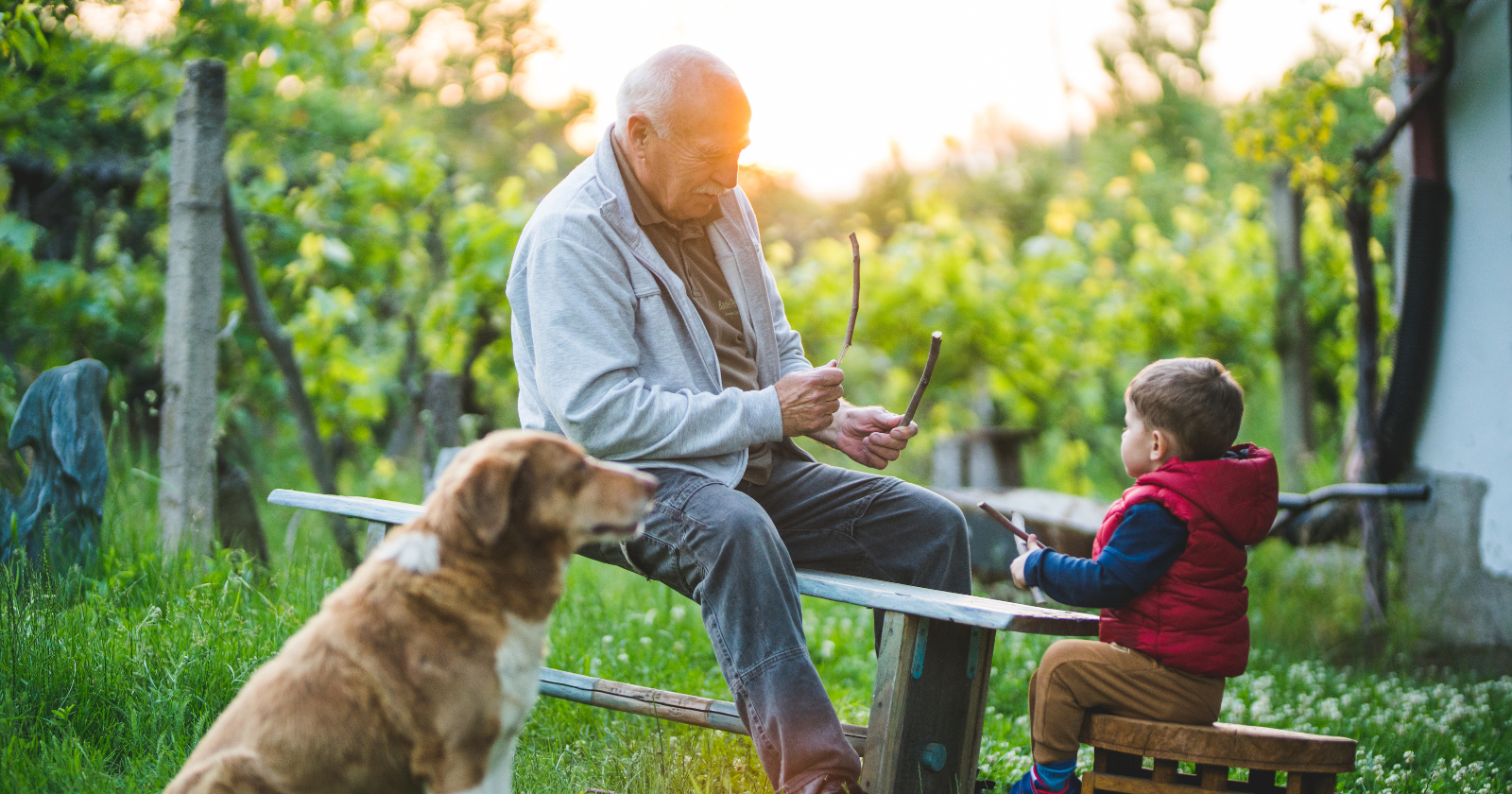
Ever notice how your kids light up differently at grandma’s house?
Last week, I watched my mom let Ellie spend an entire afternoon building fairy houses from twigs and leaves while I kept checking the clock, thinking about swim lessons and reading practice.
My mom just smiled and said, “She’s learning plenty right here.”
And you know what? She was right.
There’s something our parents and grandparents understood about childhood that we’ve somehow lost in all our enrichment classes and developmental milestones.
Maybe it’s because they raised us without Instagram comparisons or parenting blogs telling them their kids needed coding classes by age four.
Whatever the reason, they got some things really right that we might want to reconsider.
1) Boredom is actually good for kids
Remember staring at clouds for what felt like hours?
Or making up elaborate games with nothing but sticks and dirt?
Our grandparents didn’t panic when kids said they were bored.
They’d shrug and say, “Go figure it out.”
Related Stories from The Artful Parent
- Psychology says the thing children need most from their parents costs nothing and takes almost no time — it’s the 8-second pause between when a child starts talking and when the parent actually listens instead of preparing a response
- Psychology says the emotional distance many fathers maintain isn’t a personality trait — it’s a learned survival strategy passed down through generations of men who were taught that closeness was weakness, and their children pay the inheritance tax
- The loneliness many boomers feel isn’t a personal failure — it’s the predictable result of a culture that valued them for their productivity and caregiving, then offered no roadmap for building an identity or community once those roles ended
These days, we rush to fill every moment with activities and stimulation.
But boredom is where creativity lives.
When my two get restless and I resist the urge to hand them an activity, magic happens.
Yesterday they turned our couch into a pirate ship using nothing but pillows and wild imagination.
Kids need that empty space to dream, to problem-solve, to discover what actually interests them when no one’s directing the show.
2) Not every moment needs to be educational
Growing up, my grandmother let me help her bake without once mentioning we were “working on fractions” or “building fine motor skills.”
- 9 signs you’ve quietly become the most self-aware person in your social circle — and why it sometimes feels lonelier, not better - Global English Editing
- People who have no close friends but seem socially successful often share these 9 traits that explain why they’re surrounded by people but known by no one - Global English Editing
- The loneliest sound in a retired person’s house isn’t silence — it’s the refrigerator cycling on at 2pm because when the house is that quiet your brain starts cataloguing every mechanical sound just to confirm you’re still inside a life that’s running - Global English Editing
We were just making cookies.
And somehow, I still learned to measure and pour and wait patiently for good things.
Modern parenting culture has turned childhood into one long prep course for adulthood.
Every activity needs a learning objective.
But sometimes a puddle is just fun to jump in, not a science lesson about water displacement.
3) Kids can handle more than we think
My dad tells stories about walking to school alone at age six, helping with real farm work, cooking simple meals when his parents were busy.
Were things perfect? No.
But kids learned competence through actually doing things.
Now we hover and help and smooth every path.
How will they learn resilience if they never face anything challenging?
I’m trying to step back more, letting my five-year-old crack eggs even though shells might end up in the bowl, letting my toddler climb that slightly-too-high playground structure while I bite my tongue.
4) Nature is the best playground
Grandparents sent kids outside and didn’t worry about structured outdoor activities.
No nature scavenger hunts with laminated cards, no outdoor education curricula.
Just… outside.
Kids figured out which berries were good to eat, how to build forts, where the best climbing trees were.
They learned risk assessment by actually assessing risks, not by having adults pre-screen everything.
When I let go of my need to make outdoor time “productive,” my kids flourish.
They need that connection to dirt and sky and seasons changing, without me narrating the experience or turning it into a lesson.
5) Relationships matter more than achievements
You know what my grandparents bragged about?
How kind their grandkids were.
How we helped without being asked.
They didn’t care about reading levels or soccer trophies nearly as much as whether we were good humans.
We’ve gotten so focused on measurable achievements that we forget what really matters.
Will anyone care in twenty years if your child read at grade level in kindergarten?
Or will they remember the kid who included everyone at recess?
6) Simple toys spark better play
Visit any grandparent’s house, and you’ll find cardboard boxes saved “for the kids,” mismatched blocks, old pots and pans.
Nothing lights up or requires batteries.
And kids play for hours.
We buy elaborate toys that do everything except leave room for imagination.
But watch a child with a cardboard box versus the expensive toy that came in it.
The box wins every time because it can become anything.
7) Routine without rigidity
Grandparents had rhythms to their days without the strict schedules we maintain now.
Breakfast happened when folks got hungry.
Bedtime came when kids got tired.
There was structure, sure, but also flexibility.
Sometimes I catch myself so focused on nap schedules and meal times that I miss the moment.
Like when my toddler wants one more story but it’s “bedtime.”
Our grandparents understood that occasionally bending the rules wouldn’t break the children.
8) Food doesn’t need to be a battle
My grandmother’s rule was simple: eat what’s served or wait until the next meal.
No special kids’ menus, no negotiations, no stress.
And somehow, we all survived and learned to eat vegetables.
Modern parenting has turned mealtime into a complex dance of hiding vegetables in smoothies and making food into fun shapes.
But when I channel my grandmother’s matter-of-fact approach, mealtimes get easier.
Kids are capable of trying new foods without the song and dance.
9) Community raises children
Grandparents understood that kids needed multiple adults in their lives.
Neighbors watched out for all the kids.
Teachers were respected partners.
Nobody tried to do it all alone.
We’ve isolated ourselves in our nuclear family bubbles, afraid to ask for help or accept input from others.
But children thrive with that village support, those different perspectives and bonus adults who care about them.
10) Childhood is not a race
This might be the biggest thing.
Grandparents didn’t rush childhood.
They didn’t worry about kindergarten readiness at age three or college applications at age ten.
They let childhood unfold at its own pace.
There was trust that kids would learn to read when ready, would develop social skills through play, would become who they were meant to be without constant optimization.
Seven years teaching kindergarten showed me that kids develop on their own timelines, and pushing rarely helps.
Finding our way back
Look, I’m not saying everything was better in the old days.
Car seats save lives.
We understand child development better.
Some traditions needed updating.
But in our rush to give our kids every advantage, we’ve lost some simple truths about childhood.
Maybe it’s time to borrow a page from grandma’s book: slow down, trust more, worry less about perfection.
Watch your kids at their grandparents’ house.
See how they relax into a different rhythm? That’s not just grandparent magic.
That’s what happens when we remember that childhood is sacred time, not meant to be optimized or rushed.
Sometimes the best thing we can do for our kids is less.
Less scheduling, less hovering, less worrying about keeping up.
More trust, more time, more space for childhood to be exactly what it is: messy, magical, and fleeting.
What wisdom have you noticed from the grandparents in your life?
Because honestly, they might be onto something.