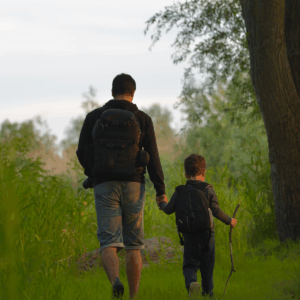

I spend a lot of time in my grandkids’ backyard these days, watching them play while my son makes lunch.
And every single time he calls them in to eat, something catches in my throat. It’s the way he gets down on their level, the patient tone when they protest, the gentle hand on a shoulder when they’re upset about having to come inside.
He parents with a softness I never mastered.
Don’t get me wrong. I loved my boys fiercely when they were growing up. Still do. But watching my son with his children has become a masterclass in all the things I could have done differently. The irony isn’t lost on me that he learned this tenderness somewhere, and it sure wasn’t from my example.
The weight of watching him do it right
Last week, my granddaughter had a meltdown over a broken toy. My instinct, honed over decades, was to tell her it was just a toy, that we could get another one, that crying wouldn’t fix it. Classic problem-solving mode from my HR days, right?
But my son? He sat right there on the floor with her. Let her cry. Acknowledged that it was her favorite and that feeling sad about broken things makes perfect sense. No rushing, no fixing, just… being there.
I remembered a similar scene from thirty years ago. My younger son, maybe five, crying over a broken action figure. I was already in my suit, briefcase by the door, running late for a meeting. “We’ll get you a new one this weekend,” I’d said, barely looking up. “Big boys don’t cry over toys.”
The meeting I was rushing to? I can’t even remember what it was about now.
When work became the easy excuse
For over thirty years, I helped other people solve their workplace problems. I was good at it, too. Got promoted regularly, became the go-to guy for conflict resolution, spent countless hours making sure everyone else’s professional life ran smoothly.
Meanwhile, my boys were growing up, and somewhere during their teenage years, I basically checked out. Not physically – I was there for dinners when I could make it, drove to soccer games when the schedule allowed. But emotionally? I was already at the office, even when I was home.
Work was demanding, sure. But if I’m being honest, work was also easier. There were clear metrics, defined problems, solutions that could be implemented and measured. Parenting teenagers? That was messy, uncertain, full of emotions I didn’t know how to handle.
Related Stories from The Artful Parent
- The thing nobody tells you about raising children the way you wish you’d been raised is that it means confronting everything you spent your whole life trying to leave behind
- Psychologists explain that people who insist they had a great childhood while displaying every marker of emotional neglect aren’t lying. Loyalty to the family story was the price of belonging, and some people will defend the narrative long after it stopped protecting them.
- 7 things estranged grandparents need to hear — including the one truth that nobody says because it sounds cruel but might be the only path back
So I chose the boardroom over the bedroom conversations. Chose spreadsheets over heart-to-hearts. Told myself they needed a provider more than they needed a present father.
Boy, was I wrong about that.
The conversations I never knew how to have
My older son called me last month, stressed about his job. My old instincts kicked in immediately – I had a dozen solutions ready, contacts he could reach out to, strategies for navigating office politics.
But then I caught myself. These days, I’ve learned to ask questions instead of offering opinions. “How are you feeling about it all?” I asked instead.
The conversation that followed was longer and more meaningful than almost any we’d had during his childhood. He talked about his fears, his hopes for his family, his struggle to balance everything. And I just… listened.
When did I become the dad who listens? About twenty years too late, that’s when.
- Women who reach their 60s without developing real emotional maturity don’t look immature from the outside — they look charming, often the most entertaining person in the room, and the immaturity only surfaces when reality doesn’t match their preference and the people who love them have quietly learned to manage around it rather than through it - Global English Editing
- Psychology says the reason most people never change their lives isn’t fear of failure – it’s that they’ve spent so long performing a version of themselves for other people that they genuinely can’t tell anymore which desires are actually theirs - Global English Editing
- Psychology says the people who hide loneliness best are the ones who learned earliest that their sadness was an inconvenience to the people they needed most — and the child who swallowed that lesson is still in there, still managing, still making sure everyone else is fine first, still waiting for someone to notice they haven’t been asked - Global English Editing
I think about all the times my boys probably needed to talk when they were younger. The breakups, the friendship dramas, the anxiety about college applications. I was always ready with advice, action plans, solutions. But I never just sat with them in their uncertainty. Never let them know that feeling lost or scared was okay.
Learning gentleness from the son I failed to teach it to
Here’s what really gets me: my son didn’t learn his parenting style from me. Maybe from his mother, maybe from friends, maybe from some internal wisdom I never managed to access. But watching him, I’m seeing what I could have been if I’d been brave enough to be vulnerable with my kids.
He apologizes to his children when he’s wrong. Can you imagine? I don’t think I apologized to my boys once during their entire childhood. Dads didn’t do that back then, or at least that’s what I told myself.
He tells them he loves them constantly, not just on birthdays or special occasions. He explains his emotions when he’s frustrated instead of just barking orders. He plays with them – really plays, not the distracted half-attention I used to give while mentally reviewing tomorrow’s presentation.
The unexpected gift of grandfather guilt
You’d think all this would just make me feel terrible, and some days it does. But mostly, it’s become a strange kind of gift. Every moment with my grandkids is a chance to practice being the person I wish I’d been thirty years ago.
When they visit, I put my phone in a drawer. When they talk, I listen with my whole body. When they’re upset, I sit with them in it instead of trying to fix it immediately. I’m learning, at 63, the emotional intelligence I should have developed at 33.
My sons notice. We don’t talk about it directly – that would require a level of emotional conversation I’m still working up to. But I see it in the way they trust me with their kids, the way they’ve started sharing more about their own lives, the way our relationships have shifted from dutiful to genuine.
As I’ve mentioned before, grandparenting is like getting a do-over, except you can’t actually do anything over. You can only do better going forward.
Closing thoughts
I’m 63 years old, and I’m finally learning how to be gentle. My teacher? The son I failed to show gentleness to when it mattered most. There’s a poetic justice in that, I suppose.
The truth is, we can’t change how we parented. I can’t go back and sit on the floor with my five-year-old son and his broken toy. I can’t redo those teenage years when work felt safer than home. But I can show up differently now. I can be the grandfather my grandkids deserve and the father my adult sons are still getting to know.
Sometimes I wonder what kind of fathers my sons would have been if I’d been different. Then I watch them with their kids and realize they’ve become amazing fathers not because of me, but despite me. And maybe that’s the greatest gift they could have given me – the chance to witness the kind of love I was too scared or too busy or too emotionally stunted to give.
What parts of yourself do you wish you could have given your children when they were young?