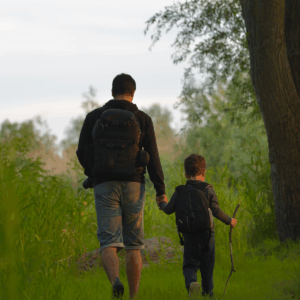

Last Thursday, I was sitting in my car outside the grocery store, tears streaming down my face.
My eight-year-old grandson had just hopped out after our weekly afternoon together, but not before turning back and saying, “Grandpa, you’re my favorite person to talk to.”
Seven simple words, and there I was, a 63-year-old man crying like a baby in a parking lot.
The thing that hit me hardest? My own son never said anything like that to me when he was growing up, not once.
When being a provider meant missing the moments
I was a good father, or at least I thought I was.
When my boys were young, I coached their little league teams, built tree houses, and taught them to ride bikes.
But, somewhere around their teenage years, work got more demanding.
I convinced myself that working those extra hours, chasing that next promotion, was what good fathers did.
We provide, right? What I didn’t realize was that while I was busy providing, I was disappearing from their daily lives.
The conversations became shorter, and the connection started fading.
By the time they were teenagers, I’d become more like a hotel manager than a dad by making sure everyone had what they needed but never really stopping to ask what they wanted.
Related Stories from The Artful Parent
- I’m 35 and I love my parents but I also resent them — and I spent years believing those two things couldn’t both be true before I understood that love and resentment are not opposites, they are the specific combination that forms when you were raised by people who did their best and whose best had limits and whose limits became your wounds
- Psychology says when adult children avoid their parents, it’s rarely about one dramatic event — it’s about a thousand small moments where the child learned that being authentic around the parent felt more dangerous than being distant
- I finally understand why my father always backed the car into the driveway — it wasn’t about convenience, it was a man who spent his whole life making sure everyone else could leave first
Have you ever looked back and realized you were solving the wrong problem? That’s exactly what I was doing.
I thought the challenge was making enough money, when the real challenge was making enough time.
The wake-up call that changed everything
A few years back, my younger son hit me with some truth I wasn’t ready for.
We were having coffee, and I was doing what I always did—offering unsolicited advice about his job, his relationship, his finances.
Finally, he put down his cup and said, “Dad, every conversation with you feels like constant criticism.”
That stung, but you know what? He was absolutely right.
I’d become that guy who couldn’t just listen as every story my kids shared became an opportunity for me to swoop in with wisdom they hadn’t asked for.
No wonder they stopped sharing!
Since that conversation, I’ve learned to bite my tongue unless specifically asked for advice.
You’d be amazed how much more my adult children share with me now that I’ve stopped trying to fix everything.
Why grandchildren see us differently
Here’s what nobody tells you about becoming a grandparent: you get a do-over.
Not with your own kids—that ship has sailed—but with your grandchildren, you get to be the person you wish you’d been the first time around.
When my grandson tells me I’m his favorite person to talk to, it’s because I’ve learned something crucial.
Kids need someone who just listens, the kind where you’re fully present.
I make a point of spending one-on-one time with each grandchild.
You wouldn’t believe how different they are when they’re not competing for attention with siblings.
My grandson, the one who made me cry last week? When it’s just us, he talks about his dreams of becoming an inventor, his worries about math class, his confusion about why his best friend suddenly doesn’t want to play with him anymore.
Here’s my secret: I just stay quiet.
Grandchildren will tell you things they won’t tell their parents if you just give them enough silence to fill.
The gift of not having an agenda
Remember when your kids were young and every interaction felt loaded with responsibility? Teaching them right from wrong, making sure they brushed their teeth, getting them to school on time.
Everything was about molding them into functioning adults.
With grandchildren, all that pressure is gone.
I’m not responsible for their homework or their bedtime or their table manners, that’s their parents’ job.
My job? Just to be there.
Last month, my granddaughter and I spent an entire afternoon looking for interesting rocks in the park.
That’s it, just two people enjoying each other’s company and occasionally saying, “Hey, look at this one!”
Would I have done that with my own kids thirty years ago? Probably not.
I would have been checking my watch, thinking about the work I brought home, mentally planning the next day’s meetings.
What I wish I could tell my younger self
If I could go back and talk to that younger version of me, the one who thought success meant never missing a deadline, I’d tell him this: Your kids will remember whether you were really there when you were there.
I see my son with his own children now, and sometimes I catch glimpses of myself at that age: The distracted look while pretending to watch them play, the phone that’s always just a bit too interesting, and the constant mental juggling of work and family.
However, I also see him doing things differently.
He’s more present than I was.
Maybe because the world has changed, or maybe because he learned from what I didn’t do.
Either way, I’m grateful his kids will have more of him than he had of me.
The unexpected healing of second chances
Being a grandparent is also about healing your relationship with your own kids.
Every time my son sees me playing with his children, listening to them, being patient with them, I think a small part of him wonders, “Where was this guy when I was growing up?”
That’s fair, but here’s what I’ve learned: You can’t change the past, but you can influence the present.
My relationship with my adult children has actually improved since I became a grandfather.
They see me being the person I couldn’t be back then, and somehow, that helps.
Plus, when you’re genuinely interested in their kids, you become more connected to your own children’s lives.
Suddenly, you’re part of the ongoing story.
Closing thoughts
That moment in the car last week, crying over my grandson’s words, was both heartbreaking and healing.
Heartbreaking because it highlighted what I missed with my own son; healing because it showed me I’ve finally learned how to really be there for someone.
I can’t go back and be a different father, but I can be the grandfather my grandchildren need: One who listens without judging, who has time without conditions, and who shows up without an agenda.
Maybe, just maybe, when my son sees his own child light up while talking to me, a small part of his younger self gets what he needed too.
Isn’t it funny how sometimes the best thing we can do for our children is to be better for theirs?